
2025 有关颜料的几个技术问题
大家好我是 克拉克莱尔的一个品牌 无HEMA凝胶抛光剂.这次,我将整理几个有关涂料颜料的技术问答,希望能对大家有所帮助。01 如何避免使用有毒的铬酸铅和钼酸铅颜料,同时又不影响涂料的颜色?
Due to the toxicity of lead-containing pigments, countries are increasingly restricting their use in coatings. Formulators typically replace lead pigments with organic pigments combined with titanium dioxide. However, in certain applications, organic pigments blended with metal oxide hybrid pigments (inorganic composite colorants) demonstrate superior performance compared to titanium dioxide. The inherent vivid hues, high saturation, and excellent hiding power of metal oxide hybrid pigments offer formulators greater flexibility to reduce costly organic pigments in formulations, minimize or even eliminate titanium dioxide. For organic pigments, numerous options also demonstrate excellent hiding power and weather resistance, making them viable alternatives to lead-containing pigments. Red pigments include Pigment Red 48:4, Red 112, Red 170, Red 254, Red 255, Violet 19, etc. Orange pigments include Pigment Orange 36 and Orange 73, among others. Yellow pigments include Pigment Yellow 74, Yellow 109, Yellow 110, Yellow 139, Yellow 151, and Yellow 154. Particularly for yellow pigments, we recommend using Bismuth Vanadate Yellow (Pigment Yellow 184). Bismuth Vanadate Yellow is significantly brighter than the metal oxide blend pigment Titanium Nickel (Pigment Yellow 53), offering superior tinting strength, better hiding power (even eliminating the need for added titanium dioxide), and outstanding heat and weather resistance. Finally, it is worth noting that compared to lead-containing pigments, all the pigments mentioned above are considered safe and non-toxic as long as proper dust extraction equipment is used during production (inhaling pigment dust is harmful to human lungs).
02 影响涂料体系中颜料絮凝的因素有哪些?
以下参数会影响絮凝效果: 粘度: 在低粘度条件下,颜料颗粒更容易移动。因此,降低涂料体系的粘度会减小絮凝团的大小,减缓絮凝速度。温度:温度对粘度的影响显而易见。温度升高会导致粘度降低,从而间接降低絮凝效果。 闪光时间 (干燥时间、湿对湿双涂层喷涂之间的间隔时间或进入烘箱前溶剂大量蒸发所需的时间):闪蒸时间过长也会导致颜料大量絮凝。 二氧化钛: 未涂层的二氧化钛有强烈的絮凝倾向。颜料颗粒大小和粒度分布:较小的颜料颗粒在涂料体系中表现出更大的流动性,增加了碰撞和随后絮凝的可能性。但这并不是绝对的。极细的颗粒尺寸可提高整个体系的粘度,减少颗粒的移动,降低絮凝风险。 颜料浓度 (二氧化钛和着色颜料):增加颜料浓度可提高体系粘度,降低絮凝倾向。 活页夹 较小的粘合剂分子更容易吸附到颜料表面。不过,由于体积较小,它们在颜料颗粒之间产生的立体阻碍较少,因此更容易发生絮凝。同时,粘合剂的化学结构也会影响颜料的絮凝性。 溶剂: 选择适当的优质溶剂可使粘合剂聚合物分子充分伸展,增加颜料颗粒之间的相互排斥力,防止絮凝。劣质溶剂会使粘合剂聚合物分子收缩成团,从而降低颜料颗粒之间的立体斥力,促进絮凝。 03 哪些类型的酞菁蓝可用于涂料工业?
Phthalocyanine blue primarily consists of copper phthalocyanine, featuring a complex chemical structure and appearing as a deep blue powder. It exhibits multiple crystalline forms, with three commercially available types: α-type phthalocyanine blue (Pigment Blue 15), which carries a red light and possesses the highest relative tinting strength; (Pigment Blue 15); β-type phthalocyanine blue (Pigment Blue 15:3), which exhibits a greenish hue and the best thermodynamic stability; and ε-type phthalocyanine blue (Pigment Blue 15:6), which possesses the most vivid reddish hue. In aromatic solvents (e.g., xylene), α-phthalocyanine blue converts to the more stable β-phthalocyanine blue. To prevent this transformation, a portion of monochlorocopper phthalocyanine is typically blended during the pigmentation process of crude phthalocyanine blue to form solvent-stable α-phthalocyanine blue or Pigment Blue 15:1.
Due to the nonpolar surface of phthalocyanine blue pigments, their interaction with binders in many coating systems is weak, leading to poor stability of the pigment dispersion. Coatings containing phthalocyanine blue pigments are prone to flocculation or separation during storage. This drawback is significantly improved by surface treatment and chemical modification of the solvent-stable Pigment Blue 15:1 molecules. The modified phthalocyanine blue pigment is designated as Pigment Blue 15:2 in the dye index.
In the coatings industry, α-type phthalocyanine blue with a red hue is preferred over β-type phthalocyanine blue with a green hue due to its vivid color, strong tinting strength, ease of dispersion, and excellent flow properties. Since flocculation occurs not only due to the pigment itself but also significantly relates to the binder and solvent in the coating system, it is impossible to identify a phthalocyanine blue variety that exhibits optimal anti-flocculation performance in every coating system. This requires coating professionals to determine the optimal formulation combinations through extensive experimentation tailored to different coating systems.
 03 哪些类型的酞菁蓝可用于涂料工业?
04 有哪些方法可以快速评估颜料的分散性?
我们有许多直接和间接的方法来评估颜料的分散性。直接方法包括细度板测试、光学显微镜和电子显微镜。
细度板测试
黑格曼细度测试是一种简单快速的方法,用于测量液体系统中研磨材料的细度。黑格曼细度板是一块长方形不锈钢板,上面有两个精密加工的浅槽。这些凹槽的深度从 100 微米逐渐减小到 0 微米。凹槽的最深处放置了少量研磨材料。然后用不锈钢双刃刮刀以均匀的速度刮向沟槽深度为零的一端,刮过整个表面。刻度沿着凹槽均匀标出,从最深点的零刻度到细度板水平表面上的 8 或 10 刻度均匀递减。颜料颗粒首次出现密集小点并明显突出于研磨材料表面的刻度被视为分散度的指标。通常情况下,至少需要 7 级才能表示有效分散。
细度测试方法:
The use of an optical microscope provides a rapid method for visually assessing pigment particle size and fineness. It also allows observation of the pigment’s tinting strength.
Additionally, it enables examination of pigment particle morphology, size, distribution, and flocculation. The specific experimental procedure involves placing a small drop of ground material onto a microscope slide and covering it with a cover slip. Take care not to apply excessive pressure when covering the slide to prevent the material from spreading excessively, which could compromise the test results. The primary limitation of optical microscopy is its low resolution, with a minimum discernible size of approximately 2 micrometers.
电子显微镜细度测试法
The high resolution of the electron microscope is a major advantage, allowing direct observation of pigment particle size. Pigment particle size critically influences key coating properties such as transparency, flowability, and hue.
The main drawbacks of the electron microscope fineness testing method are the high cost of the equipment, the lengthy testing time, the requirement for experienced technicians to analyze and interpret the test data, and the necessity for samples to be completely dry before measurement.
 04 有哪些方法可以快速评估颜料的分散性?
05 颜料的耐溶剂性是什么意思?
In paint production, we must uniformly and stably disperse pigments throughout most organic binders (composed of resins and solvents), meaning pigments must be surrounded by organic solvents. Furthermore, most paints colored with pigments inevitably come into frequent contact with organic solvents (cleaning agents, gasoline, lubricants, etc.) during their effective service life. Therefore, pigments must be as insoluble as possible in organic solvents. If complete insolubility cannot be achieved, we must recognize that pigment addition is limited in various organic solvents. Exceeding this tolerance level will cause bleeding due to pigment dissolution in the solvent. Essentially, pigment solvent resistance is the pigment’s ability to resist dissolution by solvents and prevent bleeding. Inorganic pigments (due to their inherent chemical structure) and certain complex organic synthetic pigments generally exhibit excellent solvent resistance. However, lower-grade organic pigments and surface-treated pigments typically demonstrate poorer solvent resistance. Solvents used to evaluate pigment solvent resistance include water, turpentine, toluene, xylene, methyl ethyl ketone, ethanol, ethyl acetate, diethylene glycol, and trichloroethylene.
That’s all for today! I hope this article helps you understand pigments more easily!
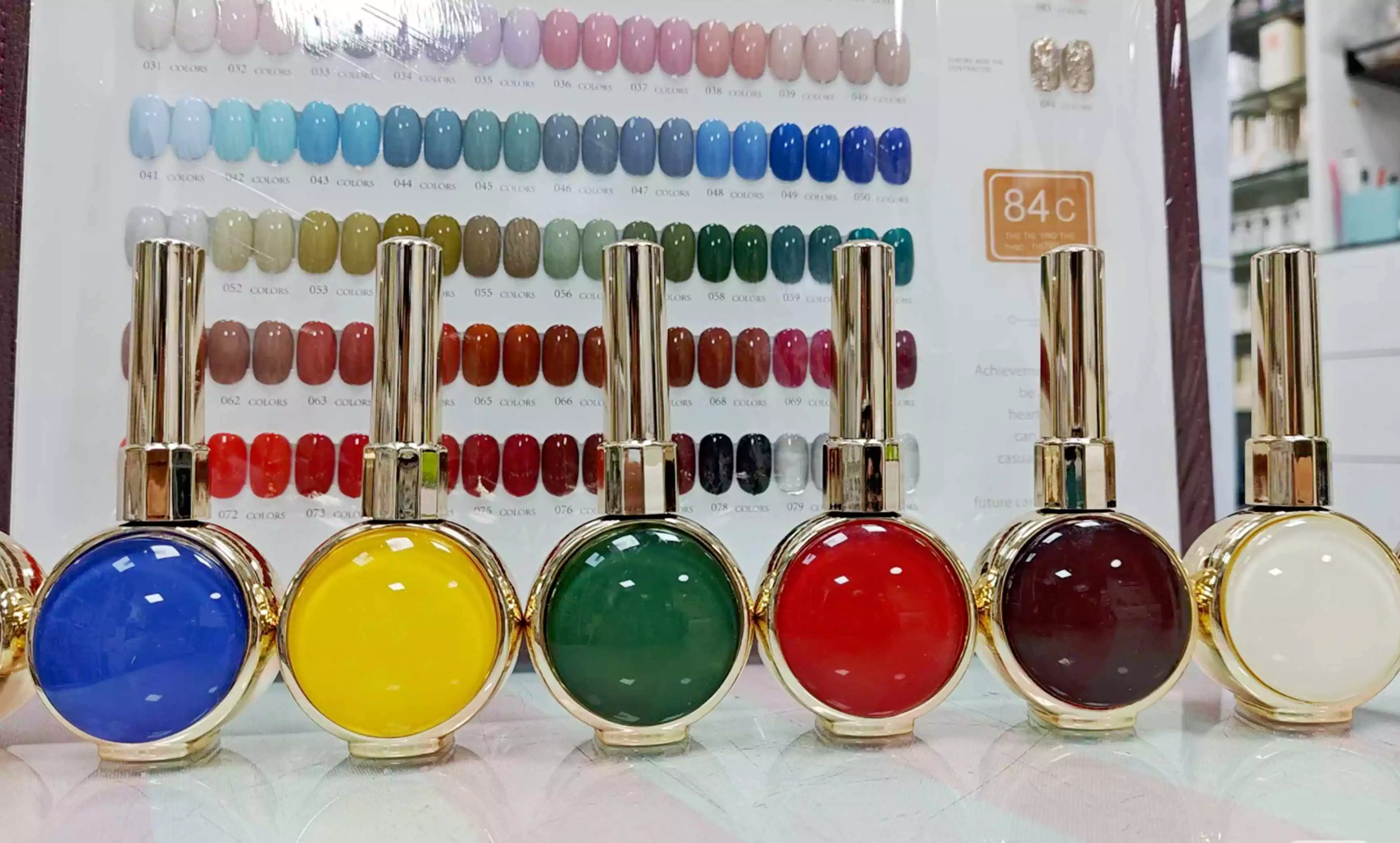
CHROMÉCLAIR offers Base coats, Top coats, solid color 不含 HEMA 的凝胶抛光剂和 无痕猫眼啫喱油.
 05 颜料的耐溶剂性是什么意思?
 他们的网站还提供美甲教程,例如
Related product references: For formulation review or sourcing comparison, see CHLUMIAO HO-17/17EH.