
2025 Verschiedene technische Fragen in Bezug auf Pigmente
Hallo zusammen! Ich bin ein Star-Mitarbeiter bei CHROMÉCLAIR, eine Marke von hemafreier Gel-PoliturDieses Mal werde ich einige technische Fragen und Antworten zu Pigmenten für Beschichtungen zusammenstellen, in der Hoffnung, dass sie Ihnen helfen können.01 Wie können wir die Verwendung von giftigen Bleichromat- und Bleimolybdatpigmenten vermeiden, ohne die Farbgebung zu beeinträchtigen?
Due to the toxicity of lead-containing pigments, countries are increasingly restricting their use in coatings. Formulators typically replace lead pigments with organic pigments combined with titanium dioxide. However, in certain applications, organic pigments blended with metal oxide hybrid pigments (inorganic composite colorants) demonstrate superior performance compared to titanium dioxide. The inherent vivid hues, high saturation, and excellent hiding power of metal oxide hybrid pigments offer formulators greater flexibility to reduce costly organic pigments in formulations, minimize or even eliminate titanium dioxide. For organic pigments, numerous options also demonstrate excellent hiding power and weather resistance, making them viable alternatives to lead-containing pigments. Red pigments include Pigment Red 48:4, Red 112, Red 170, Red 254, Red 255, Violet 19, etc. Orange pigments include Pigment Orange 36 and Orange 73, among others. Yellow pigments include Pigment Yellow 74, Yellow 109, Yellow 110, Yellow 139, Yellow 151, and Yellow 154. Particularly for yellow pigments, we recommend using Bismuth Vanadate Yellow (Pigment Yellow 184). Bismuth Vanadate Yellow is significantly brighter than the metal oxide blend pigment Titanium Nickel (Pigment Yellow 53), offering superior tinting strength, better hiding power (even eliminating the need for added titanium dioxide), and outstanding heat and weather resistance. Finally, it is worth noting that compared to lead-containing pigments, all the pigments mentioned above are considered safe and non-toxic as long as proper dust extraction equipment is used during production (inhaling pigment dust is harmful to human lungs).
02 Welche Faktoren beeinflussen die Ausflockung von Pigmenten in Beschichtungssystemen?
Die folgenden Parameter beeinflussen die Flockung: Viskosität: Unter Bedingungen mit niedriger Viskosität bewegen sich die Pigmentteilchen leichter. Eine Verringerung der Viskosität des Beschichtungssystems verringert daher die Größe der Flockungscluster und verlangsamt die Flockungsgeschwindigkeit. Die Temperatur: Der Einfluss der Temperatur auf die Viskosität ist offensichtlich. Mit steigender Temperatur nimmt die Viskosität ab, wodurch die Flockung indirekt verringert wird. Abblendzeit (Trocknungszeit, Intervall zwischen zwei Nass-in-Nass-Spritzaufträgen oder Zeit, die für eine signifikante Lösungsmittelverdampfung vor dem Eintritt in den Ofen erforderlich ist): Übermäßig lange Ablüftzeiten können ebenfalls zu einer erheblichen Ausflockung der Pigmente führen. Titaniumdioxid: Unbeschichtetes Titandioxid zeigt eine starke Tendenz zum Ausflocken. Größe und Größenverteilung der Pigmentteilchen: Kleinere Pigmentteilchen weisen eine größere Mobilität innerhalb des Beschichtungssystems auf, was die Wahrscheinlichkeit von Zusammenstößen und anschließender Ausflockung erhöht. Dies ist jedoch nicht absolut. Extrem feine Partikelgrößen können die Gesamtviskosität des Systems erhöhen, was die Partikelbewegung reduziert und das Ausflockungsrisiko verringert. Pigment-Konzentration (Titandioxid und Farbpigmente): Mit zunehmender Pigmentkonzentration erhöht sich die Viskosität des Systems, wodurch die Neigung zur Ausflockung verringert wird. Bindemittel: Kleinere Bindemittelmoleküle lassen sich leichter an Pigmentoberflächen adsorbieren. Aufgrund ihres geringeren Volumens bilden sie jedoch weniger sterische Hindernisse zwischen den Pigmentteilchen, was eine Ausflockung wahrscheinlicher macht. Gleichzeitig beeinflusst auch die chemische Struktur des Bindemittels die Ausflockung der Pigmente. Lösungsmittel: Die Auswahl eines geeigneten, guten Lösungsmittels ermöglicht es den Bindemittelpolymermolekülen, sich vollständig auszudehnen, wodurch die gegenseitige Abstoßung zwischen den Pigmentteilchen verstärkt und ein Ausflocken verhindert wird. Schlechte Lösungsmittel bewirken, dass sich die Bindemittelpolymermoleküle zu Clustern zusammenziehen, was die sterische Abstoßung zwischen den Pigmentteilchen verringert und die Ausflockung fördert. 03 Welche Arten von Phthalocyaninblau können in der Lackindustrie verwendet werden?
Phthalocyanine blue primarily consists of copper phthalocyanine, featuring a complex chemical structure and appearing as a deep blue powder. It exhibits multiple crystalline forms, with three commercially available types: α-type phthalocyanine blue (Pigment Blue 15), which carries a red light and possesses the highest relative tinting strength; (Pigment Blue 15); β-type phthalocyanine blue (Pigment Blue 15:3), which exhibits a greenish hue and the best thermodynamic stability; and ε-type phthalocyanine blue (Pigment Blue 15:6), which possesses the most vivid reddish hue. In aromatic solvents (e.g., xylene), α-phthalocyanine blue converts to the more stable β-phthalocyanine blue. To prevent this transformation, a portion of monochlorocopper phthalocyanine is typically blended during the pigmentation process of crude phthalocyanine blue to form solvent-stable α-phthalocyanine blue or Pigment Blue 15:1.
Due to the nonpolar surface of phthalocyanine blue pigments, their interaction with binders in many coating systems is weak, leading to poor stability of the pigment dispersion. Coatings containing phthalocyanine blue pigments are prone to flocculation or separation during storage. This drawback is significantly improved by surface treatment and chemical modification of the solvent-stable Pigment Blue 15:1 molecules. The modified phthalocyanine blue pigment is designated as Pigment Blue 15:2 in the dye index.
In the coatings industry, α-type phthalocyanine blue with a red hue is preferred over β-type phthalocyanine blue with a green hue due to its vivid color, strong tinting strength, ease of dispersion, and excellent flow properties. Since flocculation occurs not only due to the pigment itself but also significantly relates to the binder and solvent in the coating system, it is impossible to identify a phthalocyanine blue variety that exhibits optimal anti-flocculation performance in every coating system. This requires coating professionals to determine the optimal formulation combinations through extensive experimentation tailored to different coating systems.
 03 Welche Arten von Phthalocyaninblau können in der Lackindustrie verwendet werden?
04 Mit welchen Methoden lässt sich die Dispergierbarkeit eines Pigments schnell beurteilen?
Wir verfügen über zahlreiche direkte und indirekte Methoden zur Bewertung der Pigmentdispersion. Zu den direkten Methoden gehören der Feinheitsplatten-Test, die optische Mikroskopie und die Elektronenmikroskopie.
Feinheitsplatten-Test:
Der Hegman-Feinheitstest ist eine einfache und schnelle Methode zur Messung der Feinheit von gemahlenem Material in flüssigen Systemen. Die Hegman-Feinheitsplatte ist eine rechteckige Edelstahlplatte mit zwei präzisionsgefertigten, flachen Rillen. Die Tiefe dieser Rillen nimmt von 100 Mikron auf 0 Mikron ab. An der tiefsten Stelle der Rillen wird eine kleine Menge an gemahlenem Material platziert. Ein doppelschneidiger Schaber aus Edelstahl schabt dann mit gleichmäßiger Geschwindigkeit die gesamte Oberfläche bis zum Ende der Rille mit der Tiefe Null ab. Entlang der Rille sind gleichmäßig Teilungen angebracht, die von Null am tiefsten Punkt bis zur Teilung 8 oder 10 auf der horizontalen Oberfläche der Feinheitsplatte gleichmäßig abnehmen. Als Indikator für den Dispersionsgrad gilt die Teilung, bei der die Pigmentteilchen zuerst als dichte Punkte erscheinen, die deutlich über die Oberfläche des Grundmaterials hinausragen. In der Regel ist eine Mindestteilung von 7 erforderlich, um eine effektive Dispersion anzuzeigen.
Methode der Feinheitsmessung:
The use of an optical microscope provides a rapid method for visually assessing pigment particle size and fineness. It also allows observation of the pigment’s tinting strength.
Additionally, it enables examination of pigment particle morphology, size, distribution, and flocculation. The specific experimental procedure involves placing a small drop of ground material onto a microscope slide and covering it with a cover slip. Take care not to apply excessive pressure when covering the slide to prevent the material from spreading excessively, which could compromise the test results. The primary limitation of optical microscopy is its low resolution, with a minimum discernible size of approximately 2 micrometers.
Elektronenmikroskopie Feinheitsmessverfahren:
The high resolution of the electron microscope is a major advantage, allowing direct observation of pigment particle size. Pigment particle size critically influences key coating properties such as transparency, flowability, and hue.
The main drawbacks of the electron microscope fineness testing method are the high cost of the equipment, the lengthy testing time, the requirement for experienced technicians to analyze and interpret the test data, and the necessity for samples to be completely dry before measurement.
 04 Mit welchen Methoden lässt sich die Dispergierbarkeit eines Pigments schnell beurteilen?
05 Was bedeutet Pigmentlösungsmittelbeständigkeit?
In paint production, we must uniformly and stably disperse pigments throughout most organic binders (composed of resins and solvents), meaning pigments must be surrounded by organic solvents. Furthermore, most paints colored with pigments inevitably come into frequent contact with organic solvents (cleaning agents, gasoline, lubricants, etc.) during their effective service life. Therefore, pigments must be as insoluble as possible in organic solvents. If complete insolubility cannot be achieved, we must recognize that pigment addition is limited in various organic solvents. Exceeding this tolerance level will cause bleeding due to pigment dissolution in the solvent. Essentially, pigment solvent resistance is the pigment’s ability to resist dissolution by solvents and prevent bleeding. Inorganic pigments (due to their inherent chemical structure) and certain complex organic synthetic pigments generally exhibit excellent solvent resistance. However, lower-grade organic pigments and surface-treated pigments typically demonstrate poorer solvent resistance. Solvents used to evaluate pigment solvent resistance include water, turpentine, toluene, xylene, methyl ethyl ketone, ethanol, ethyl acetate, diethylene glycol, and trichloroethylene.
That’s all for today! I hope this article helps you understand pigments more easily!
CHROMÉCLAIR offers Base coats, Top coats, solid color Gel-Politur ohne HEMAund hemafreier Gel-Lack für Katzenaugen.
 05 Was bedeutet Pigmentlösungsmittelbeständigkeit?
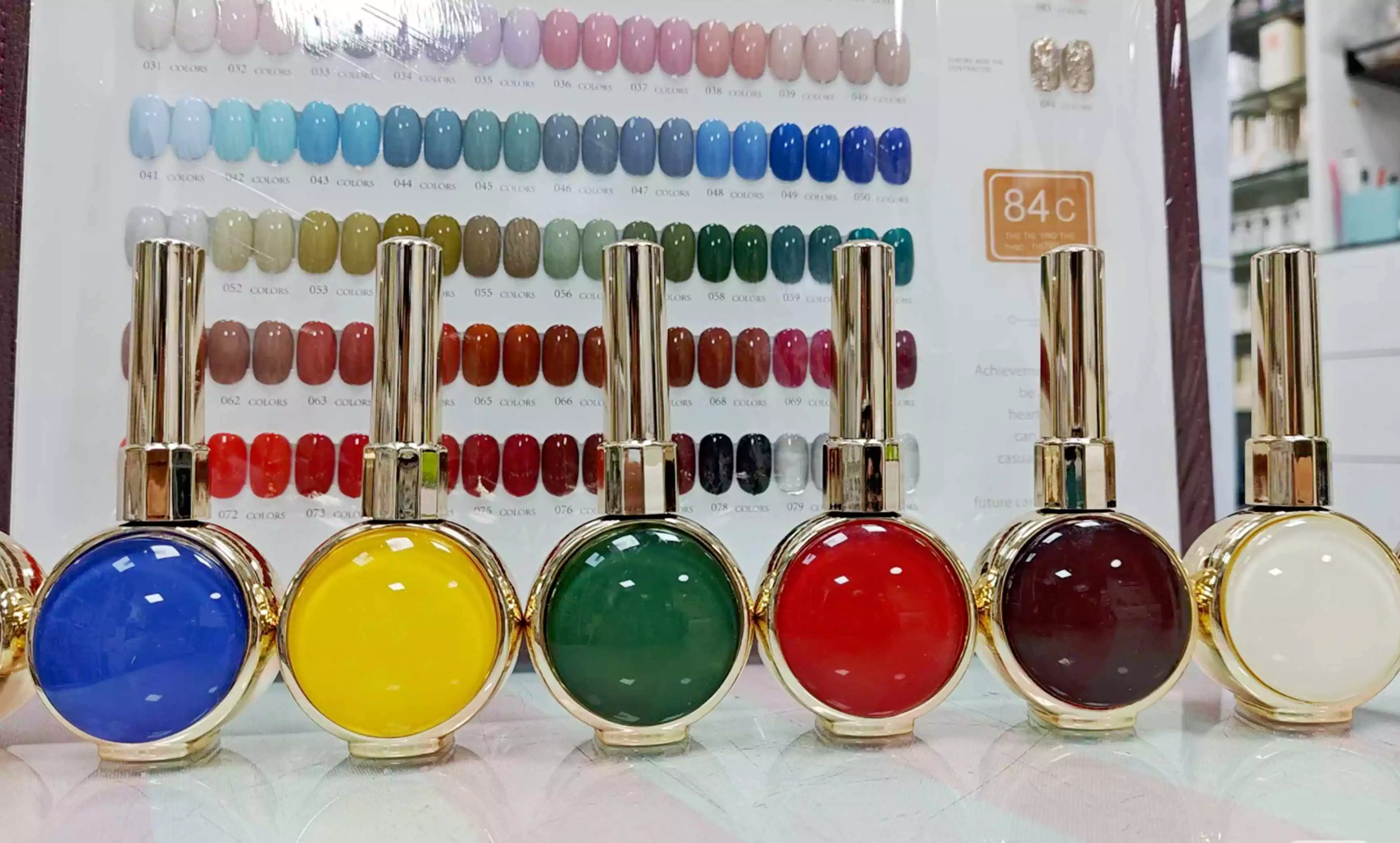 Auf ihrer Website finden Sie auch Anleitungen für die Nagelkunst, wie zum Beispiel:
Wie macht man die 3D-Blumen-Nagelkunst aus Metall zu Hause?
Holen Sie sich eine transparente französische Maniküre ohne Kristallkleber!
Related product references: For formulation review or sourcing comparison, see CHLUMIAO HO-17/17EH.