
2025 Várias questões técnicas relacionadas a pigmentos
Olá a todos! Sou uma funcionária estrela da CHROMÉCLAIR, uma marca de esmalte em gel sem hemaDesta vez, organizarei várias perguntas e respostas técnicas sobre pigmentos para revestimentos, esperando que isso possa ser útil para você.01 Como podemos evitar o uso de pigmentos tóxicos de cromato de chumbo e molibdato de chumbo sem comprometer a cor da tinta?
Due to the toxicity of lead-containing pigments, countries are increasingly restricting their use in coatings. Formulators typically replace lead pigments with organic pigments combined with titanium dioxide. However, in certain applications, organic pigments blended with metal oxide hybrid pigments (inorganic composite colorants) demonstrate superior performance compared to titanium dioxide. The inherent vivid hues, high saturation, and excellent hiding power of metal oxide hybrid pigments offer formulators greater flexibility to reduce costly organic pigments in formulations, minimize or even eliminate titanium dioxide. For organic pigments, numerous options also demonstrate excellent hiding power and weather resistance, making them viable alternatives to lead-containing pigments. Red pigments include Pigment Red 48:4, Red 112, Red 170, Red 254, Red 255, Violet 19, etc. Orange pigments include Pigment Orange 36 and Orange 73, among others. Yellow pigments include Pigment Yellow 74, Yellow 109, Yellow 110, Yellow 139, Yellow 151, and Yellow 154. Particularly for yellow pigments, we recommend using Bismuth Vanadate Yellow (Pigment Yellow 184). Bismuth Vanadate Yellow is significantly brighter than the metal oxide blend pigment Titanium Nickel (Pigment Yellow 53), offering superior tinting strength, better hiding power (even eliminating the need for added titanium dioxide), and outstanding heat and weather resistance. Finally, it is worth noting that compared to lead-containing pigments, all the pigments mentioned above are considered safe and non-toxic as long as proper dust extraction equipment is used during production (inhaling pigment dust is harmful to human lungs).
02 Quais fatores influenciam a floculação de pigmentos em sistemas de revestimento?
Os seguintes parâmetros afetam a floculação: Viscosidade: Em condições de baixa viscosidade, as partículas de pigmento se movem com mais facilidade. Portanto, a redução da viscosidade do sistema de revestimento diminuirá o tamanho do grupo de floculação e reduzirá a taxa de floculação. Temperatura: O efeito da temperatura sobre a viscosidade é evidente. O aumento da temperatura faz com que a viscosidade diminua, reduzindo indiretamente a floculação. Tempo de desligamento do flash (tempo de secagem, intervalo entre aplicações de pulverização de duas camadas úmidas sobre úmidas ou tempo necessário para evaporação significativa do solvente antes de entrar no forno): Tempos de flash-off excessivamente longos também podem causar floculação significativa do pigmento. Dióxido de titânio: O dióxido de titânio não revestido apresenta uma forte tendência à floculação. Tamanho da partícula do pigmento e distribuição do tamanho: As partículas menores de pigmento apresentam maior mobilidade dentro do sistema de revestimento, aumentando a probabilidade de colisões e subsequente floculação. Entretanto, isso não é absoluto. Tamanhos de partículas extremamente finos podem elevar a viscosidade geral do sistema, reduzindo o movimento das partículas e diminuindo o risco de floculação. Concentração de pigmentos (Dióxido de titânio e pigmentos de coloração): O aumento da concentração de pigmento aumenta a viscosidade do sistema, reduzindo a tendência de floculação. Fichário: As moléculas menores de aglutinante são mais facilmente adsorvidas nas superfícies dos pigmentos. No entanto, devido ao seu volume reduzido, elas criam menos obstáculos estéricos entre as partículas de pigmento, tornando a floculação mais provável. Ao mesmo tempo, a estrutura química do aglutinante também influencia a floculação do pigmento. Solvente: A seleção de um solvente bom e adequado permite que as moléculas do polímero aglutinante se estendam totalmente, aumentando a repulsão mútua entre as partículas de pigmento e evitando a floculação. Os solventes ruins fazem com que as moléculas de polímero aglutinante se contraiam em grupos, reduzindo a repulsão estérica entre as partículas de pigmento e promovendo a floculação. 03 Que tipos de azul de ftalocianina podem ser usados no setor de revestimentos?
Phthalocyanine blue primarily consists of copper phthalocyanine, featuring a complex chemical structure and appearing as a deep blue powder. It exhibits multiple crystalline forms, with three commercially available types: α-type phthalocyanine blue (Pigment Blue 15), which carries a red light and possesses the highest relative tinting strength; (Pigment Blue 15); β-type phthalocyanine blue (Pigment Blue 15:3), which exhibits a greenish hue and the best thermodynamic stability; and ε-type phthalocyanine blue (Pigment Blue 15:6), which possesses the most vivid reddish hue. In aromatic solvents (e.g., xylene), α-phthalocyanine blue converts to the more stable β-phthalocyanine blue. To prevent this transformation, a portion of monochlorocopper phthalocyanine is typically blended during the pigmentation process of crude phthalocyanine blue to form solvent-stable α-phthalocyanine blue or Pigment Blue 15:1.
Due to the nonpolar surface of phthalocyanine blue pigments, their interaction with binders in many coating systems is weak, leading to poor stability of the pigment dispersion. Coatings containing phthalocyanine blue pigments are prone to flocculation or separation during storage. This drawback is significantly improved by surface treatment and chemical modification of the solvent-stable Pigment Blue 15:1 molecules. The modified phthalocyanine blue pigment is designated as Pigment Blue 15:2 in the dye index.
In the coatings industry, α-type phthalocyanine blue with a red hue is preferred over β-type phthalocyanine blue with a green hue due to its vivid color, strong tinting strength, ease of dispersion, and excellent flow properties. Since flocculation occurs not only due to the pigment itself but also significantly relates to the binder and solvent in the coating system, it is impossible to identify a phthalocyanine blue variety that exhibits optimal anti-flocculation performance in every coating system. This requires coating professionals to determine the optimal formulation combinations through extensive experimentation tailored to different coating systems.
 03 Que tipos de azul de ftalocianina podem ser usados no setor de revestimentos?
04 Que métodos podem ser usados para avaliar rapidamente a dispersibilidade de um pigmento?
Temos vários métodos diretos e indiretos para avaliar a dispersão de pigmentos. Os métodos diretos incluem o teste de placa de finura, microscopia óptica e microscopia eletrônica.
Teste de placa de finura:
O teste de finura Hegman é um método simples e rápido para medir a finura de materiais moídos em sistemas líquidos. A placa de finura Hegman é uma placa retangular de aço inoxidável que apresenta duas ranhuras rasas usinadas com precisão. Essas ranhuras diminuem gradualmente em profundidade de 100 mícrons para 0 mícrons. Uma pequena quantidade de material moído é colocada no ponto mais profundo da ranhura. Em seguida, um raspador de lâmina dupla de aço inoxidável é usado para raspar toda a superfície em uma velocidade uniforme em direção à extremidade com profundidade zero do sulco. As graduações são marcadas uniformemente ao longo da ranhura, diminuindo uniformemente de zero no ponto mais profundo até a graduação 8 ou 10 na superfície horizontal da placa de finura. A graduação em que as partículas de pigmento aparecem pela primeira vez como pontos densos, claramente salientes acima da superfície do material moído, é considerada o indicador do grau de dispersão. Normalmente, é necessária uma graduação mínima de 7 para indicar uma dispersão efetiva.
Método de teste de finura:
The use of an optical microscope provides a rapid method for visually assessing pigment particle size and fineness. It also allows observation of the pigment’s tinting strength.
Additionally, it enables examination of pigment particle morphology, size, distribution, and flocculation. The specific experimental procedure involves placing a small drop of ground material onto a microscope slide and covering it with a cover slip. Take care not to apply excessive pressure when covering the slide to prevent the material from spreading excessively, which could compromise the test results. The primary limitation of optical microscopy is its low resolution, with a minimum discernible size of approximately 2 micrometers.
Microscopia eletrônica Método de teste de finura:
The high resolution of the electron microscope is a major advantage, allowing direct observation of pigment particle size. Pigment particle size critically influences key coating properties such as transparency, flowability, and hue.
The main drawbacks of the electron microscope fineness testing method are the high cost of the equipment, the lengthy testing time, the requirement for experienced technicians to analyze and interpret the test data, and the necessity for samples to be completely dry before measurement.
 04 Que métodos podem ser usados para avaliar rapidamente a dispersibilidade de um pigmento?
05 O que significa resistência a solventes de pigmentos?
In paint production, we must uniformly and stably disperse pigments throughout most organic binders (composed of resins and solvents), meaning pigments must be surrounded by organic solvents. Furthermore, most paints colored with pigments inevitably come into frequent contact with organic solvents (cleaning agents, gasoline, lubricants, etc.) during their effective service life. Therefore, pigments must be as insoluble as possible in organic solvents. If complete insolubility cannot be achieved, we must recognize that pigment addition is limited in various organic solvents. Exceeding this tolerance level will cause bleeding due to pigment dissolution in the solvent. Essentially, pigment solvent resistance is the pigment’s ability to resist dissolution by solvents and prevent bleeding. Inorganic pigments (due to their inherent chemical structure) and certain complex organic synthetic pigments generally exhibit excellent solvent resistance. However, lower-grade organic pigments and surface-treated pigments typically demonstrate poorer solvent resistance. Solvents used to evaluate pigment solvent resistance include water, turpentine, toluene, xylene, methyl ethyl ketone, ethanol, ethyl acetate, diethylene glycol, and trichloroethylene.
That’s all for today! I hope this article helps you understand pigments more easily!
CHROMÉCLAIR offers Base coats, Top coats, solid color polimento em gel sem HEMAe esmalte em gel para olhos de gato sem hema.
 05 O que significa resistência a solventes de pigmentos?
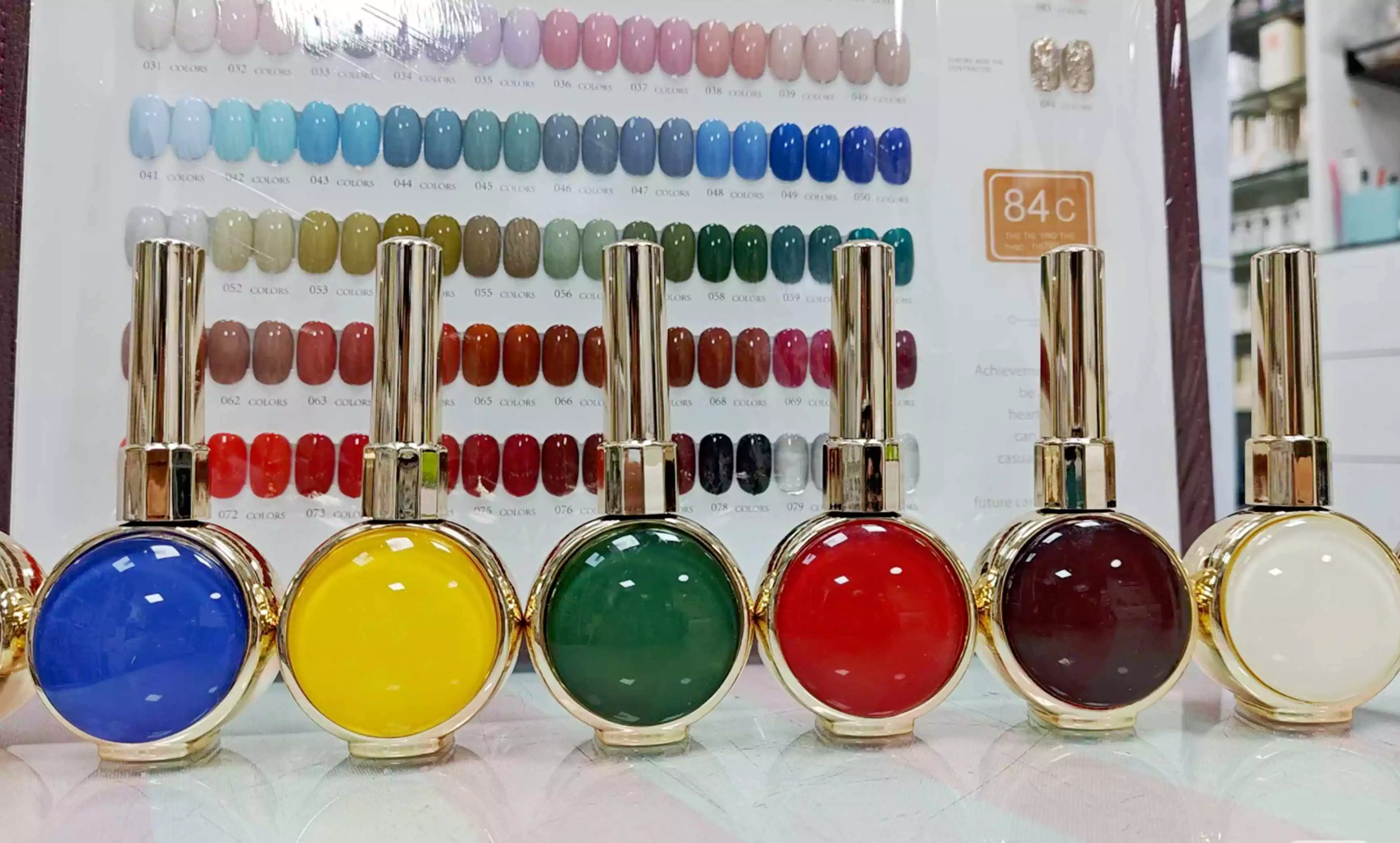 Seu site também apresenta tutoriais de nail art, como:
Como fazer a nail art floral 3D de metal em casa?
Faça uma manicure francesa transparente sem cola de cristal!
Related product references: For formulation review or sourcing comparison, see CHLUMIAO HO-17/17EH.