
2025 Pigmentlerle İlgili Bazı Teknik Konular
Herkese merhaba! Ben bir yıldız çalışanıyım CHROMÉCLAIRbir marka olan hema free jel cilaBu kez, size yardımcı olabileceğini umarak, kaplamalar için pigmentlerle ilgili birkaç teknik soru ve cevap düzenleyeceğim.01 Boya renginden ödün vermeden toksik kurşun kromat ve kurşun molibdat pigmentlerini kullanmaktan nasıl kaçınabiliriz?
Due to the toxicity of lead-containing pigments, countries are increasingly restricting their use in coatings. Formulators typically replace lead pigments with organic pigments combined with titanium dioxide. However, in certain applications, organic pigments blended with metal oxide hybrid pigments (inorganic composite colorants) demonstrate superior performance compared to titanium dioxide. The inherent vivid hues, high saturation, and excellent hiding power of metal oxide hybrid pigments offer formulators greater flexibility to reduce costly organic pigments in formulations, minimize or even eliminate titanium dioxide. For organic pigments, numerous options also demonstrate excellent hiding power and weather resistance, making them viable alternatives to lead-containing pigments. Red pigments include Pigment Red 48:4, Red 112, Red 170, Red 254, Red 255, Violet 19, etc. Orange pigments include Pigment Orange 36 and Orange 73, among others. Yellow pigments include Pigment Yellow 74, Yellow 109, Yellow 110, Yellow 139, Yellow 151, and Yellow 154. Particularly for yellow pigments, we recommend using Bismuth Vanadate Yellow (Pigment Yellow 184). Bismuth Vanadate Yellow is significantly brighter than the metal oxide blend pigment Titanium Nickel (Pigment Yellow 53), offering superior tinting strength, better hiding power (even eliminating the need for added titanium dioxide), and outstanding heat and weather resistance. Finally, it is worth noting that compared to lead-containing pigments, all the pigments mentioned above are considered safe and non-toxic as long as proper dust extraction equipment is used during production (inhaling pigment dust is harmful to human lungs).
02 Kaplama sistemlerinde pigment flokülasyonunu etkileyen faktörler nelerdir?
Aşağıdaki parametreler flokülasyonu etkiler: Viskozite: Düşük viskozite koşulları altında pigment partikülleri daha kolay hareket eder. Bu nedenle, kaplama sisteminin viskozitesinin azaltılması flokülasyon kümesi boyutunu azaltacak ve flokülasyon hızını yavaşlatacaktır. Sıcaklık: Sıcaklığın viskozite üzerindeki etkisi açıktır. Artan sıcaklık viskozitenin düşmesine neden olarak flokülasyonu dolaylı olarak azaltır. Parlama süresi (kuruma süresi, ıslak üzerine ıslak iki kat püskürtme uygulamaları arasındaki aralık veya fırına girmeden önce önemli ölçüde solvent buharlaşması için gereken süre): Aşırı uzun flash-off süreleri de önemli pigment flokülasyonuna neden olabilir. Titanyum dioksit: Kaplanmamış titanyum dioksit güçlü bir flokülasyon eğilimi gösterir. Pigment partikül boyutu ve boyut dağılımı: Daha küçük pigment partikülleri kaplama sistemi içinde daha fazla hareketlilik sergileyerek çarpışma ve ardından flokülasyon olasılığını artırır. Ancak bu mutlak değildir. Son derece ince partikül boyutları genel sistem viskozitesini yükselterek partikül hareketini azaltabilir ve flokülasyon riskini azaltabilir. Pigment Konsantrasyonu (Titanyum Dioksit ve Renklendirici Pigmentler): Pigment konsantrasyonunun artırılması sistemin viskozitesini yükselterek flokülasyon eğilimini azaltır. Cilt: Daha küçük bağlayıcı moleküller pigment yüzeylerine daha kolay adsorbe olurlar. Bununla birlikte, hacimlerinin azalması nedeniyle pigment partikülleri arasında daha az sterik engel oluşturarak flokülasyon olasılığını artırırlar. Aynı zamanda, bağlayıcının kimyasal yapısı da pigment flokülasyonunu etkiler. Çözücü: Uygun, iyi bir çözücünün seçilmesi bağlayıcı polimer moleküllerinin tamamen uzamasını sağlayarak pigment partikülleri arasındaki karşılıklı itmeyi artırır ve flokülasyonu önler. Kötü çözücüler bağlayıcı polimer moleküllerinin kümeler halinde büzülmesine neden olarak pigment partikülleri arasındaki sterik itmeyi azaltır ve flokülasyonu teşvik eder. 03 Kaplama endüstrisinde ne tür ftalosiyanin mavisi kullanılabilir?
Phthalocyanine blue primarily consists of copper phthalocyanine, featuring a complex chemical structure and appearing as a deep blue powder. It exhibits multiple crystalline forms, with three commercially available types: α-type phthalocyanine blue (Pigment Blue 15), which carries a red light and possesses the highest relative tinting strength; (Pigment Blue 15); β-type phthalocyanine blue (Pigment Blue 15:3), which exhibits a greenish hue and the best thermodynamic stability; and ε-type phthalocyanine blue (Pigment Blue 15:6), which possesses the most vivid reddish hue. In aromatic solvents (e.g., xylene), α-phthalocyanine blue converts to the more stable β-phthalocyanine blue. To prevent this transformation, a portion of monochlorocopper phthalocyanine is typically blended during the pigmentation process of crude phthalocyanine blue to form solvent-stable α-phthalocyanine blue or Pigment Blue 15:1.
Due to the nonpolar surface of phthalocyanine blue pigments, their interaction with binders in many coating systems is weak, leading to poor stability of the pigment dispersion. Coatings containing phthalocyanine blue pigments are prone to flocculation or separation during storage. This drawback is significantly improved by surface treatment and chemical modification of the solvent-stable Pigment Blue 15:1 molecules. The modified phthalocyanine blue pigment is designated as Pigment Blue 15:2 in the dye index.
In the coatings industry, α-type phthalocyanine blue with a red hue is preferred over β-type phthalocyanine blue with a green hue due to its vivid color, strong tinting strength, ease of dispersion, and excellent flow properties. Since flocculation occurs not only due to the pigment itself but also significantly relates to the binder and solvent in the coating system, it is impossible to identify a phthalocyanine blue variety that exhibits optimal anti-flocculation performance in every coating system. This requires coating professionals to determine the optimal formulation combinations through extensive experimentation tailored to different coating systems.
 03 Kaplama endüstrisinde ne tür ftalosiyanin mavisi kullanılabilir?
04 Bir pigmentin dağılabilirliğini hızlı bir şekilde değerlendirmek için hangi yöntemler kullanılabilir?
Pigment dağılımını değerlendirmek için çok sayıda doğrudan ve dolaylı yöntemimiz bulunmaktadır. Doğrudan yöntemler arasında incelik plakası testi, optik mikroskopi ve elektron mikroskobu bulunmaktadır.
İncelik Plakası Testi:
Hegman incelik testi, sıvı sistemlerde öğütülmüş malzemelerin inceliğini ölçmek için basit ve hızlı bir yöntemdir. Hegman incelik plakası, iki hassas işlenmiş sığ oluk içeren dikdörtgen şeklinde paslanmaz çelik bir plakadır. Bu olukların derinliği 100 mikrondan 0 mikrona kadar kademeli olarak azalır. Yivin en derin noktasına az miktarda öğütülmüş malzeme yerleştirilir. Daha sonra paslanmaz çelikten çift bıçaklı bir sıyırıcı, tüm yüzeyi sıfır oluk derinliğine sahip uca doğru eşit bir hızda sıyırmak için kullanılır. Dereceler yiv boyunca eşit şekilde işaretlenir ve en derin noktadaki sıfırdan incelik plakasının yatay yüzeyindeki 8 veya 10 derecesine kadar eşit şekilde azalır. Pigment partiküllerinin ilk olarak zemin malzemesi yüzeyinin üzerinde açıkça çıkıntı yapan yoğun noktalar olarak göründüğü derece, dağılma derecesinin göstergesi olarak kabul edilir. Tipik olarak, etkili dağılımın gösterilmesi için minimum 7 derece gereklidir.
İncelik Test Yöntemi:
The use of an optical microscope provides a rapid method for visually assessing pigment particle size and fineness. It also allows observation of the pigment’s tinting strength.
Additionally, it enables examination of pigment particle morphology, size, distribution, and flocculation. The specific experimental procedure involves placing a small drop of ground material onto a microscope slide and covering it with a cover slip. Take care not to apply excessive pressure when covering the slide to prevent the material from spreading excessively, which could compromise the test results. The primary limitation of optical microscopy is its low resolution, with a minimum discernible size of approximately 2 micrometers.
Elektron Mikroskobu İncelik Test Yöntemi:
The high resolution of the electron microscope is a major advantage, allowing direct observation of pigment particle size. Pigment particle size critically influences key coating properties such as transparency, flowability, and hue.
The main drawbacks of the electron microscope fineness testing method are the high cost of the equipment, the lengthy testing time, the requirement for experienced technicians to analyze and interpret the test data, and the necessity for samples to be completely dry before measurement.
 04 Bir pigmentin dağılabilirliğini hızlı bir şekilde değerlendirmek için hangi yöntemler kullanılabilir?
05 Pigment solvent direnci ne anlama gelir?
In paint production, we must uniformly and stably disperse pigments throughout most organic binders (composed of resins and solvents), meaning pigments must be surrounded by organic solvents. Furthermore, most paints colored with pigments inevitably come into frequent contact with organic solvents (cleaning agents, gasoline, lubricants, etc.) during their effective service life. Therefore, pigments must be as insoluble as possible in organic solvents. If complete insolubility cannot be achieved, we must recognize that pigment addition is limited in various organic solvents. Exceeding this tolerance level will cause bleeding due to pigment dissolution in the solvent. Essentially, pigment solvent resistance is the pigment’s ability to resist dissolution by solvents and prevent bleeding. Inorganic pigments (due to their inherent chemical structure) and certain complex organic synthetic pigments generally exhibit excellent solvent resistance. However, lower-grade organic pigments and surface-treated pigments typically demonstrate poorer solvent resistance. Solvents used to evaluate pigment solvent resistance include water, turpentine, toluene, xylene, methyl ethyl ketone, ethanol, ethyl acetate, diethylene glycol, and trichloroethylene.
That’s all for today! I hope this article helps you understand pigments more easily!
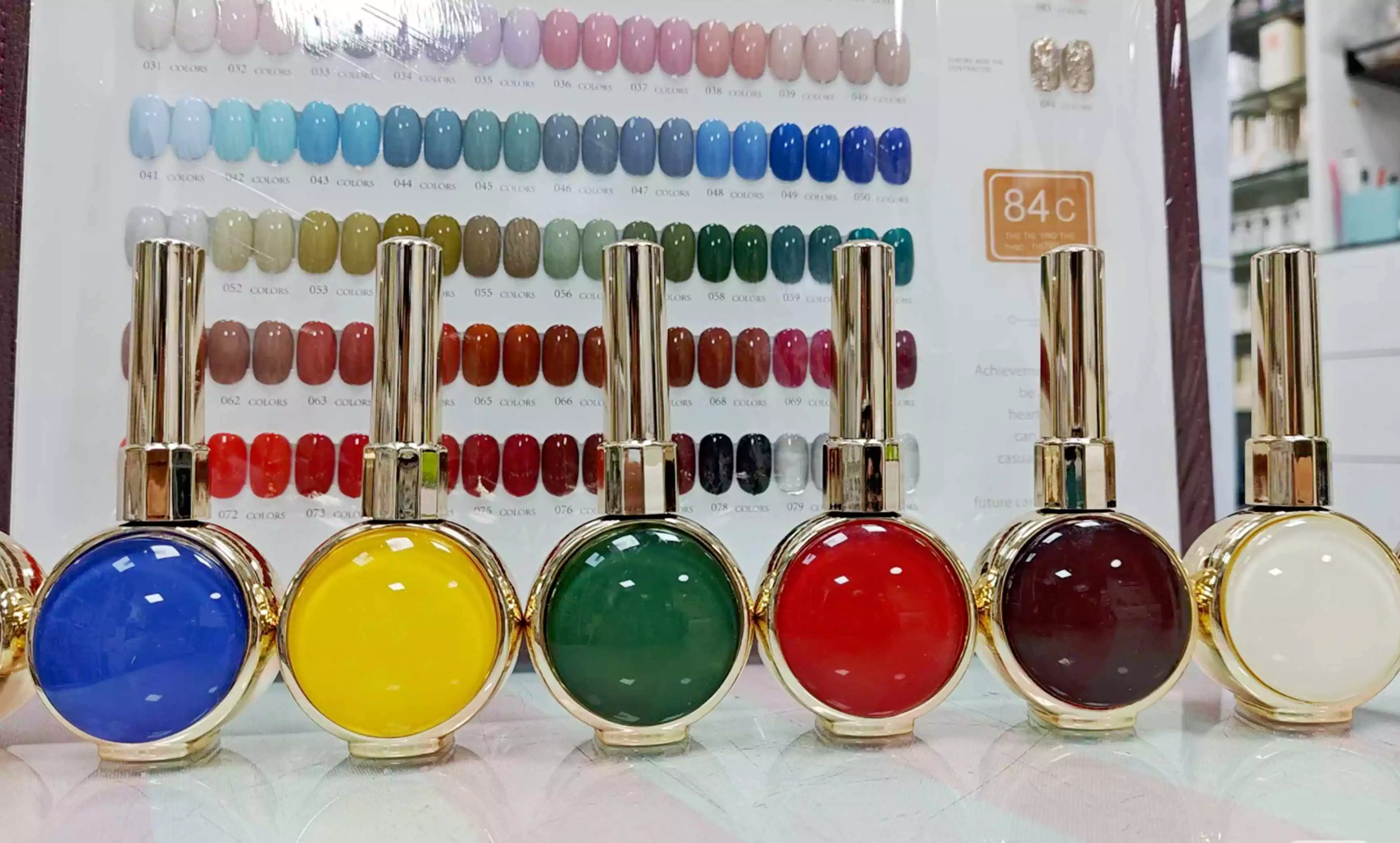
CHROMÉCLAIR offers Base coats, Top coats, solid color HEMA içermeyen jel cilave hema free kedi gözü jel cila.
 05 Pigment solvent direnci ne anlama gelir?
 Web sitelerinde ayrıca tırnak sanatı eğitimleri de yer alıyor:
Metal 3D Çiçekli Tırnak Sanatı Evde Nasıl Yapılır?
Kristal yapıştırıcı olmadan şeffaf bir Fransız manikürü elde edin!
Related product references: For formulation review or sourcing comparison, see CHLUMIAO HO-17/17EH.