
2025 Several Technical Issues Regarding Pigments
Hello everyone! I’m a star employee at CHROMÉCLAIR, a brand of hema free gel polish.This time, I’ll organize several technical questions and answers regarding pigments for coatings, hoping it can be of help to you.01 How can we avoid using toxic lead chromate and lead molybdate pigments without compromising paint color?
Due to the toxicity of lead-containing pigments, countries are increasingly restricting their use in coatings. Formulators typically replace lead pigments with organic pigments combined with titanium dioxide. However, in certain applications, organic pigments blended with metal oxide hybrid pigments (inorganic composite colorants) demonstrate superior performance compared to titanium dioxide. The inherent vivid hues, high saturation, and excellent hiding power of metal oxide hybrid pigments offer formulators greater flexibility to reduce costly organic pigments in formulations, minimize or even eliminate titanium dioxide. For organic pigments, numerous options also demonstrate excellent hiding power and weather resistance, making them viable alternatives to lead-containing pigments. Red pigments include Pigment Red 48:4, Red 112, Red 170, Red 254, Red 255, Violet 19, etc. Orange pigments include Pigment Orange 36 and Orange 73, among others. Yellow pigments include Pigment Yellow 74, Yellow 109, Yellow 110, Yellow 139, Yellow 151, and Yellow 154. Particularly for yellow pigments, we recommend using Bismuth Vanadate Yellow (Pigment Yellow 184). Bismuth Vanadate Yellow is significantly brighter than the metal oxide blend pigment Titanium Nickel (Pigment Yellow 53), offering superior tinting strength, better hiding power (even eliminating the need for added titanium dioxide), and outstanding heat and weather resistance. Finally, it is worth noting that compared to lead-containing pigments, all the pigments mentioned above are considered safe and non-toxic as long as proper dust extraction equipment is used during production (inhaling pigment dust is harmful to human lungs).
02 What factors influence pigment flocculation in coating systems?
The following parameters affect flocculation: Viscosity: Under low-viscosity conditions, pigment particles move more easily. Therefore, reducing the viscosity of the coating system will decrease flocculation cluster size and slow flocculation rate. Temperature: Temperature’s effect on viscosity is evident. Increasing temperature causes viscosity to decrease, thereby indirectly reducing flocculation. Flash-off time (drying time, interval between wet-on-wet two-coat spraying applications, or time required for significant solvent evaporation before entering the oven): Excessively long flash-off times can also cause significant pigment flocculation. Titanium dioxide: Uncoated titanium dioxide exhibits a strong tendency to flocculate. Pigment particle size and size distribution: Smaller pigment particles exhibit greater mobility within the coating system, increasing the likelihood of collisions and subsequent flocculation. However, this is not absolute. Extremely fine particle sizes can elevate overall system viscosity, reducing particle movement and diminishing flocculation risk. Pigment Concentration (Titanium Dioxide and Coloring Pigments): Increasing pigment concentration raises the system’s viscosity, reducing the tendency for flocculation. Binder: Smaller binder molecules are more readily adsorbed onto pigment surfaces. However, due to their reduced volume, they create less steric hindrance between pigment particles, making flocculation more likely. Simultaneously, the chemical structure of the binder also influences pigment flocculation. Solvent: Selecting an appropriate, good solvent allows binder polymer molecules to fully extend, increasing mutual repulsion between pigment particles and preventing flocculation. Poor solvents cause binder polymer molecules to contract into clusters, reducing steric repulsion between pigment particles and promoting flocculation. 03 What types of phthalocyanine blue can be used in the coatings industry?
Phthalocyanine blue primarily consists of copper phthalocyanine, featuring a complex chemical structure and appearing as a deep blue powder. It exhibits multiple crystalline forms, with three commercially available types: α-type phthalocyanine blue (Pigment Blue 15), which carries a red light and possesses the highest relative tinting strength; (Pigment Blue 15); β-type phthalocyanine blue (Pigment Blue 15:3), which exhibits a greenish hue and the best thermodynamic stability; and ε-type phthalocyanine blue (Pigment Blue 15:6), which possesses the most vivid reddish hue. In aromatic solvents (e.g., xylene), α-phthalocyanine blue converts to the more stable β-phthalocyanine blue. To prevent this transformation, a portion of monochlorocopper phthalocyanine is typically blended during the pigmentation process of crude phthalocyanine blue to form solvent-stable α-phthalocyanine blue or Pigment Blue 15:1.
Due to the nonpolar surface of phthalocyanine blue pigments, their interaction with binders in many coating systems is weak, leading to poor stability of the pigment dispersion. Coatings containing phthalocyanine blue pigments are prone to flocculation or separation during storage. This drawback is significantly improved by surface treatment and chemical modification of the solvent-stable Pigment Blue 15:1 molecules. The modified phthalocyanine blue pigment is designated as Pigment Blue 15:2 in the dye index.
In the coatings industry, α-type phthalocyanine blue with a red hue is preferred over β-type phthalocyanine blue with a green hue due to its vivid color, strong tinting strength, ease of dispersion, and excellent flow properties. Since flocculation occurs not only due to the pigment itself but also significantly relates to the binder and solvent in the coating system, it is impossible to identify a phthalocyanine blue variety that exhibits optimal anti-flocculation performance in every coating system. This requires coating professionals to determine the optimal formulation combinations through extensive experimentation tailored to different coating systems.
 03 What types of phthalocyanine blue can be used in the coatings industry?
04 What methods can be used to quickly assess the dispersibility of a pigment?
We have numerous direct and indirect methods to evaluate pigment dispersion. Direct methods include the fineness plate test, optical microscopy, and electron microscopy.
Fineness Plate Test:
The Hegman fineness test is a simple and rapid method for measuring the fineness of ground materials in liquid systems. The Hegman fineness plate is a rectangular stainless steel plate featuring two precision-machined shallow grooves. These grooves gradually decrease in depth from 100 microns to 0 microns. A small amount of ground material is placed at the deepest point of the groove. A stainless steel double-bladed scraper is then used to scrape the entire surface at a uniform speed toward the end with zero groove depth. Graduations are evenly marked alongside the groove, decreasing uniformly from zero at the deepest point to graduation 8 or 10 on the horizontal surface of the fineness plate. The graduation where pigment particles first appear as dense dots, clearly protruding above the ground material surface, is considered the indicator for dispersion degree. Typically, a minimum graduation of 7 is required to indicate effective dispersion.
Fineness Testing Method:
The use of an optical microscope provides a rapid method for visually assessing pigment particle size and fineness. It also allows observation of the pigment’s tinting strength.
Additionally, it enables examination of pigment particle morphology, size, distribution, and flocculation. The specific experimental procedure involves placing a small drop of ground material onto a microscope slide and covering it with a cover slip. Take care not to apply excessive pressure when covering the slide to prevent the material from spreading excessively, which could compromise the test results. The primary limitation of optical microscopy is its low resolution, with a minimum discernible size of approximately 2 micrometers.
Electron Microscopy Fineness Testing Method:
The high resolution of the electron microscope is a major advantage, allowing direct observation of pigment particle size. Pigment particle size critically influences key coating properties such as transparency, flowability, and hue.
The main drawbacks of the electron microscope fineness testing method are the high cost of the equipment, the lengthy testing time, the requirement for experienced technicians to analyze and interpret the test data, and the necessity for samples to be completely dry before measurement.
 04 What methods can be used to quickly assess the dispersibility of a pigment?
05 What does pigment solvent resistance mean?
In paint production, we must uniformly and stably disperse pigments throughout most organic binders (composed of resins and solvents), meaning pigments must be surrounded by organic solvents. Furthermore, most paints colored with pigments inevitably come into frequent contact with organic solvents (cleaning agents, gasoline, lubricants, etc.) during their effective service life. Therefore, pigments must be as insoluble as possible in organic solvents. If complete insolubility cannot be achieved, we must recognize that pigment addition is limited in various organic solvents. Exceeding this tolerance level will cause bleeding due to pigment dissolution in the solvent. Essentially, pigment solvent resistance is the pigment’s ability to resist dissolution by solvents and prevent bleeding. Inorganic pigments (due to their inherent chemical structure) and certain complex organic synthetic pigments generally exhibit excellent solvent resistance. However, lower-grade organic pigments and surface-treated pigments typically demonstrate poorer solvent resistance. Solvents used to evaluate pigment solvent resistance include water, turpentine, toluene, xylene, methyl ethyl ketone, ethanol, ethyl acetate, diethylene glycol, and trichloroethylene.
That’s all for today! I hope this article helps you understand pigments more easily!
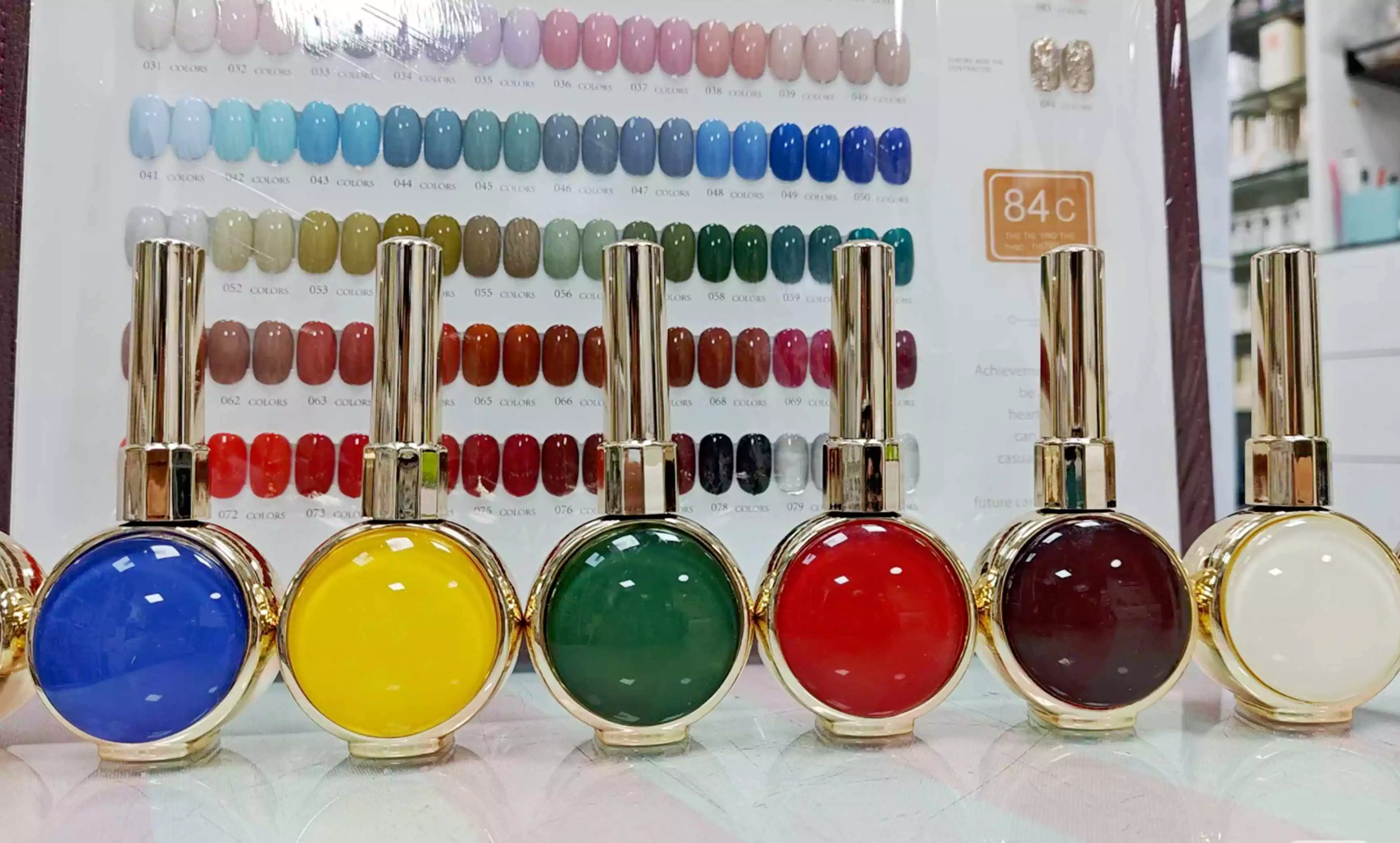
CHROMÉCLAIR offers Base coats, Top coats, solid color gel polish without HEMA, and hema free cat eye gel polish.
 05 What does pigment solvent resistance mean?
 Their website also features nail art tutorials, such as:
How to Do the Metal 3D Floral Nail Art at Home?
Get a sheer French manicure without crystal glue!
Related product references: For formulation review or sourcing comparison, see CHLUMIAO HO-17/17EH.