
2025 Diverse technische kwesties met betrekking tot pigmenten
Hallo allemaal! Ik ben een ster medewerker bij CHROMÉCLAIR, een merk van hemavrije gelpolishDeze keer organiseer ik een aantal technische vragen en antwoorden over pigmenten voor coatings, in de hoop dat je er iets aan hebt.01 Hoe kunnen we het gebruik van giftige loodchromaat- en loodmolybdaatpigmenten vermijden zonder de verfkleur aan te tasten?
Due to the toxicity of lead-containing pigments, countries are increasingly restricting their use in coatings. Formulators typically replace lead pigments with organic pigments combined with titanium dioxide. However, in certain applications, organic pigments blended with metal oxide hybrid pigments (inorganic composite colorants) demonstrate superior performance compared to titanium dioxide. The inherent vivid hues, high saturation, and excellent hiding power of metal oxide hybrid pigments offer formulators greater flexibility to reduce costly organic pigments in formulations, minimize or even eliminate titanium dioxide. For organic pigments, numerous options also demonstrate excellent hiding power and weather resistance, making them viable alternatives to lead-containing pigments. Red pigments include Pigment Red 48:4, Red 112, Red 170, Red 254, Red 255, Violet 19, etc. Orange pigments include Pigment Orange 36 and Orange 73, among others. Yellow pigments include Pigment Yellow 74, Yellow 109, Yellow 110, Yellow 139, Yellow 151, and Yellow 154. Particularly for yellow pigments, we recommend using Bismuth Vanadate Yellow (Pigment Yellow 184). Bismuth Vanadate Yellow is significantly brighter than the metal oxide blend pigment Titanium Nickel (Pigment Yellow 53), offering superior tinting strength, better hiding power (even eliminating the need for added titanium dioxide), and outstanding heat and weather resistance. Finally, it is worth noting that compared to lead-containing pigments, all the pigments mentioned above are considered safe and non-toxic as long as proper dust extraction equipment is used during production (inhaling pigment dust is harmful to human lungs).
02 Welke factoren beïnvloeden de uitvlokking van pigmenten in coatingsystemen?
De volgende parameters beïnvloeden de uitvlokking: Viscositeit: Bij een lage viscositeit bewegen pigmentdeeltjes gemakkelijker. Daarom zal het verlagen van de viscositeit van het coatingsysteem de grootte van flocculatieclusters verminderen en de flocculatiesnelheid vertragen. Temperatuur: Het effect van temperatuur op viscositeit is duidelijk. Verhoging van de temperatuur zorgt ervoor dat de viscositeit afneemt, waardoor de uitvlokking indirect afneemt. Uitschakeltijd (droogtijd, interval tussen nat-in-nat spuiten met twee lagen, of tijd die nodig is voor een significante verdamping van het oplosmiddel voordat het de oven ingaat): Buitensporig lange flash-off tijden kunnen ook aanzienlijke pigmentvlokvorming veroorzaken. Titaandioxide: Titaniumdioxide zonder coating heeft een sterke neiging tot vlokvorming. Grootte en verdeling van pigmentdeeltjes: Kleinere pigmentdeeltjes vertonen een grotere mobiliteit binnen het coatingsysteem, waardoor de kans op botsingen en daaropvolgende vlokvorming toeneemt. Dit is echter niet absoluut. Extreem fijne deeltjesgroottes kunnen de algehele viscositeit van het systeem verhogen, waardoor de deeltjes minder bewegen en het risico op vlokvorming afneemt. Pigmentconcentratie (Titaandioxide en kleurpigmenten): Een hogere pigmentconcentratie verhoogt de viscositeit van het systeem, waardoor de neiging tot vlokvorming afneemt. Map: Kleinere bindmiddelmoleculen worden gemakkelijker geadsorbeerd aan pigmentoppervlakken. Door hun kleinere volume creëren ze echter minder sterische hinder tussen pigmentdeeltjes, waardoor flocculatie waarschijnlijker wordt. Tegelijkertijd beïnvloedt de chemische structuur van het bindmiddel ook de uitvlokking van het pigment. Oplosmiddel: Door een geschikt, goed oplosmiddel te kiezen, kunnen bindmiddelpolymeermoleculen zich volledig uitstrekken, waardoor de onderlinge afstoting tussen pigmentdeeltjes toeneemt en vlokvorming wordt voorkomen. Slechte oplosmiddelen zorgen ervoor dat bindmiddelpolymeermoleculen zich samentrekken tot clusters, waardoor de sterische afstoting tussen pigmentdeeltjes wordt verminderd en vlokvorming wordt bevorderd. 03 Welke soorten ftalocyanineblauw kunnen worden gebruikt in de coatingindustrie?
Phthalocyanine blue primarily consists of copper phthalocyanine, featuring a complex chemical structure and appearing as a deep blue powder. It exhibits multiple crystalline forms, with three commercially available types: α-type phthalocyanine blue (Pigment Blue 15), which carries a red light and possesses the highest relative tinting strength; (Pigment Blue 15); β-type phthalocyanine blue (Pigment Blue 15:3), which exhibits a greenish hue and the best thermodynamic stability; and ε-type phthalocyanine blue (Pigment Blue 15:6), which possesses the most vivid reddish hue. In aromatic solvents (e.g., xylene), α-phthalocyanine blue converts to the more stable β-phthalocyanine blue. To prevent this transformation, a portion of monochlorocopper phthalocyanine is typically blended during the pigmentation process of crude phthalocyanine blue to form solvent-stable α-phthalocyanine blue or Pigment Blue 15:1.
Due to the nonpolar surface of phthalocyanine blue pigments, their interaction with binders in many coating systems is weak, leading to poor stability of the pigment dispersion. Coatings containing phthalocyanine blue pigments are prone to flocculation or separation during storage. This drawback is significantly improved by surface treatment and chemical modification of the solvent-stable Pigment Blue 15:1 molecules. The modified phthalocyanine blue pigment is designated as Pigment Blue 15:2 in the dye index.
In the coatings industry, α-type phthalocyanine blue with a red hue is preferred over β-type phthalocyanine blue with a green hue due to its vivid color, strong tinting strength, ease of dispersion, and excellent flow properties. Since flocculation occurs not only due to the pigment itself but also significantly relates to the binder and solvent in the coating system, it is impossible to identify a phthalocyanine blue variety that exhibits optimal anti-flocculation performance in every coating system. This requires coating professionals to determine the optimal formulation combinations through extensive experimentation tailored to different coating systems.
 03 Welke soorten ftalocyanineblauw kunnen worden gebruikt in de coatingindustrie?
04 Welke methoden kunnen worden gebruikt om snel de dispergeerbaarheid van een pigment te beoordelen?
We beschikken over talloze directe en indirecte methoden om pigmentdispersie te evalueren. Directe methoden zijn onder andere de fijnheidsplaattest, optische microscopie en elektronenmicroscopie.
Fijnheidsplaattest:
De Hegman fijnheidstest is een eenvoudige en snelle methode om de fijnheid van gemalen materialen in vloeibare systemen te meten. De Hegman fijnheidsplaat is een rechthoekige roestvrijstalen plaat met twee precisie-bewerkte ondiepe groeven. Deze groeven nemen geleidelijk af in diepte van 100 micron tot 0 micron. Een kleine hoeveelheid gemalen materiaal wordt op het diepste punt van de groef geplaatst. Vervolgens wordt een roestvrijstalen schraper met dubbele bladen gebruikt om het hele oppervlak met een gelijkmatige snelheid af te schrapen naar het uiteinde met nul groefdiepte. Langs de groef zijn gelijkmatig schaalverdelingen aangebracht, die gelijkmatig afnemen van nul op het diepste punt tot schaalverdeling 8 of 10 op het horizontale oppervlak van de fijnheidsplaat. De gradatie waar pigmentdeeltjes voor het eerst verschijnen als dichte punten die duidelijk boven het oppervlak van het gemalen materiaal uitsteken, wordt beschouwd als de indicator voor de dispersiegraad. Doorgaans is een minimumdosering van 7 vereist om een effectieve dispersie aan te geven.
Fijnheid testmethode:
The use of an optical microscope provides a rapid method for visually assessing pigment particle size and fineness. It also allows observation of the pigment’s tinting strength.
Additionally, it enables examination of pigment particle morphology, size, distribution, and flocculation. The specific experimental procedure involves placing a small drop of ground material onto a microscope slide and covering it with a cover slip. Take care not to apply excessive pressure when covering the slide to prevent the material from spreading excessively, which could compromise the test results. The primary limitation of optical microscopy is its low resolution, with a minimum discernible size of approximately 2 micrometers.
Elektronenmicroscopie Fijnheidstestmethode:
The high resolution of the electron microscope is a major advantage, allowing direct observation of pigment particle size. Pigment particle size critically influences key coating properties such as transparency, flowability, and hue.
The main drawbacks of the electron microscope fineness testing method are the high cost of the equipment, the lengthy testing time, the requirement for experienced technicians to analyze and interpret the test data, and the necessity for samples to be completely dry before measurement.
 04 Welke methoden kunnen worden gebruikt om snel de dispergeerbaarheid van een pigment te beoordelen?
05 Wat betekent bestand tegen oplosmiddelen in pigment?
In paint production, we must uniformly and stably disperse pigments throughout most organic binders (composed of resins and solvents), meaning pigments must be surrounded by organic solvents. Furthermore, most paints colored with pigments inevitably come into frequent contact with organic solvents (cleaning agents, gasoline, lubricants, etc.) during their effective service life. Therefore, pigments must be as insoluble as possible in organic solvents. If complete insolubility cannot be achieved, we must recognize that pigment addition is limited in various organic solvents. Exceeding this tolerance level will cause bleeding due to pigment dissolution in the solvent. Essentially, pigment solvent resistance is the pigment’s ability to resist dissolution by solvents and prevent bleeding. Inorganic pigments (due to their inherent chemical structure) and certain complex organic synthetic pigments generally exhibit excellent solvent resistance. However, lower-grade organic pigments and surface-treated pigments typically demonstrate poorer solvent resistance. Solvents used to evaluate pigment solvent resistance include water, turpentine, toluene, xylene, methyl ethyl ketone, ethanol, ethyl acetate, diethylene glycol, and trichloroethylene.
That’s all for today! I hope this article helps you understand pigments more easily!
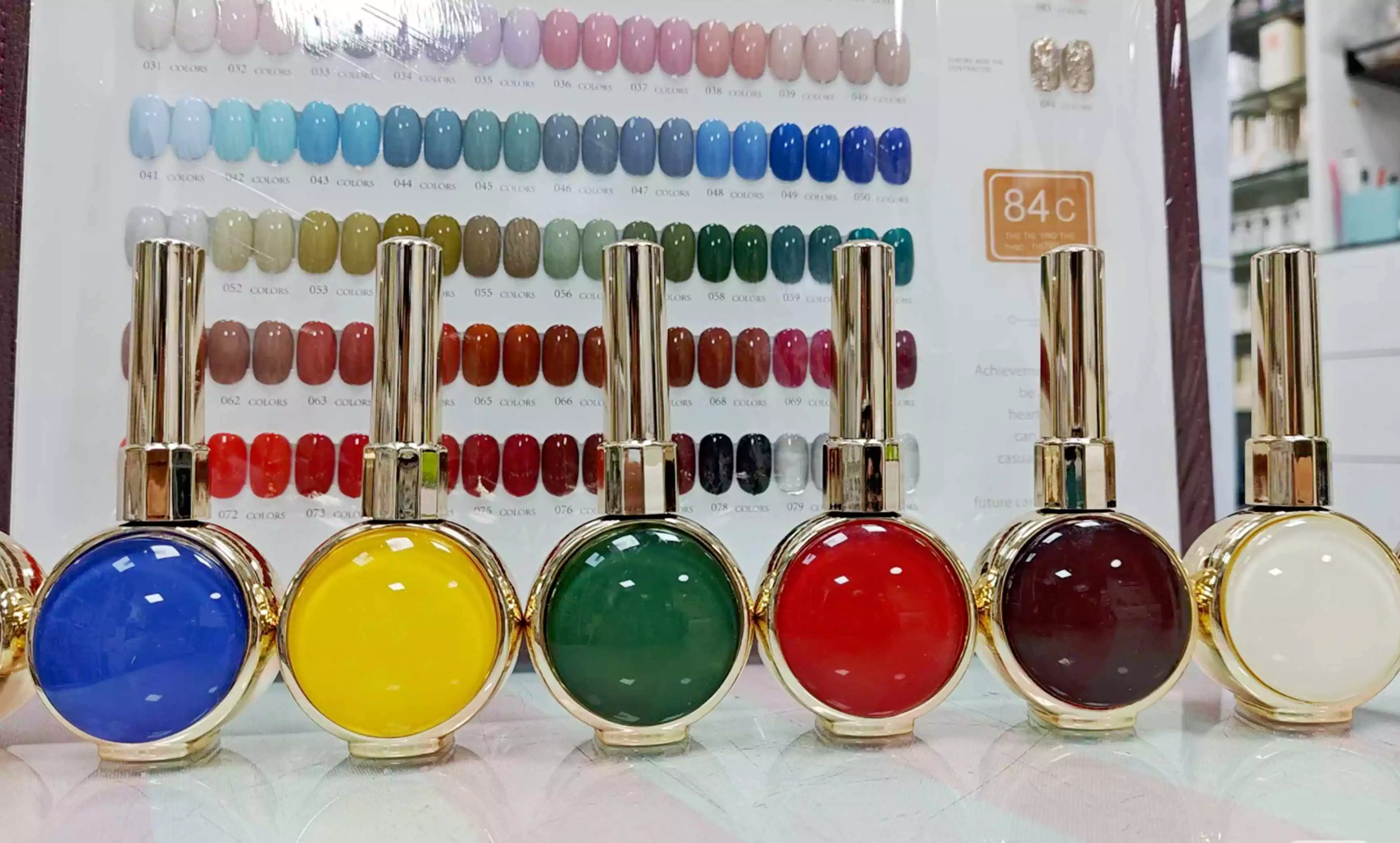
CHROMÉCLAIR offers Base coats, Top coats, solid color gelpolish zonder HEMAen hema free cat eye gel polish.
 05 Wat betekent bestand tegen oplosmiddelen in pigment?
 Op hun website staan ook nail art tutorials, zoals:
Hoe maak je de Metal 3D Floral Nail Art thuis?
Krijg een transparante French manicure zonder kristallen lijm!
Related product references: For formulation review or sourcing comparison, see CHLUMIAO HO-17/17EH.