
2025 Beberapa Masalah Teknis Mengenai Pigmen
Halo semuanya! Saya seorang karyawan bintang di CHROMÉCLAIR, sebuah merek dari cat kuku gel bebas hemaKali ini, saya akan menyusun beberapa pertanyaan dan jawaban teknis mengenai pigmen untuk pelapis, dengan harapan dapat membantu Anda.01 Bagaimana cara menghindari penggunaan pigmen timbal kromat dan timbal molibdat yang beracun tanpa mengorbankan warna cat?
Due to the toxicity of lead-containing pigments, countries are increasingly restricting their use in coatings. Formulators typically replace lead pigments with organic pigments combined with titanium dioxide. However, in certain applications, organic pigments blended with metal oxide hybrid pigments (inorganic composite colorants) demonstrate superior performance compared to titanium dioxide. The inherent vivid hues, high saturation, and excellent hiding power of metal oxide hybrid pigments offer formulators greater flexibility to reduce costly organic pigments in formulations, minimize or even eliminate titanium dioxide. For organic pigments, numerous options also demonstrate excellent hiding power and weather resistance, making them viable alternatives to lead-containing pigments. Red pigments include Pigment Red 48:4, Red 112, Red 170, Red 254, Red 255, Violet 19, etc. Orange pigments include Pigment Orange 36 and Orange 73, among others. Yellow pigments include Pigment Yellow 74, Yellow 109, Yellow 110, Yellow 139, Yellow 151, and Yellow 154. Particularly for yellow pigments, we recommend using Bismuth Vanadate Yellow (Pigment Yellow 184). Bismuth Vanadate Yellow is significantly brighter than the metal oxide blend pigment Titanium Nickel (Pigment Yellow 53), offering superior tinting strength, better hiding power (even eliminating the need for added titanium dioxide), and outstanding heat and weather resistance. Finally, it is worth noting that compared to lead-containing pigments, all the pigments mentioned above are considered safe and non-toxic as long as proper dust extraction equipment is used during production (inhaling pigment dust is harmful to human lungs).
02 Faktor-faktor apa saja yang memengaruhi flokulasi pigmen dalam sistem pelapisan?
Parameter-parameter berikut ini mempengaruhi flokulasi: Viskositas: Dalam kondisi viskositas rendah, partikel pigmen lebih mudah bergerak. Oleh karena itu, mengurangi viskositas sistem pelapisan akan mengurangi ukuran kluster flokulasi dan memperlambat laju flokulasi. Suhu: Efek suhu pada viskositas sangat jelas. Peningkatan suhu menyebabkan viskositas menurun, sehingga secara tidak langsung mengurangi flokulasi. Waktu mati lampu kilat (waktu pengeringan, interval antara aplikasi penyemprotan dua lapis basah-basah, atau waktu yang diperlukan untuk penguapan pelarut yang signifikan sebelum memasuki oven): Waktu flash-off yang terlalu lama juga dapat menyebabkan flokulasi pigmen yang signifikan. Titanium dioksida: Titanium dioksida yang tidak dilapisi menunjukkan kecenderungan yang kuat untuk berflokulasi. Ukuran partikel pigmen dan distribusi ukuran: Partikel pigmen yang lebih kecil menunjukkan mobilitas yang lebih besar di dalam sistem pelapisan, sehingga meningkatkan kemungkinan tabrakan dan flokulasi berikutnya. Namun, ini tidak mutlak. Ukuran partikel yang sangat halus dapat meningkatkan viskositas sistem secara keseluruhan, mengurangi pergerakan partikel dan mengurangi risiko flokulasi. Konsentrasi Pigmen (Titanium Dioksida dan Pigmen Pewarna): Meningkatkan konsentrasi pigmen akan meningkatkan viskositas sistem, mengurangi kecenderungan flokulasi. Binder: Molekul pengikat yang lebih kecil lebih mudah diserap ke permukaan pigmen. Namun demikian, karena volumenya yang lebih kecil, pengikat ini menciptakan lebih sedikit penghalang sterik di antara partikel pigmen, sehingga flokulasi lebih mungkin terjadi. Bersamaan dengan itu, struktur kimiawi pengikat juga memengaruhi flokulasi pigmen. Pelarut: Memilih pelarut yang tepat dan baik memungkinkan molekul polimer pengikat memanjang sepenuhnya, meningkatkan daya tolak-menolak antara partikel pigmen dan mencegah flokulasi. Pelarut yang buruk menyebabkan molekul polimer pengikat berkontraksi menjadi kelompok, mengurangi tolak-menolak sterik di antara partikel pigmen dan mendorong flokulasi. 03 Jenis biru ftalosianin apa yang dapat digunakan dalam industri pelapis?
Phthalocyanine blue primarily consists of copper phthalocyanine, featuring a complex chemical structure and appearing as a deep blue powder. It exhibits multiple crystalline forms, with three commercially available types: α-type phthalocyanine blue (Pigment Blue 15), which carries a red light and possesses the highest relative tinting strength; (Pigment Blue 15); β-type phthalocyanine blue (Pigment Blue 15:3), which exhibits a greenish hue and the best thermodynamic stability; and ε-type phthalocyanine blue (Pigment Blue 15:6), which possesses the most vivid reddish hue. In aromatic solvents (e.g., xylene), α-phthalocyanine blue converts to the more stable β-phthalocyanine blue. To prevent this transformation, a portion of monochlorocopper phthalocyanine is typically blended during the pigmentation process of crude phthalocyanine blue to form solvent-stable α-phthalocyanine blue or Pigment Blue 15:1.
Due to the nonpolar surface of phthalocyanine blue pigments, their interaction with binders in many coating systems is weak, leading to poor stability of the pigment dispersion. Coatings containing phthalocyanine blue pigments are prone to flocculation or separation during storage. This drawback is significantly improved by surface treatment and chemical modification of the solvent-stable Pigment Blue 15:1 molecules. The modified phthalocyanine blue pigment is designated as Pigment Blue 15:2 in the dye index.
In the coatings industry, α-type phthalocyanine blue with a red hue is preferred over β-type phthalocyanine blue with a green hue due to its vivid color, strong tinting strength, ease of dispersion, and excellent flow properties. Since flocculation occurs not only due to the pigment itself but also significantly relates to the binder and solvent in the coating system, it is impossible to identify a phthalocyanine blue variety that exhibits optimal anti-flocculation performance in every coating system. This requires coating professionals to determine the optimal formulation combinations through extensive experimentation tailored to different coating systems.
 03 Jenis biru ftalosianin apa yang dapat digunakan dalam industri pelapis?
04 Metode apa yang dapat digunakan untuk menilai dispersibilitas pigmen secara cepat?
Kami memiliki banyak metode langsung dan tidak langsung untuk mengevaluasi dispersi pigmen. Metode langsung meliputi uji pelat kehalusan, mikroskop optik, dan mikroskop elektron.
Uji Pelat Kehalusan:
Uji kehalusan Hegman adalah metode yang sederhana dan cepat untuk mengukur kehalusan bahan tanah dalam sistem cairan. Pelat kehalusan Hegman adalah pelat baja tahan karat persegi panjang yang memiliki dua alur dangkal yang dibuat secara presisi. Alur ini secara bertahap berkurang kedalamannya dari 100 mikron menjadi 0 mikron. Sejumlah kecil material tanah ditempatkan pada titik terdalam dari alur. Pengikis berbilah ganda dari baja tahan karat kemudian digunakan untuk mengikis seluruh permukaan dengan kecepatan yang seragam ke arah ujung dengan kedalaman alur nol. Kelulusan ditandai secara merata di sepanjang alur, menurun secara seragam dari nol pada titik terdalam ke kelulusan 8 atau 10 pada permukaan horizontal pelat kehalusan. Kelulusan di mana partikel pigmen pertama kali muncul sebagai titik-titik padat, yang secara jelas menonjol di atas permukaan material tanah, dianggap sebagai indikator untuk tingkat dispersi. Biasanya, kelulusan minimum 7 diperlukan untuk mengindikasikan dispersi yang efektif.
Metode Pengujian Kehalusan:
The use of an optical microscope provides a rapid method for visually assessing pigment particle size and fineness. It also allows observation of the pigment’s tinting strength.
Additionally, it enables examination of pigment particle morphology, size, distribution, and flocculation. The specific experimental procedure involves placing a small drop of ground material onto a microscope slide and covering it with a cover slip. Take care not to apply excessive pressure when covering the slide to prevent the material from spreading excessively, which could compromise the test results. The primary limitation of optical microscopy is its low resolution, with a minimum discernible size of approximately 2 micrometers.
Metode Pengujian Kehalusan Mikroskop Elektron:
The high resolution of the electron microscope is a major advantage, allowing direct observation of pigment particle size. Pigment particle size critically influences key coating properties such as transparency, flowability, and hue.
The main drawbacks of the electron microscope fineness testing method are the high cost of the equipment, the lengthy testing time, the requirement for experienced technicians to analyze and interpret the test data, and the necessity for samples to be completely dry before measurement.
 04 Metode apa yang dapat digunakan untuk menilai dispersibilitas pigmen secara cepat?
05 Apa yang dimaksud dengan ketahanan pelarut pigmen?
In paint production, we must uniformly and stably disperse pigments throughout most organic binders (composed of resins and solvents), meaning pigments must be surrounded by organic solvents. Furthermore, most paints colored with pigments inevitably come into frequent contact with organic solvents (cleaning agents, gasoline, lubricants, etc.) during their effective service life. Therefore, pigments must be as insoluble as possible in organic solvents. If complete insolubility cannot be achieved, we must recognize that pigment addition is limited in various organic solvents. Exceeding this tolerance level will cause bleeding due to pigment dissolution in the solvent. Essentially, pigment solvent resistance is the pigment’s ability to resist dissolution by solvents and prevent bleeding. Inorganic pigments (due to their inherent chemical structure) and certain complex organic synthetic pigments generally exhibit excellent solvent resistance. However, lower-grade organic pigments and surface-treated pigments typically demonstrate poorer solvent resistance. Solvents used to evaluate pigment solvent resistance include water, turpentine, toluene, xylene, methyl ethyl ketone, ethanol, ethyl acetate, diethylene glycol, and trichloroethylene.
That’s all for today! I hope this article helps you understand pigments more easily!
CHROMÉCLAIR offers Base coats, Top coats, solid color cat kuku gel tanpa HEMAdan cat kuku gel mata kucing bebas hema.
 05 Apa yang dimaksud dengan ketahanan pelarut pigmen?
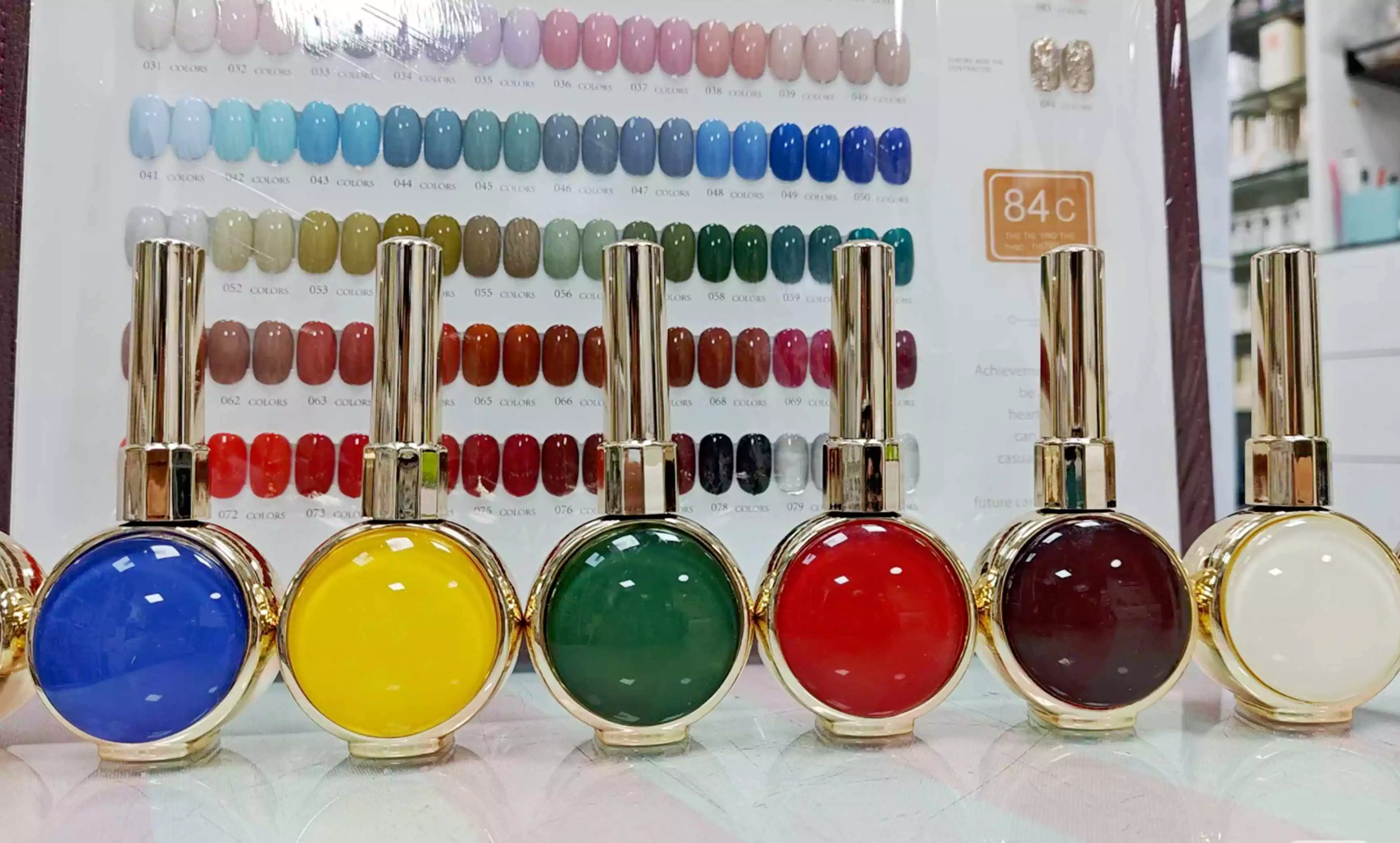 Situs web mereka juga menampilkan tutorial nail art, seperti:
Bagaimana Cara Membuat Seni Kuku Bunga 3D Logam di Rumah?
Dapatkan manikur Prancis yang tipis tanpa lem kristal!
Related product references: For formulation review or sourcing comparison, see CHLUMIAO HO-17/17EH.