
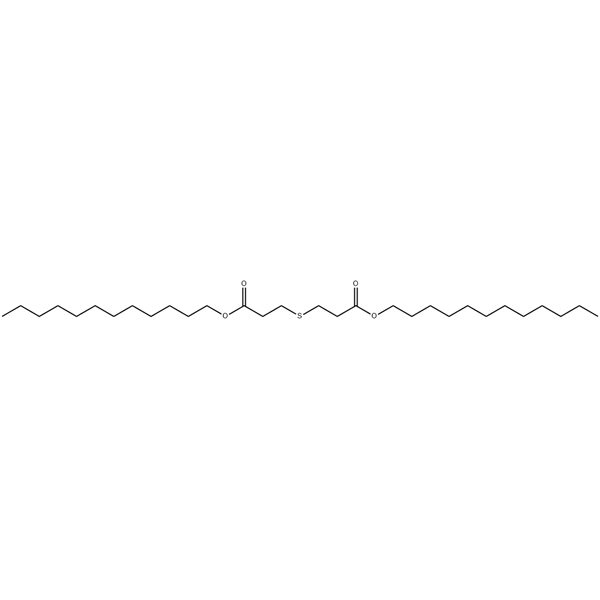

Description
CHLUMIAO® DLTDP / Dilauryl thiodipropionate CAS 123-28-4
| Item | Specifications |
| Appearance | White powder |
| Crystallization point ℃ | 39.5~41.5 |
| Volatile % | ≤0.05% |
| Ash % | ≤0.01% |
Application:
CHLUMIAO® DLTDP is an excellent auxiliary antioxidant, widely used in polypropylene, polyethylene, ABS, PBT and other synthetic materials, and can also be used in rubber processing and lubricating grease. This product is mostly used in combination with phenolic main antioxidants to produce a synergistic effect, which can greatly increase the antioxidant effect of the main antioxidant and improve the processing performance and service life of the product. Because of its low toxicity, it can be used to make food packaging films.
Storage:
Avoid exposure to the sun or high temperature storage, and should be stored in a cool, dry and ventilated place to prevent moisture, water, and heat.
Package:
Use carton lined with plastic bag, net weight of each box is 25kg
Other Name:
Lowinox DLTDP
Di Lauryl Thiodi Propionate
SONGNOX DLTDP
Contact Us Now!
If you need Price, please fill in your contact information in the form below, we will usually contact you within 24 hours. You could also email me info@changhongchemical.com during working hours ( 8:30 am to 6:00 pm UTC+8 Mon.~Sat. ) or use the website live chat to get prompt reply.
| Low Impurity Phosphites | ||
| CHLUMIAO® DPOP | CAS 15647-08-2 | 2-ethylhexyl diphenyl phosphite |
| CHLUMIAO® 8621 | CAS 68123-00-2 | Antioxidant 8621 |
| CHLUMIAO® DPDP | CAS 26544-23-0 | Antioxidant DPDP |
| CHLUMIAO® PDDP | CAS 25550-98-5 | Antioxidant PDDP |
| CHLUMIAO® PDOP | CAS 3164-60-1 | Antioxidant PDOP |
| CHLUMIAO® TPP | CAS 101-02-0 | Antioxidant TPP |
| CHLUMIAO® Poly(dicyclopentadiene-co-p-cresol) | CAS 68610-51-5 | Poly(dicyclopentadiene-co-p-cresol) |
| CHLUMIAO® SEED | CAS 42774-15-2 | Antioxidant SEED / Omnistab LS 5519 / Light Stabilizer 856 |
| Inhibited phenolic Antioxidants | ||
| CHLUMIAO® 264 | CAS 128-37-0 | Antioxidant 264 / Butylated hydroxytoluene |
| CHLUMIAO® 2,6-Di-tert-butylphenol | CAS 128-39-2 | 2,6-Di-tert-butylphenol |
| CHLUMIAO® 300 | CAS 96-69-5 | Irganox 300 / Antioxidant 300 |
| CHLUMIAO® 2246 | CAS 119-47-1 | Irganox 2246 / BNX 2246 |
| CHLUMIAO® 1222 | CAS 976-56-7 | Antioxidant 1222 / Irganox 1222 |
| CHLUMIAO® 702 | CAS 118-82-1 | Irganox 702 / Antioxidant 702 / Ethanox 702 |
| CHLUMIAO® DBHQ | CAS 88-58-4 | Antioxidant DTBHQ |
| CHLUMIAO® MTBHQ | CAS 1948-33-0 |
2-tert-butylhydroquinone |
| CHLUMIAO® 1076 | CAS 2082-79-3 | Irganox 1076 / Antioxidant 1076 |
| CHLUMIAO® 1010 | CAS 6683-19-8 | Irganox 1010 / Antioxidant 1010 |
| CHLUMIAO® 1330 | CAS 1709-70-2 | Irganox 1330 / Ethanox 330 |
| CHLUMIAO® 1520 | CAS 110553-27-0 | Irganox 1520 / Antioxidant 1520 |
| Phenol Free Phosphites Antioxidants | ||
| CHLUMIAO® 8608 | CAS 26544-27-4 | Antioxidant AO DPD / Everaox 202 |
| CHLUMIAO® 430 | CAS 36788-39-3 | Antioxidant 430 / WESTON 430 |
| CHLUMIAO® 8608T | CAS 1334238-11-7, 69439-68-5 | Antioxidant 8608T |
| CHLUMIAO® 8627 | CAS 68610-62-8 | Antioxidant 8627 |
| CHLUMIAO® TDP | CAS 25448-25-3 | Antioxidant TDP |
| CHLUMIAO® TLP | CAS 3076-63-9 | Antioxidant TLP |
| CHLUMIAO® TOP | CAS 301-13-3 | Antioxidant TOP |
| CHLUMIAO® TTDP | CAS 77745-66-5 | Antioxidant TTDP |
| Thiol esters Antioxidants | ||
| CHLUMIAO® DLTDP | CAS 123-28-4 | Dilauryl thiodipropionate |
| CHLUMIAO® DSTDP | CAS 693-36-7 | istearyl thiodipropionate/ Antioxidant DSTDP |
| Aminic Antioxidants | ||
| CHLUMIAO® 3114 | CAS 27676-62-6 | Irganox 3114 / Antioxidant 3114 |
| CHLUMIAO® 4,4′-biphenol | CAS 92-88-6 |
4,4′-biphenol |
| Metal deactivators Antioxidants | ||
| CHLUMIAO® 1098 | CAS 23128-74-7 | Irganox 1098 / Antioxidant 1098 |
Phenolic antioxidant coordination effect
1, synergistic effect
When two chain-terminating antioxidants such as hindered phenols and used, the high activity of the antioxidant gives hydrogen atoms, so that the free radicals are inactive; and low activity of the antioxidant can be for the high activity of the antioxidant supply of hydrogen atoms to regenerate it, so that the long-term effectiveness of the effectiveness of the antioxidant effect is better. Different spatial obstruction of the antioxidant when used in conjunction, but also inhibit the free radical transfer effect. For example, after the termination of peroxyl radicals (ROO・) by highly active hindered phenols, the aryloxyl radicals generated can easily trigger oxidative aging of macromolecules. The low activity hindered phenol can make the aryloxyl radicals to generate the high activity hindered phenol, thus avoiding the chain transfer effect caused by the interaction of aryloxyl radicals and macromolecules.
Hindered phenol and hydroperoxide decomposer and use, on the one hand, can make the main antioxidant regeneration, on the other hand, can decompose hydroperoxide, synergistic effect is stronger, is the current plastics antioxidant is often used in the ‘golden partner’, such as antioxidant 1010 and antioxidant 168 of the use of the antioxidant. The same molecule with two or more different stabilisation mechanisms and the synergistic reaction, known as self-synergistic effect. For example, the antioxidant 300 and the antioxidant 2246-S, simultaneously function as primary and secondary antioxidants.
In addition, the main antioxidant and ultraviolet absorber, metal ion passivator may also produce synergistic effect. Composite stabiliser of the main antioxidant for phenolic antioxidants, such as antioxidant 1010, antioxidant 1076, antioxidant 264, etc., the secondary antioxidant for the phosphite, antioxidant 168, the mainstream composite antioxidant varieties on the market are mostly imported products.
2, against the effect
Two kinds of antioxidants and with each other to weaken their beneficial effects, there is a confrontation effect, such as amines and phenolic antioxidants on polyethylene plastics is the main antioxidant is effective, carbon black is also very effective antioxidant, but when amines or hindered phenolic antioxidants added to the polyethylene containing carbon black, the two are not only no synergistic effect, but rather than the original stability of their respective effects are worse, that is, the antagonistic effect is produced. This antagonistic effect is not only related to the type of antioxidant, but also with the resin varieties also have a relationship, such as in ABS plastics and carbon black and hindered phenol, not only no antagonistic effect, but also showed a greater synergistic effect.
3, strong oxidation effect
When the concentration of antioxidant in the polymer system exceeds a certain value, the antioxidant directly with the molecular oxygen reaction increased, antioxidant molecules are prone to the formation of new free radicals and produce a strengthened oxidation reaction. Therefore, the general use of antioxidants have a critical concentration of the best use of the concentration range, otherwise the dosage is too much instead of producing a strengthened oxidation reaction, thereby accelerating the aging of polymers.



Henry Cooper –
Outstanding service, quick responses, seamless logistics, wonderful shopping!