

Beschreibung
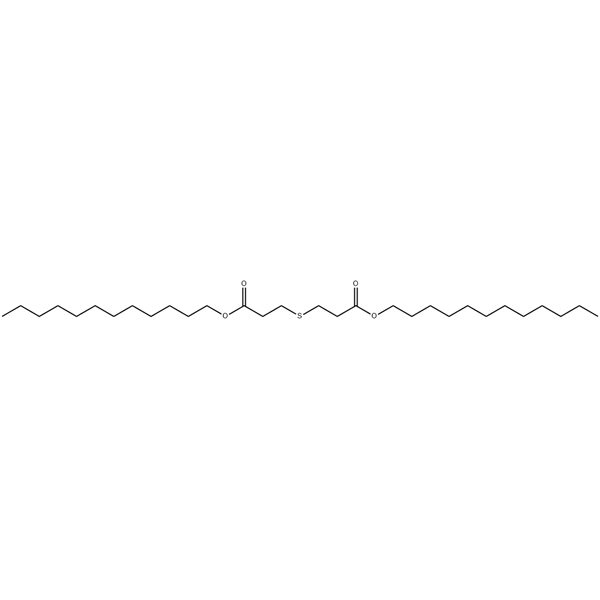
CHLUMIAO® DLTDP / Dilaurylthiodipropionat CAS 123-28-4
| Artikel | Spezifikationen |
| Erscheinungsbild | Weißes Pulver |
| Kristallisationspunkt ℃ | 39.5~41.5 |
| Flüchtig % | ≤0,05% |
| Esche % | ≤0,01% |
Anwendung:
CHLUMIAO® DLTDP ist ein ausgezeichnetes Hilfsantioxidans, das in Polypropylen, Polyethylen, ABS, PBT und anderen Kunststoffen weit verbreitet ist und auch in der Gummiverarbeitung und in Schmierfetten eingesetzt werden kann. Dieses Produkt wird meist in Kombination mit phenolischen Hauptantioxidantien verwendet, um einen Synergieeffekt zu erzielen, der die antioxidative Wirkung des Hauptantioxidans erheblich steigern und die Verarbeitungsleistung und Lebensdauer des Produkts verbessern kann. Aufgrund seiner geringen Toxizität kann es zur Herstellung von Lebensmittelverpackungsfolien verwendet werden.
Lagerung:
Vermeiden Sie es, das Produkt der Sonne auszusetzen oder es bei hohen Temperaturen zu lagern, und bewahren Sie es an einem kühlen, trockenen und belüfteten Ort auf, um Feuchtigkeit, Wasser und Hitze zu vermeiden.
Paket:
Verwenden Sie einen mit einer Plastiktüte ausgekleideten Karton, das Nettogewicht eines jeden Kartons beträgt 25 kg.
Anderer Name:
Lowinox DLTDP
Di Lauryl Thiodi Propionat
SONGNOX DLTDP
Kontaktieren Sie uns jetzt!
Wenn Sie einen Preis benötigen, tragen Sie bitte Ihre Kontaktdaten in das unten stehende Formular ein. Wir werden uns in der Regel innerhalb von 24 Stunden mit Ihnen in Verbindung setzen. Sie können mir auch mailen info@changhongchemical.com während der Geschäftszeiten ( 8:30 bis 18:00 Uhr UTC+8 Mo.~Sa. ) oder nutzen Sie den Live-Chat auf der Website, um eine schnelle Antwort zu erhalten.
| Phosphite mit geringer Verunreinigung | ||
| CHLUMIAO® DPOP | CAS 15647-08-2 | 2-Ethylhexyl-Diphenylphosphit |
| CHLUMIAO® 8621 | CAS 68123-00-2 | Antioxidationsmittel 8621 |
| CHLUMIAO® DPDP | CAS 26544-23-0 | Antioxidationsmittel DPDP |
| CHLUMIAO® PDDP | CAS 25550-98-5 | Antioxidationsmittel PDDP |
| CHLUMIAO® PDOP | CAS 3164-60-1 | Antioxidationsmittel PDOP |
| CHLUMIAO® TPP | CAS 101-02-0 | Antioxidationsmittel TPP |
| CHLUMIAO® Poly(dicyclopentadien-co-p-cresol) | CAS 68610-51-5 | Poly(dicyclopentadien-co-p-cresol) |
| CHLUMIAO® SEED | CAS 42774-15-2 | Antioxidationsmittel SEED / Omnistab LS 5519 / Lichtstabilisator 856 |
| Hemmende phenolische Antioxidantien | ||
| CHLUMIAO® 264 | CAS 128-37-0 | Antioxidationsmittel 264 / Butyliertes Hydroxytoluol |
| CHLUMIAO® 2,6-Di-tert-Butylphenol | CAS 128-39-2 | 2,6-Di-tert-Butylphenol |
| CHLUMIAO® 300 | CAS 96-69-5 | Irganox 300 / Antioxidationsmittel 300 |
| CHLUMIAO® 2246 | CAS-NR. 119-47-1 | Irganox 2246 / BNX 2246 |
| CHLUMIAO® 1222 | CAS 976-56-7 | Antioxidationsmittel 1222 / Irganox 1222 |
| CHLUMIAO® 702 | CAS-NR. 118-82-1 | Irganox 702 / Antioxidationsmittel 702 / Ethanox 702 |
| CHLUMIAO® DBHQ | CAS 88-58-4 | Antioxidationsmittel DTBHQ |
| CHLUMIAO® MTBHQ | CAS 1948-33-0 |
2-tert-Butylhydrochinon |
| CHLUMIAO® 1076 | CAS 2082-79-3 | Irganox 1076 / Antioxidationsmittel 1076 |
| CHLUMIAO® 1010 | CAS 6683-19-8 | Irganox 1010 / Antioxidationsmittel 1010 |
| CHLUMIAO® 1330 | CAS 1709-70-2 | Irganox 1330 / Ethanox 330 |
| CHLUMIAO® 1520 | CAS 110553-27-0 | Irganox 1520 / Antioxidationsmittel 1520 |
| Phenolfreie Phosphite Antioxidantien | ||
| CHLUMIAO® 8608 | CAS 26544-27-4 | Antioxidationsmittel AO DPD / Everaox 202 |
| CHLUMIAO® 430 | CAS 36788-39-3 | Antioxidationsmittel 430 / WESTON 430 |
| CHLUMIAO® 8608T | CAS 1334238-11-7, 69439-68-5 | Antioxidationsmittel 8608T |
| CHLUMIAO® 8627 | CAS 68610-62-8 | Antioxidationsmittel 8627 |
| CHLUMIAO® TDP | CAS 25448-25-3 | Antioxidationsmittel TDP |
| CHLUMIAO® TLP | CAS 3076-63-9 | Antioxidationsmittel TLP |
| CHLUMIAO® TOP | CAS 301-13-3 | Antioxidans TOP |
| CHLUMIAO® TTDP | CAS 77745-66-5 | Antioxidationsmittel TTDP |
| Thiol-Ester Antioxidantien | ||
| CHLUMIAO® DLTDP | CAS-NR. 123-28-4 | Dilauryl-Thiodipropionat |
| CHLUMIAO® DSTDP | CAS 693-36-7 | Istearylthiodipropionat/ Antioxidationsmittel DSTDP |
| Aminische Antioxidantien | ||
| CHLUMIAO® 3114 | CAS 27676-62-6 | Irganox 3114 / Antioxidationsmittel 3114 |
| CHLUMIAO® 4,4′-Biphenol | CAS 92-88-6 |
4,4′-Biphenol |
| Metalldeaktivatoren Antioxidantien | ||
| CHLUMIAO® 1098 | CAS 23128-74-7 | Irganox 1098 / Antioxidationsmittel 1098 |
Phenolische antioxidative Koordinationswirkung
1, synergistische Wirkung
Wenn zwei kettenabschließende Antioxidantien wie gehinderte Phenole und verwendet, die hohe Aktivität des Antioxidans gibt Wasserstoffatome, so dass die freien Radikale inaktiv sind; und geringe Aktivität des Antioxidans kann für die hohe Aktivität des Antioxidans Versorgung mit Wasserstoffatomen zu regenerieren, so dass die langfristige Wirksamkeit der Wirksamkeit des Antioxidans Wirkung ist besser. Verschiedene räumliche Behinderung des Antioxidans, wenn in Verbindung verwendet, sondern auch hemmen die freie Radikale übertragen Wirkung. Zum Beispiel können nach der Beendigung von Peroxylradikalen (ROO・) durch hochaktive gehinderte Phenole die erzeugten Aryloxylradikale leicht die oxidative Alterung von Makromolekülen auslösen. Das niedrigaktive gehinderte Phenol kann die Aryloxylradikale dazu bringen, das hochaktive gehinderte Phenol zu erzeugen, wodurch der Kettentransfereffekt vermieden wird, der durch die Wechselwirkung von Aryloxylradikalen und Makromolekülen verursacht wird.
Gehindert Phenol und Hydroperoxid Zersetzer und Verwendung, auf der einen Seite, kann die wichtigsten Antioxidans Regeneration, auf der anderen Seite, kann Hydroperoxid zersetzen, synergistische Wirkung ist stärker, ist die aktuelle Kunststoff-Antioxidans wird oft in der "goldenen Partner", wie Antioxidans 1010 und Antioxidans 168 der Verwendung des Antioxidans. Das gleiche Molekül mit zwei oder mehr verschiedenen Stabilisierungsmechanismen und die synergistische Reaktion, bekannt als selbst-synergistischer Effekt. Zum Beispiel wirken das Antioxidans 300 und das Antioxidans 2246-S gleichzeitig als primäre und sekundäre Antioxidantien.
Darüber hinaus können das Hauptantioxidans und der Ultraviolettabsorber, der Metallionenpassivator auch eine synergistische Wirkung haben. Composite-Stabilisator der wichtigsten Antioxidans für phenolische Antioxidantien, wie Antioxidans 1010, Antioxidans 1076, Antioxidans 264, etc., die sekundäre Antioxidans für die Phosphit, Antioxidans 168, die Mainstream-Composite-Antioxidans Sorten auf dem Markt sind meist importierte Produkte.
2, gegen die Wirkung
Zwei Arten von Antioxidantien und mit einander zu schwächen ihre positive Wirkung, gibt es eine Konfrontation Wirkung, wie Amine und phenolische Antioxidantien auf Polyethylen-Kunststoffe ist die wichtigste Antioxidans wirksam ist, Ruß ist auch sehr wirksam Antioxidans, aber wenn Amine oder gehindert phenolischen Antioxidantien hinzugefügt, um die Polyethylen mit Ruß, die beiden sind nicht nur keine synergistische Wirkung, sondern als die ursprüngliche Stabilität der jeweiligen Effekte sind schlechter, das heißt, die antagonistische Wirkung erzeugt wird. Diese antagonistische Wirkung ist nicht nur im Zusammenhang mit der Art der Antioxidantien, sondern auch mit dem Harz Sorten haben auch eine Beziehung, wie in ABS-Kunststoffe und Ruß und gehindert Phenol, nicht nur keine antagonistische Wirkung, sondern zeigte auch eine größere synergistische Wirkung.
3, starke Oxidationswirkung
Wenn die Konzentration von Antioxidantien in der Polymer-System einen bestimmten Wert überschreitet, das Antioxidans direkt mit dem molekularen Sauerstoff Reaktion erhöht, Antioxidans Moleküle sind anfällig für die Bildung neuer freier Radikale und produzieren eine verstärkte Oxidationsreaktion. Daher ist die allgemeine Verwendung von Antioxidantien haben eine kritische Konzentration der besten Nutzung des Konzentrationsbereichs, da sonst die Dosierung ist zu viel, anstatt eine verstärkte Oxidationsreaktion, wodurch die Alterung von Polymeren beschleunigt.


Henry Cooper -
Hervorragender Service, schnelle Antworten, reibungslose Logistik, wunderbarer Einkauf!