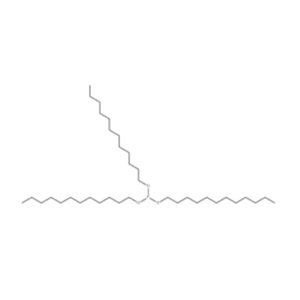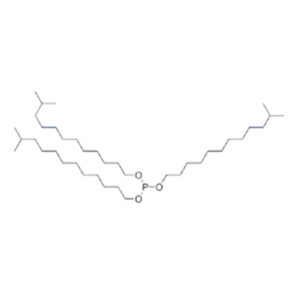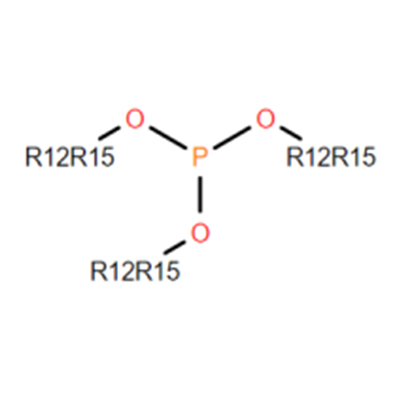
CHLUMIAO®8627 CAS 68610-62-8

Tri (C12-15 alkyl) phosphite

No CAS : 68610-62-8

Poids moléculaire : 608

Instructions relatives à la candidature

Antioxydant phénolique et écologique à base de trialkane phosphite, exempt de phénol, d'octylphénol, de nonylphénol et de bisphénol A. Il peut être largement appliqué aux polymères tels que le PVC, le LLDPE, le HDPE, l'ABS, le SBS et le polyuréthane, offrant une excellente stabilité thermique et une bonne stabilité de la couleur. En tant que stabilisateur auxiliaire et agent chélateur efficace, il peut être utilisé dans les matériaux en PVC (tels que les stabilisateurs en PVC, les feuilles/matériaux façonnés en PVC, les revêtements de sol en PVC, etc.), améliorant efficacement leur stabilité thermique et leur stabilité à la lumière, et maintenant la stabilité de la couleur et la transparence des produits. Il peut également être utilisé dans diverses encres telles que le SBR, le NBR, le SBS et le polyuréthane.
Dans les polymères, améliore la résistance à la chaleur des produits. Quantité d'ajout suggérée : 0,1-2,0%

Description

Indice de qualité

Aspect du produit : Liquide incolore et transparent
Chromaticité (APHA) : ≤50
Indice d'acidité (mgKOH/g) : ≤0,1
Indice de réfraction (25℃) : -
Teneur en phénol wt% : N.D.

Caractéristiques de l'emballage

Tambour en fer de 170 kg

Application

PVC, LLDPE, HDPE, ABS, SBS, PU, SBR, CR

Contactez-nous dès maintenant !

Si vous avez besoin de Price, veuillez indiquer vos coordonnées dans le formulaire ci-dessous. Nous vous contacterons généralement dans les 24 heures. Vous pouvez également m'envoyer un courriel info@changhongchemical.com pendant les heures de travail ( 8:30 am to 6:00 pm UTC+8 Mon.~Sat. ) ou utilisez le chat en direct du site web pour obtenir une réponse rapide.


Phosphites à faible degré d'impureté
CHLUMIAO® DPOP CAS 15647-08-2 Phosphite de 2-éthylhexyle et de diphényle
CHLUMIAO® 8621 CAS 68123-00-2 Antioxydant 8621
CHLUMIAO® DPDP CAS 26544-23-0 Antioxydant DPDP
CHLUMIAO® PDDP CAS 25550-98-5 Antioxydant PDDP
CHLUMIAO® PDOP CAS 3164-60-1 Antioxydant PDOP
CHLUMIAO® TPP CAS 101-02-0 Antioxydant TPP
CHLUMIAO® Poly(dicyclopentadiène-co-p-crésol) CAS 68610-51-5 Poly(dicyclopentadiène-co-p-crésol)
CHLUMIAO® SEED CAS 42774-15-2 Antioxydant SEED / Omnistab LS 5519 / Stabilisateur de lumière 856
Antioxydants phénoliques inhibés
CHLUMIAO® 264 CAS 128-37-0 Antioxydant 264 / Butylhydroxytoluène
CHLUMIAO® 2,6-Di-tert-butylphénol CAS 128-39-2 2,6-Di-tert-butylphénol
CHLUMIAO® 300 CAS 96-69-5 Irganox 300 / Antioxydant 300
CHLUMIAO® 2246 CAS 119-47-1 Irganox 2246 / BNX 2246
CHLUMIAO® 1222 CAS 976-56-7 Antioxydant 1222 / Irganox 1222
CHLUMIAO® 702 CAS 118-82-1 Irganox 702 / Antioxydant 702 / Ethanox 702
CHLUMIAO® DBHQ CAS 88-58-4 Antioxydant DTBHQ
CHLUMIAO® MTBHQ CAS 1948-33-0 2-tert-butylhydroquinone聽 Qualité industrielle
CHLUMIAO® 1076 CAS 2082-79-3 Irganox 1076 / Antioxydant 1076
CHLUMIAO® 1010 CAS 6683-19-8 Irganox 1010 / Antioxydant 1010
CHLUMIAO® 1330 CAS 1709-70-2 Irganox 1330 / Ethanox 330
CHLUMIAO® 1520 CAS 110553-27-0 Irganox 1520 / Antioxydant 1520
Phosphites sans phénol Antioxydants
CHLUMIAO® 8608 CAS 26544-27-4 Antioxydant AO DPD / Everaox 202
CHLUMIAO® 430 CAS 36788-39-3 Antioxydant 430 / WESTON 430
CHLUMIAO® 8608T CAS 1334238-11-7, 69439-68-5 Antioxydant 8608T
CHLUMIAO® 8627 CAS 68610-62-8 Antioxydant 8627
CHLUMIAO® TDP CAS 25448-25-3 Antioxydant TDP
CHLUMIAO® TLP CAS 3076-63-9 Antioxydant TLP
CHLUMIAO® TOP CAS 301-13-3 Antioxydant TOP
CHLUMIAO® TTDP CAS 77745-66-5 Antioxydant TTDP
Esters thioliques Antioxydants
CHLUMIAO® DLTDP CAS 123-28-4 Thiodipropionate de dilauryle
CHLUMIAO® DSTDP CAS 693-36-7 istearyl thiodipropionate/ Antioxydant DSTDP
Antioxydants aminiques
CHLUMIAO® 3114 CAS 27676-62-6 Irganox 3114 / Antioxydant 3114
CHLUMIAO® 4,4′-biphénol CAS 92-88-6

4,4′-biphénol

Désactivateurs de métaux Antioxydants
CHLUMIAO® 1098 CAS 23128-74-7 Irganox 1098 / Antioxydant 1098

Antioxidants 8627 Application scenarios

1. Polyolefin Processing and Products:

Used in the production of PP and PE (LDPE, LLDPE, HDPE) films, fibers, injection molded parts, pipes, etc. It inhibits thermo-oxidative degradation during processing and use, prevents yellowing and embrittlement, and improves long-term mechanical properties and weather resistance. It is particularly effective in PP fibers and HDPE pressure pipes, with a typical addition level of 0.1% – 0.5%.

2. PVC Stabilization System:

Suitable for rigid PVC (door and window profiles, building panels) and flexible PVC (cable sheaths, films). Often compounded with metal stabilizers such as calcium and zinc, it inhibits thermal degradation during processing, improves initial color and long-term weather resistance, leaves no phenol residue, and meets environmental stabilization system requirements. The addition level is approximately 0.3% – 0.6%.

3. Engineering Plastics and Alloys:

Applied to engineering plastics and alloys such as ABS, PC, PA, and PBT, it prevents thermal degradation during high-temperature processing, improves thermal stability and long-term durability, and is suitable for electronic and electrical enclosures, automotive parts, etc. When combined with UV absorbers, it can enhance outdoor weather resistance.

4. Rubber Industry:

Used in rubber products such as SBR, NBR, and CR (tires, seals, hoses), it delays thermo-oxidative aging, protects the elasticity and mechanical properties of rubber, and reduces performance degradation during high temperatures and long-term use. Its effect is even better when combined with commonly used rubber antioxidants.

5. Coatings, Inks, and Adhesives:

Suitable for solvent-based, water-based, and high-solids coatings, inks, and high-temperature curing adhesives, it prevents oxidation, yellowing, loss of gloss, thickening, and performance degradation in the system. It is especially suitable for outdoor architectural coatings, automotive coatings, billboard inks, and other applications requiring high weather resistance.

6. Lubricating Oils and Greases:

As an extreme pressure anti-wear and antioxidant additive in industrial lubricating oils and greases, it can decompose hydroperoxides, chelate metal ions, and synergistically improve the thermal stability, anti-wear properties, and service life of the oil with sulfurized olefins, making it suitable for high-temperature and high-load conditions.

7. Biodegradable Materials and Specialty Plastics:

Used in biodegradable plastics such as PLA, it can improve heat distortion temperature and processing stability, and reduce degradation; it can also be used in epoxy resin encapsulation materials, and when compounded with magnesium hydroxide, it can act as a flame retardant synergist to improve flame retardant properties.

8. Sealants and Composite Materials:

Used in building sealants (doors, windows, curtain walls, roof waterproofing, etc.), it inhibits aging caused by ultraviolet rays, moisture, and high temperatures, maintaining sealing performance; it can also be used in composite materials to ensure thermal and oxygen stability and color retention during processing and use.

Contact US

French