
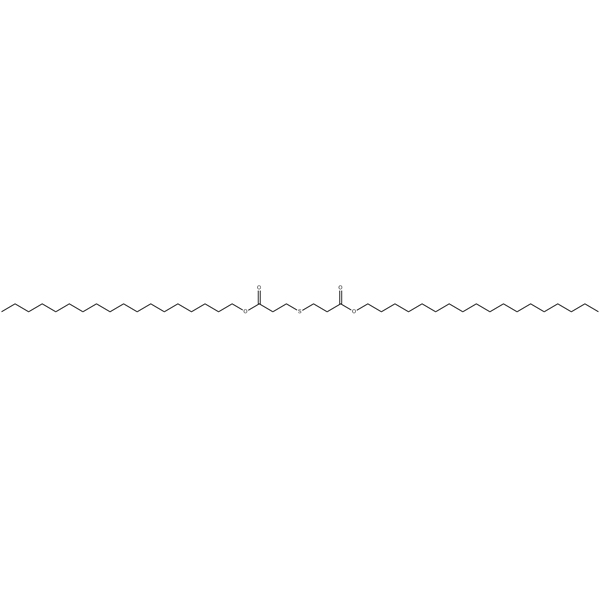

Description
Lcanox®DSTDP is a kind of thioester auxiliary antioxidant with excellent performance. Its antioxidant effect is higher than Lcanox®DLTDP, low volatility, low thermal processing loss, no pollution and no coloring. It has a synergistic effect when used together with the main antioxidants CHLUMIAO® 1010 and CHLUMIAO® 1076,Lcanox® CA, etc. It is widely used in petroleum products such as polyethylene, polypropylene, ABS resin, and the general dosage is 0.1% to 1.0%.
| Item | Specifications |
| Appearance | White powder |
| Melting point ℃ | 63.5~68.5 |
| Volatile % | ≤0.05% |
| Ash % | ≤0.01% |
Application:
Lcanox®DSTDP is a kind of thioester auxiliary antioxidant with excellent performance. Its antioxidant effect is higher than Lcanox®DLTDP, low volatility, low thermal processing loss, no pollution and no coloring. It has a synergistic effect when used together with the main antioxidants CHLUMIAO® 1010 and CHLUMIAO® 1076,Lcanox® CA, etc. It is widely used in petroleum products such as polyethylene, polypropylene, ABS resin, and the general dosage is 0.1% to 1.0%.
Storage:
Avoid exposure to the sun or high temperature storage, and should be stored in a cool, dry and ventilated place to prevent moisture, water, and heat.
Package:
Use carton lined with plastic bag, net weight of each box is 25kg
Other Name:
Advastab 802;
Arbestab DSTDP;
Cyanox STDP;
Naugard DSTDP;
Plastanox STDP;
Hostanox SE 2;
Irganox PS 802;
Contact Us Now!
If you need Price, please fill in your contact information in the form below, we will usually contact you within 24 hours. You could also email me info@changhongchemical.com during working hours ( 8:30 am to 6:00 pm UTC+8 Mon.~Sat. ) or use the website live chat to get prompt reply.
| Low Impurity Phosphites | ||
| CHLUMIAO® DPOP | CAS 15647-08-2 | 2-ethylhexyl diphenyl phosphite |
| CHLUMIAO® 8621 | CAS 68123-00-2 | Antioxidant 8621 |
| CHLUMIAO® DPDP | CAS 26544-23-0 | Antioxidant DPDP |
| CHLUMIAO® PDDP | CAS 25550-98-5 | Antioxidant PDDP |
| CHLUMIAO® PDOP | CAS 3164-60-1 | Antioxidant PDOP |
| CHLUMIAO® TPP | CAS 101-02-0 | Antioxidant TPP |
| CHLUMIAO® Poly(dicyclopentadiene-co-p-cresol) | CAS 68610-51-5 | Poly(dicyclopentadiene-co-p-cresol) |
| CHLUMIAO® SEED | CAS 42774-15-2 | Antioxidant SEED / Omnistab LS 5519 / Light Stabilizer 856 |
| Inhibited phenolic Antioxidants | ||
| CHLUMIAO® 264 | CAS 128-37-0 | Antioxidant 264 / Butylated hydroxytoluene |
| CHLUMIAO® 2,6-Di-tert-butylphenol | CAS 128-39-2 | 2,6-Di-tert-butylphenol |
| CHLUMIAO® 300 | CAS 96-69-5 | Irganox 300 / Antioxidant 300 |
| CHLUMIAO® 2246 | CAS 119-47-1 | Irganox 2246 / BNX 2246 |
| CHLUMIAO® 1222 | CAS 976-56-7 | Antioxidant 1222 / Irganox 1222 |
| CHLUMIAO® 702 | CAS 118-82-1 | Irganox 702 / Antioxidant 702 / Ethanox 702 |
| CHLUMIAO® DBHQ | CAS 88-58-4 | Antioxidant DTBHQ |
| CHLUMIAO® MTBHQ | CAS 1948-33-0 |
2-tert-butylhydroquinone |
| CHLUMIAO® 1076 | CAS 2082-79-3 | Irganox 1076 / Antioxidant 1076 |
| CHLUMIAO® 1010 | CAS 6683-19-8 | Irganox 1010 / Antioxidant 1010 |
| CHLUMIAO® 1330 | CAS 1709-70-2 | Irganox 1330 / Ethanox 330 |
| CHLUMIAO® 1520 | CAS 110553-27-0 | Irganox 1520 / Antioxidant 1520 |
| Phenol Free Phosphites Antioxidants | ||
| CHLUMIAO® 8608 | CAS 26544-27-4 | Antioxidant AO DPD / Everaox 202 |
| CHLUMIAO® 430 | CAS 36788-39-3 | Antioxidant 430 / WESTON 430 |
| CHLUMIAO® 8608T | CAS 1334238-11-7, 69439-68-5 | Antioxidant 8608T |
| CHLUMIAO® 8627 | CAS 68610-62-8 | Antioxidant 8627 |
| CHLUMIAO® TDP | CAS 25448-25-3 | Antioxidant TDP |
| CHLUMIAO® TLP | CAS 3076-63-9 | Antioxidant TLP |
| CHLUMIAO® TOP | CAS 301-13-3 | Antioxidant TOP |
| CHLUMIAO® TTDP | CAS 77745-66-5 | Antioxidant TTDP |
| Thiol esters Antioxidants | ||
| CHLUMIAO® DLTDP | CAS 123-28-4 | Dilauryl thiodipropionate |
| CHLUMIAO® DSTDP | CAS 693-36-7 | istearyl thiodipropionate/ Antioxidant DSTDP |
| Aminic Antioxidants | ||
| CHLUMIAO® 3114 | CAS 27676-62-6 | Irganox 3114 / Antioxidant 3114 |
| CHLUMIAO® 4,4′-biphenol | CAS 92-88-6 |
4,4′-biphenol |
| Metal deactivators Antioxidants | ||
| CHLUMIAO® 1098 | CAS 23128-74-7 | Irganox 1098 / Antioxidant 1098 |
When we come into contact with plastics or other polymers, we often hear about antioxidants. Perhaps also probably understand that the addition of antioxidants is to antioxidant, anti-aging, but may be a large majority of friends still do not understand the mechanism. Today, we will learn to learn the causes of aging of polymer materials, the mechanism and its solution.
What is oxidation?
Professional explanation: oxidation (oxidation), narrowly defined as the chemical reaction between oxygen and other material elements, is also an important chemical unit process. Broadly speaking, oxidation refers to the process in which a substance loses electrons (the oxidation number rises).
Common explanation: yellowing, aging, hardening, brittleness, softening, dullness, rusting and other phenomena caused by wind, sun and rain, oxygen in the air, hydrodynamic and wind erosion can be roughly categorised as oxidation.
The best example is the phenomenon of a cut apple, exposed to the air for some time, gradually turning yellow. In fact, not only apples will oxidise, our skin will also oxidise, plastic products and polymers will oxidise and age! Aging is a common process in nature, the most common around us is life from birth, growth, aging process, is the most typical of an aging process.
Corrosion of metal materials is also a kind of aging, from shiny objects into rust, until the loss of value.
The same goes for polymers. During processing and use, due to the combined effects of heat, oxygen, water, light, microorganisms, chemical media and other environmental factors, the chemical composition and structure of polymers undergo a series of changes, and their physical properties deteriorate accordingly, such as hardening, sticking, brittleness, discolouration, loss of strength, and so on, which are known as aging.
Molecular polymer aging, what will produce bad?
1, reduce mechanical properties
2, discolouration
3, reduce transparency
4, yellowing, aging
5, cracking
6, odour (alcohols, aldehydes, ketones)
—–
Polymer aging, what factors are at fault?
1, the structure of the polymer: double bond, benzene ring is not stable enough structure, easily lead to polymer decomposition, yellowing
2, polymer synthesis of residual impurities: peroxide, metal ions lead to polymer degradation, yellowing
3、Oxygen (air): the presence of oxygen, ozone caused by the decomposition of polymer
4, energy: mechanical stress, heat, ultraviolet light
5、Air pollution: NOx, SOx.
6, water, moisture: may lead to dissolution, precipitation of biological: degradation caused by biological enzymes
Why do polymers age?
Polymers form excited state molecules in the presence of heat or light. When the energy is high enough, the molecular chains break to form free radicals, which can form chain reactions within the polymer that continue to initiate degradation and may also cause cross-linking. The Culprit: Free Radicals R-
If oxygen or ozone is present in the environment, a series of oxidation reactions are also induced, resulting in the formation of hydroperoxides (ROOH), which further decompose into carbonyl groups.
If residual catalyst metal ions are present in the polymer, or if metal ions such as copper, iron, manganese, cobalt, etc., are brought in during processing or use, the oxidative degradation reaction of the polymer will be accelerated. Polymers protect against ageing.
Therefore, antioxidants have become a life-saving elixir for the materials industry!
To prevent polymer aging, you can isolate light and heat, and most importantly, add antioxidants! So here’s the point! Where to find efficient, genuine, good quality antioxidants?


Charlotte West –
Excellent service, rapid replies, hassle-free logistics, delightful shopping!