
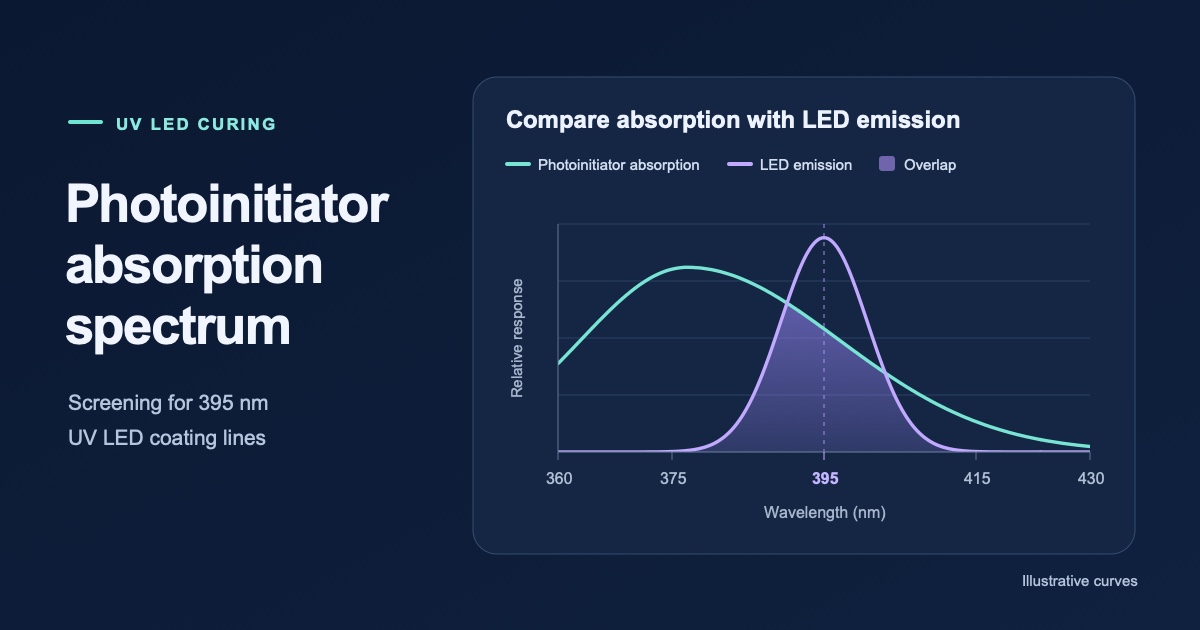
A photoinitiator absorption spectrum helps you decide whether a sample is worth testing on a 395 nm UV LED line. Compare the spectrum with your lamp’s emission band, then test the candidate beside your current grade in the same coating. Check both at your normal line speed and at the fastest speed your process already runs.
Check the overlap around 395 nm
Ask for the full UV–Vis curve for the grade you’ll receive. A datasheet may list only the wavelength of maximum absorption. The useful part for your line is the absorption across the wavelengths your lamp emits. Check the curve’s units, solvent, concentration, and optical path length before comparing it with another supplier’s chart. Two curves normalized to their own peaks can show where each material absorbs, but their heights do not tell you which absorbs more. UV LED wavelength technical article
Check whether the candidate dissolves or disperses in your formulation as intended. In one published study, researchers measured the absorption spectra in acetonitrile and ran a separate 395 nm cure test in a model acrylate. BAPO appeared in the spectrum comparison but was left out of that cure comparison because it did not fully dissolve at the test loading. If you receive a curve for a pure compound and the sample is a blend, ask for the blend’s active content and how the supplier measured it. Dietlin et al., Figure 2, Table 1 and Figure 4 If BAPO is on your shortlist, check the specifications for Changhong’s 819 (BAPO) powder photoinitiator before requesting a sample.
Run the current grade and the candidate side by side
Use the same resin, pigment, substrate, and target film thickness for both samples. Record the lot and the amount added. If the candidate is supplied as a solution or dispersion, record the active loading and any change the carrier makes to the formula.
At the coating position, use a radiometer suitable for your lamp’s emission band. Record peak irradiance in W/cm² and dose in J/cm², along with lamp distance and line speed. Those readings let you reproduce the trial. In a published 395 nm coating experiment, increasing lamp distance changed how many passes were needed to reach the same surface result. RadTech coating trial, Table 4
| What to check | What to record |
|---|---|
| Surface | Tack or marking after the same conditioning time |
| Coating performance | Adhesion and any hardness, solvent resistance, or appearance limits in your specification |
| Through cure | A validated test for cure at depth, if your application requires it |
| Line speed | Which grades met all limits at both normal and maximum qualified speed |
Give purchasing a clear acceptance record
If a candidate passes at normal speed but fails at your fastest qualified speed, record the speed at which it passed and keep it out of approval for the full operating range. Give purchasing the exact grade and lot, the applicable TDS and SDS, the batch COA, and the trial results. If you are evaluating a liquid grade, review the specifications for Changhong’s TPO-L liquid photoinitiator. For a Changhong sample inquiry, share your lamp wavelength, substrate, film thickness, and target line speed so the technical discussion starts with your actual process. Changhong photoinitiator selection guide