
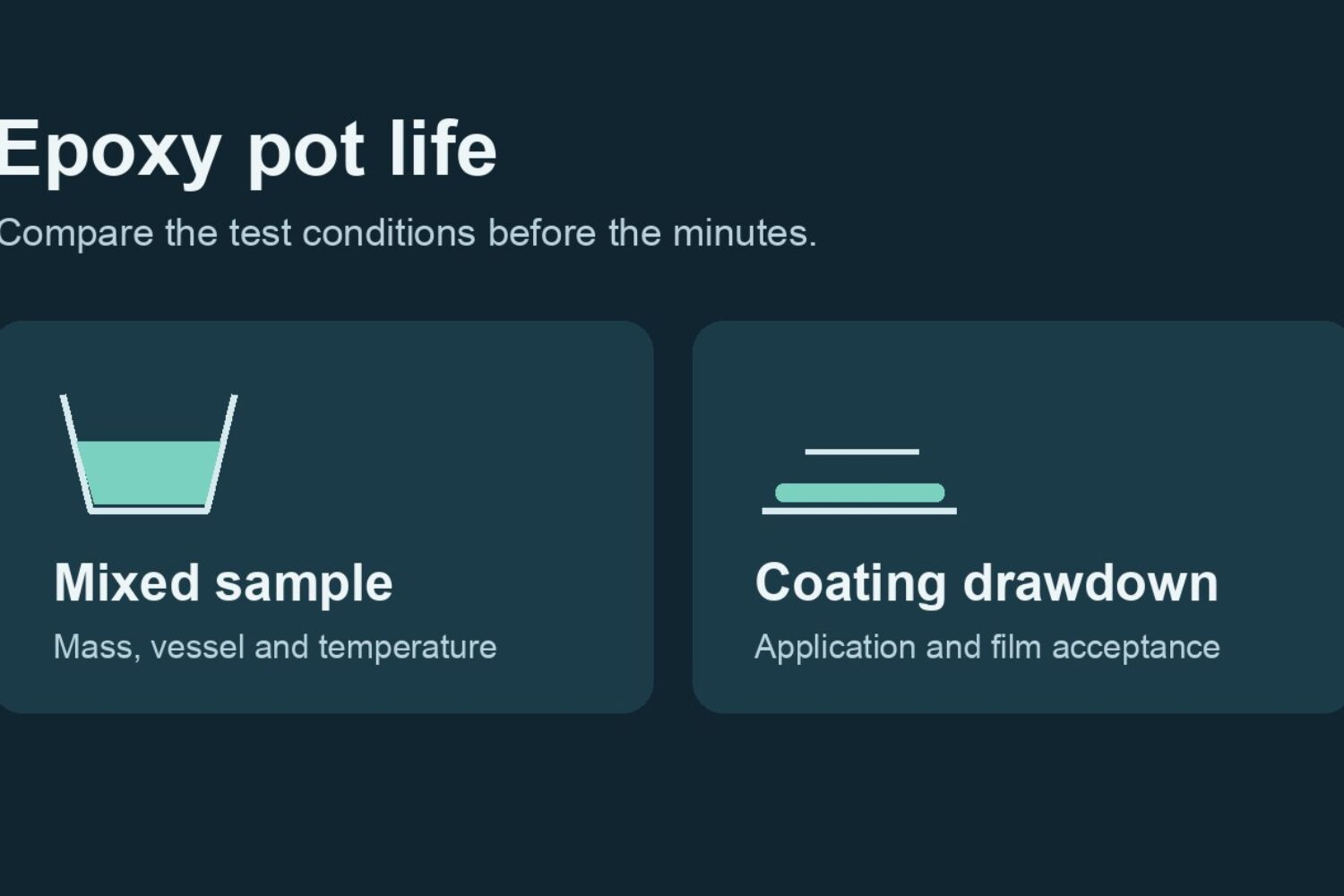
Ask what ends the test before you compare two epoxy pot-life values. A data sheet may report when a cup sample gels, when the mixed coating reaches a viscosity limit, or when a film drawn from the aging mix falls outside its appearance specification. Each endpoint answers a different question about the same batch. A buyer comparing hardeners needs the endpoint and test conditions alongside the number of minutes.
Pot life vs. working time in two-part epoxy coatings
Pot life is a time measured for a particular mixture under stated conditions. The laboratory may monitor one or more properties after mixing. Gel time identifies the point at which the sample reaches the gel endpoint defined in that test. A coating can lose its ability to level or form an acceptable film well before a cup sample reaches visible gel.
Working time describes the application window in a specific setup. For a roller coating, that includes the time needed to transfer and spread the mix and achieve an acceptable film. Some suppliers use working time and pot life interchangeably. Others list cup pot life and thin-film working time on separate lines. Ask where the material was held, when the clock started, and what the operator or instrument measured.
Four details to put beside each supplier’s result
- Formulation. Ask which resin and hardener were paired, what ratio was used, whether it was measured by weight or volume, and whether the test included the fillers and other ingredients in your coating.
- Mass and container. Record the mixed weight, the vessel and the approximate depth of the mix. Curing epoxy releases heat. A deep mass can retain more of that heat than the same mass spread out, which can accelerate the reaction.
- Temperature. Record the starting temperatures of both components and the conditions during the measurement. For a coating trial, log substrate temperature separately. The temperature listed next to a lab value may differ from the temperature at your mixing station.
- Pass or fail criterion. Ask for the actual viscosity limit, gel criterion or film property used. If the supplier records viscosity, ask for the measurement conditions so the number can be reproduced.
Suppose two suppliers report 35 and 50 minutes. The first used a viscosity cutoff and the second timed visible gel, with different sample sizes. The numbers alone cannot rank their application windows. Ask both suppliers to quote the same endpoint with a documented resin pair, and test the two complete coatings against the same application requirement.
Check the coating from the mix you will actually hold
For a bench comparison, prepare the two mixes using the documented ratios for their respective systems. Set a common time zero and agree before the test on what an acceptable coating looks like. Track the mix condition over time, and apply fresh drawdowns from the held mix at planned intervals. Judge the resulting films after the same cure conditions and elapsed cure time. Choose the tests your application needs, such as leveling, gloss or adhesion.
For example, if a fresh drawdown passes at 30 minutes and the next drawdown fails at 45 minutes, record 30 minutes as the last confirmed passing interval and 45 as the first observed failure. The crossing lies between those times under that trial’s conditions. Treat both times as illustrative. For some waterborne epoxy systems, appearance can deteriorate with only moderate viscosity change, so include the film check even when the mix still spreads.
Before approving a production change, compare the bench result with the intended holding and application conditions. Use your supplier’s handling guidance and site safety procedures when assessing larger mixes, since a deeper mass may accumulate heat. If the resin grade is changing too, use the epoxy equivalent weight guide to review the ratio calculation before comparing timed results.
What to request with a resin sample
If you are evaluating CHLUMICRYL 241 epoxy resin, ask for a test record for the exact hardener and formulation you intend to use. Request the mix ratio and its basis, the batch mass, container, starting temperature and endpoint. Send your required application window and the film properties that define a pass. Use the returned data to design the comparison, then confirm the window with drawdowns from your own mix.