
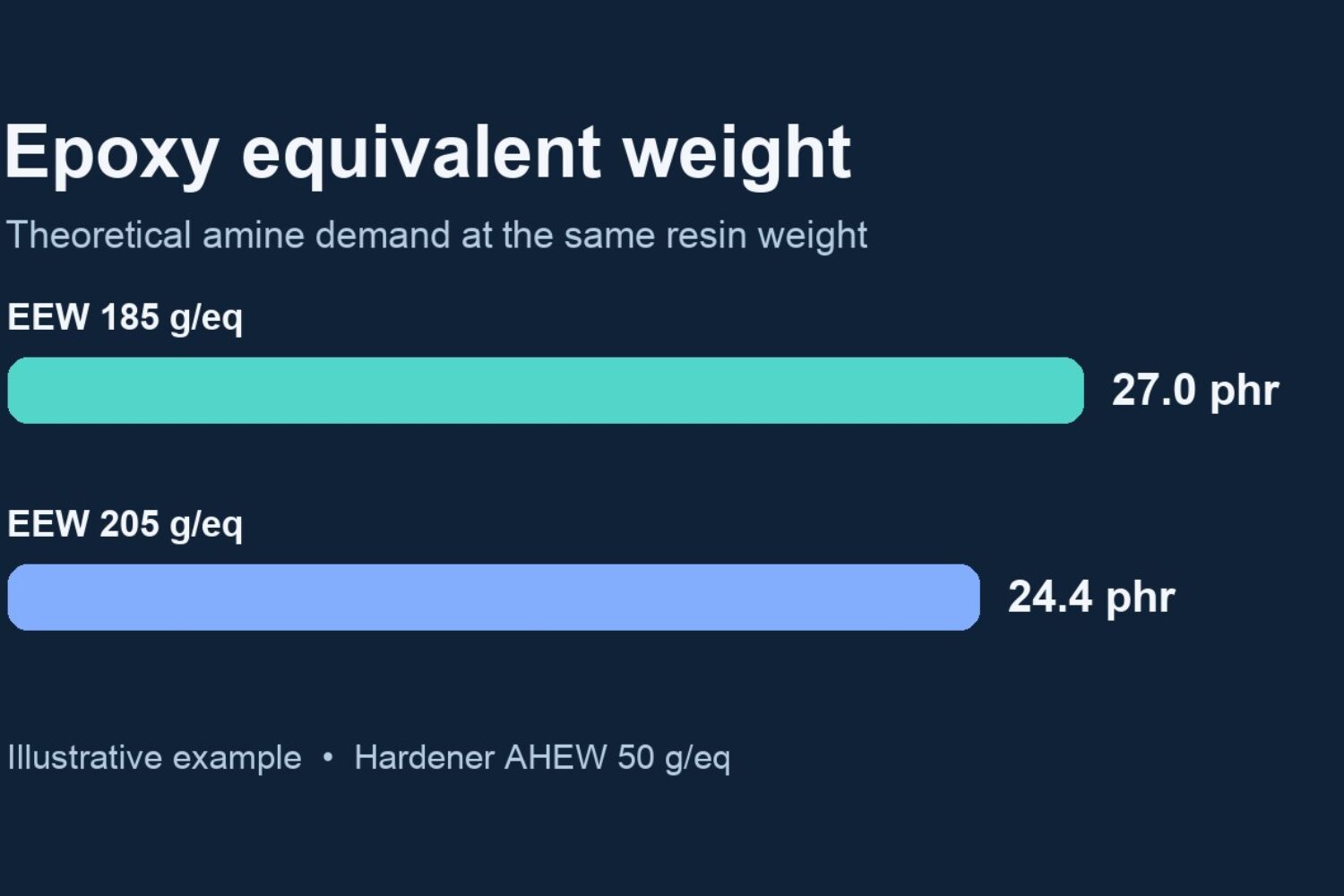
Before you approve a different epoxy resin for a two-part amine-cured coating or adhesive, compare the two grades’ epoxy equivalent weight (EEW) on the same basis. At a fixed resin weight, a grade with a higher EEW supplies fewer epoxy equivalents. The theoretical amount of the same amine hardener therefore falls, even if the two liquid resins have similar viscosities.
What the EEW on a resin specification tells you
EEW is the mass of resin, in grams, that supplies one mole of epoxy groups. Divide the resin mass by its EEW to get the epoxy equivalents in that portion of the batch. A resin with an EEW of 200 g/eq supplies 0.5 equivalents in 100 g. If a sheet reports an epoxy index in equivalents per kilogram, divide 1,000 by that index to express the result in g/eq. Confirm the unit first, because some suppliers report epoxy content per 100 g instead.
Check whether the supplier’s number applies to the material as delivered, resin solids, or a blend that includes a reactive diluent. Also separate the grade’s typical value from its sales specification and the actual lot result. Request the certificate of analysis and test method when the value will go into a batch calculation.
Calculate the effect of a grade change by weight
For a theoretical one-to-one balance of epoxy and reactive amine hydrogen equivalents, multiply the epoxy equivalents by the hardener’s amine hydrogen equivalent weight (AHEW). Use the AHEW supplied for the exact hardener grade and delivery form. An amine value in mg KOH/g and an AHEW in g/eq describe different quantities.
Suppose two undiluted resins have EEWs of 185 and 205 g/eq, and you are comparing both against the same as-supplied hardener with an AHEW of 50 g/eq. These numbers are illustrative. Parts per hundred resin (phr) are parts of hardener by weight for every 100 parts of resin by weight.
| Illustrative grade | EEW (g/eq) | Epoxy equivalents in 100 g | Theoretical hardener (phr) |
|---|---|---|---|
| Current resin | 185 | 0.541 | 27.0 |
| Candidate resin | 205 | 0.488 | 24.4 |
Keeping the current 27.0 phr setting would put the candidate batch about 11% above its theoretical amine requirement. That difference flags a mixing instruction for review. For a formulated resin and hardener kit, confirm the supplier’s specified ratio and whether it is expressed by weight or volume before changing anything on the production floor.
Count the epoxy groups in the complete resin side
When a resin side uses two epoxy-bearing materials, divide each ingredient’s weight by its own EEW, then add the resulting equivalents. Use that total in the hardener calculation. Averaging the two EEW values by weight gives a different result. A reactive diluent with epoxy groups contributes equivalents, while an inert filler contributes mass without adding epoxy groups. If your instructions give parts of hardener per hundred parts of the filled mixture, document that denominator explicitly.
What to ask for before approving the purchase
Record the exact resin and hardener grades, the as-delivered basis for both equivalent weights, and the supplier’s ratio for that combination. For a candidate such as CHLUMICRYL 241 epoxy resin, the product sheet lists an epoxide equivalent range of 220–240. Ask for the unit, test method and lot-specific result before carrying that published range into your formulation worksheet.
Use the calculation to decide whether the old mix instructions deserve a second look. Before approving a swap, compare the candidate with the current resin using the product’s intended cure conditions and the same acceptance tests, such as working time, hardness or adhesion. Document the ratio and material lots that passed so purchasing and production refer to the same combination.