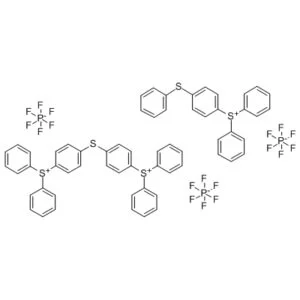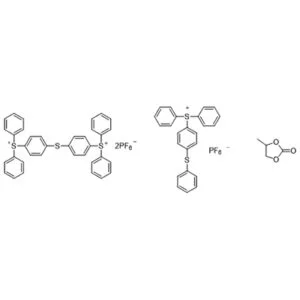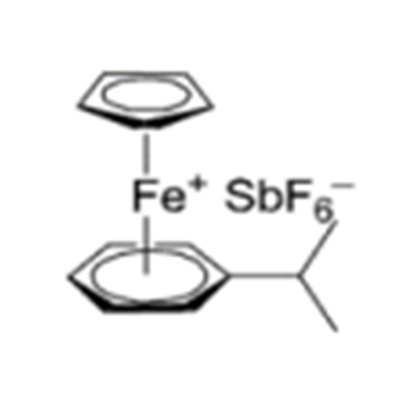
Photoinitiator 262 Anwendungsszenarien
1. Kationische Photopolymerisationsinitiatoren:
Wird in UV-härtenden Epoxidharzen, Vinylethern und anderen Systemen verwendet, z. B. in UV-härtenden Beschichtungen, Druckfarben, Klebstoffen und elektronischen Verpackungsmaterialien. Durch die Bestrahlung mit UV-Licht wird Säure erzeugt, die eine kationische Polymerisation auslöst und die Aushärtungseffizienz sowie die Beschichtungsleistung (Härte, Haftung, chemische Beständigkeit) verbessert.
2. Photosäuregeneratoren (PAGs) für Photoresists:
Als Kern-PAG in chemisch verstärkten Photoresisten, geeignet für g-line, i-line und andere UV-Lithographieverfahren. Wird bei der Herstellung von Mustern im Mikrometerbereich von Halbleitern, LCDs und PCBs verwendet. Durch die Bestrahlung mit UV-Licht wird eine Säure erzeugt, die die Vernetzung oder Zersetzung des Harzes einleitet und die Übertragung der Muster ermöglicht.
3. Aushärtung von mikroelektronischen Materialien:
Wird bei der Fotohärtung von mikroelektronischen Verpackungsklebstoffen, dielektrischen Materialien und Lötmasken für Leiterplatten (PCB) verwendet und trägt zur hochpräzisen Herstellung und verbesserten Zuverlässigkeit elektronischer Komponenten bei.
4. Feinchemikalien und organische Synthese:
Wird als Säurequellenkatalysator in der organischen Synthese für bestimmte säurekatalysierte Reaktionen (wie Veretherungs-, Kondensations- und Zyklisierungsreaktionen) und in der Synthese und Modifizierung funktioneller Polymermaterialien verwendet und bietet eine kontrollierbare saure Umgebung.
5. 3D-Druck-Materialien:
Wird in den Harzformulierungen des photopolymeren 3D-Drucks (SLA/DLP) als kationischer Initiator eingesetzt, der die mechanische Festigkeit, Wärmebeständigkeit und Maßgenauigkeit der gedruckten Teile verbessert und die Anforderungen des Hochleistungs-3D-Drucks erfüllt.