
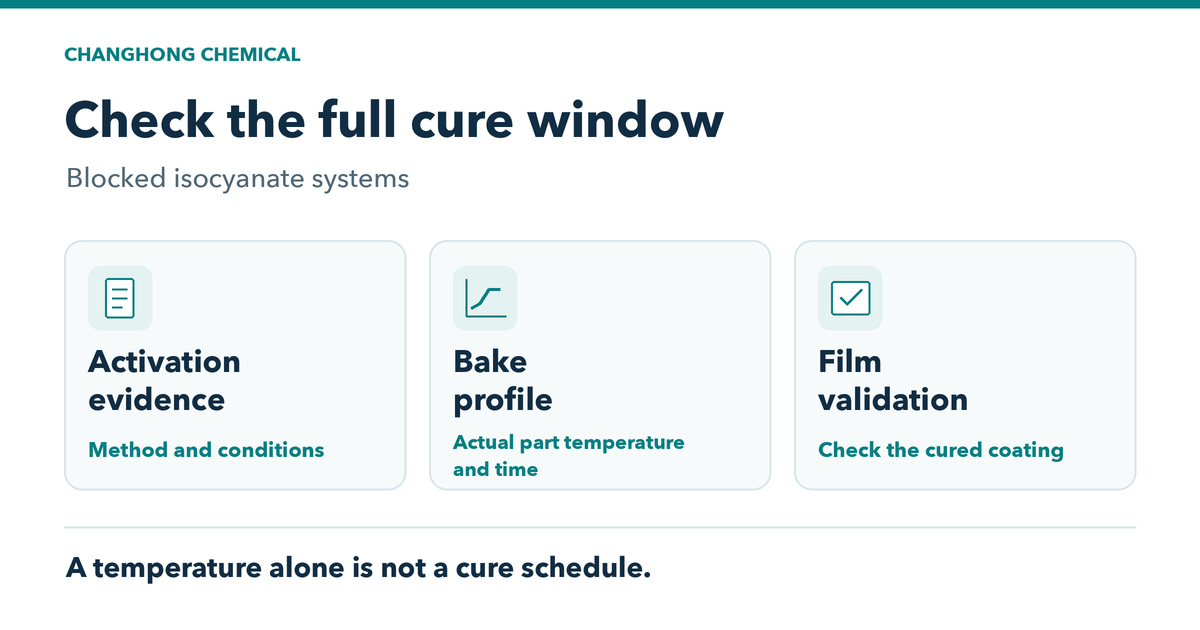
A blocked isocyanate’s quoted deblocking temperature is not enough to approve a baking process. Before selecting a resin and crosslinker for a one-component coating, ask for the identified formulation, its time–temperature conditions and the film-test results obtained under those conditions. An analytical activation result and an acceptable finished coating answer different questions.
What is a blocked isocyanate?
Blocking temporarily modifies an isocyanate’s reactive groups so that their subsequent reaction can be activated by heat. Blocked polyisocyanates are used as crosslinkers in some one-component baking systems, including systems with hydroxyl-functional resins. The relevant activation behavior belongs to the specific chemistry and formulation; the description “blocked” does not supply a complete processing specification.
For a buyer, the useful distinction is between three pieces of evidence:
| Evidence | Question it should answer |
|---|---|
| Deblocking measurement | What change was detected, by which method and under what heating conditions? |
| Formulation cure assessment | How did the identified resin–crosslinker combination react during the specified bake? |
| Finished-film testing | Did that coating meet the agreed application requirements after curing? |
Check how the deblocking temperature was measured
A temperature without a method can conceal an important difference in meaning. In a study of pyridinol-blocked isophorone diisocyanate, thermal analysis and a chemical detection method produced different temperature results for the same laboratory adducts. The authors also examined the effect of heating rate. These were measurements on particular experimental materials, not recommended baking conditions for commercial coatings.
When reviewing a technical data sheet, ask whether the reported number describes the first detectable change, a peak in an analytical signal or another defined endpoint. Record the method, sample condition and heating rate beside it. Do not rank two candidates as faster or slower merely because their temperature labels differ.
Keep the resin and crosslinker identities attached to the results
Evidence for an isolated crosslinker is not evidence for every coating that could contain it. In research on one-component aqueous coatings with a vanillin-blocked crosslinker, the investigators examined deblocking, reactions with selected hydroxyl-functional binders and coating properties separately. Their assessment included film tests such as adhesion and impact behavior. The study illustrates why the binder partner and the tested conditions must travel with a performance claim.
Request the exact resin and hardener grades, the document revisions and the formulation used for the supporting tests. If a catalyst or another additive was included, ask for that information as well. A result from a different partner or an unspecified formulation is a reason to plan a trial, not evidence that a proposed replacement has already been qualified.
Ask for a bake profile you can interpret
Turn a single temperature claim into a clear set of process questions:
- Does the stated temperature refer to oven air, the substrate or the coated part, and where was it measured?
- When does the stated holding time begin, and what heating ramp was used?
- What drying or flash-off stage preceded the bake?
- Which substrate, pretreatment and film thickness were evaluated?
- Which film properties were tested, and what acceptance criteria apply to the intended end use?
These questions define the evidence needed to compare the supplier’s trial with the buyer’s process. They do not establish a universal temperature or holding time. Keep missing fields visible in the comparison sheet instead of filling them with conditions from a different coating.
Where a verified resin specification fits
CH-WR2003 waterborne hydroxyl acrylic dispersion is a resin candidate for general industrial baking coatings. Its product documentation describes use with amino resins or blocked isocyanates in water-based one-component formulations. The listed solids content is 43 ± 1 wt%, with hydroxyl content of 4.2% on solids.
That application description does not identify a particular blocked-isocyanate partner or prescribe a validated bake schedule. When requesting a sample for this route, ask for the proposed crosslinker and the complete evaluation conditions. If the resin and crosslinker documents use different functional-content conventions, first clarify the hydroxyl value and solids basis rather than comparing unqualified numbers.
A practical release decision
For an initial quotation, an application statement and a deblocking result may be enough to identify a candidate. Approval for production needs a documented resin–crosslinker combination, an interpretable bake profile and film results relevant to the application. Keep those three items together in the trial record. If only a temperature has been supplied, the next step is to request the missing evidence before treating it as a production setting.