
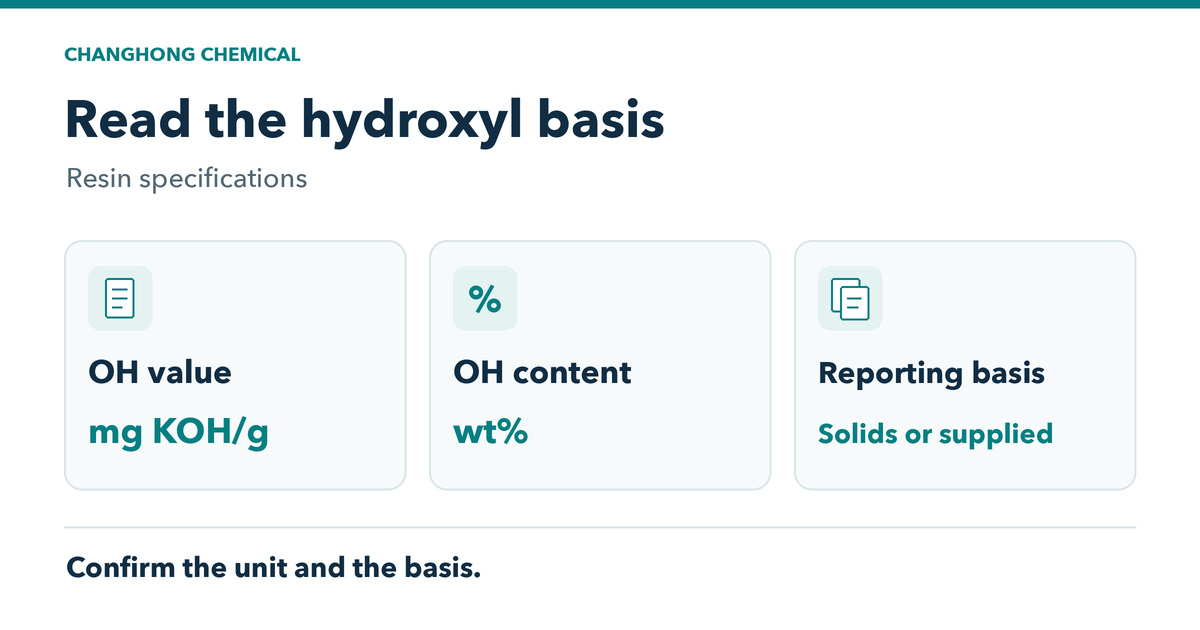
Before comparing the hydroxyl value of two resins, check both the unit and the mass basis. A value in mg KOH/g is different from hydroxyl content expressed as OH wt%, and a figure reported on resin solids cannot be compared directly with one reported per gram of the supplied liquid. Put those fields on the same basis before using them to screen grades or request samples.
What does hydroxyl value tell a resin buyer?
Hydroxyl value, often called hydroxyl number, expresses hydroxyl groups as a potassium hydroxide equivalent per gram of the material being evaluated. The unit is mg KOH/g. It does not mean that the resin contains that amount of potassium hydroxide.
The test conditions matter. ISO 4629-1 defines a titrimetric method for certain paint and varnish binders and binder solutions. Its scope also cautions that other constituents carrying hydroxyl groups must be considered when determining the binder contribution. A supplier’s stated test method, sample preparation and reporting basis therefore belong beside the number.
For purchasing, separate three questions: how much OH is attributed to the resin, how concentrated the supplied product is, and how the reported figure was obtained. A single OH number does not answer all three.
Read the unit and basis as a pair
| Specification entry | What to confirm |
|---|---|
| Hydroxyl value: mg KOH/g | Does the gram refer to resin solids or the supplied product? Is the value measured or calculated? |
| Hydroxyl content: OH wt% | Is this the mass percentage of OH groups on solids, or on the total supply mixture? |
| Solids: wt% | What test conditions define the nonvolatile fraction, and does that definition match the OH basis? |
A certificate of analysis may contain a batch result, while a technical data sheet may give a typical value or a specification range. Keep those labels when transferring data into a comparison sheet. Do not turn a typical calculated figure into a guaranteed acceptance limit.
Convert OH content only after aligning the basis
When both figures describe the same hydroxyl groups and the same mass basis, the approximate conversion is:
OH-equivalent value (mg KOH/g) ≈ OH content (wt%) × 33
Use the percentage number itself: enter 4.2 for 4.2 wt%, not 0.042. The factor is derived from the approximate formula masses of KOH and OH, 56.1 and 17.0 g/mol, with the percentage and milligram conversions included. The underlying elemental masses are listed in the CIAAW atomic-weight table.
To express the specified resin OH contribution per gram of supplied product, multiply the solids-basis result by the solids mass fraction. For 43 wt% solids, that fraction is 0.43. Do not apply this correction again if the original OH figure is already reported on the supply basis.
Two waterborne resin examples
The published specification for CH-WR2018 waterborne hydroxyl acrylic dispersion lists 4.2% hydroxyl content on solids and 43 ± 2 wt% solids. CH-WR2021 lists 3.3% on solids and 45 ± 2 wt% solids. Their nominal figures illustrate why the denominator matters.
| Nominal calculation | CH-WR2018 | CH-WR2021 |
|---|---|---|
| OH equivalent on solids, mg KOH/g solids | 4.2 × 33 = 138.6 | 3.3 × 33 = 108.9 |
| Resin-OH equivalent per gram of supplied product, mg KOH/g | 138.6 × 0.43 ≈ 59.6 | 108.9 × 0.45 ≈ 49.0 |
These are illustrative calculations using nominal solids, not measured hydroxyl values or lot-specific COA results. They account for the reported resin OH contribution only. They do not establish the total response of an aqueous mixture in a hydroxyl test, nor do they show that the grades are interchangeable.
For a waterborne dispersion, ask the supplier or laboratory how the sample is prepared and which method is suitable. Do not assume the raw dispersion can be tested unchanged by any chosen titration method. Likewise, the balance after subtracting solids is not automatically a measured water content.
What to request before approving a resin change
- The exact grade, current technical data sheet and a representative batch COA.
- OH unit, mass basis and whether the number is a test result or a calculation.
- Solids test conditions and the lot’s solids result when a supply-basis comparison is needed.
- The OH test method, sample preparation and treatment of other OH-bearing constituents.
- Application trial criteria and the intended curing system, reviewed separately from this numerical comparison.
Matching the reporting basis gives purchasing and formulation teams a usable comparison. It does not by itself determine hardener dosage, cured performance or replacement suitability. Resolve the document questions first, then evaluate the candidate in the intended formulation.