
To calculate isocyanate equivalent weight, divide 4,202 by the NCO content expressed as a weight percentage. The result is grams per NCO equivalent. Before using that number to weigh a hardener, confirm what the percentage refers to: the product in the container or its resin solids. The same printed NCO value can give different charging quantities when the reporting bases differ.
What the conversion actually tells you
NCO equivalent weight describes the mass carrying one equivalent of isocyanate groups. It is not the molecular weight of the entire hardener mixture. When the supplier reports NCO as wt% of the supplied product, the calculation is:
Isocyanate equivalent weight, g/eq = 4,202 ÷ NCO wt%
Enter a percentage such as 18.0 as 18.0, not 0.18. Some technical guides use the rounded factor 4,200. Keep the convention consistent in the calculation record; the reporting basis is a separate issue that rounding cannot resolve.
If the NCO percentage is stated on resin solids, the direct result is grams of those solids per equivalent. It is not yet the mass of the solution to charge.
Read NCO content and solids as two separate fields
A solids result describes a nonvolatile fraction under the stated test conditions. An NCO result describes isocyanate-group content on a defined mass basis. Do not replace one with the other. Reporting NCO on solids is a real analytical convention: a published method for polyurethane paints explicitly uses a 100% resin-solids basis.
For each quotation or certificate, record the NCO unit, reporting basis and method alongside the solids result. If NCO is already reported on the supplied product, multiplying it by solids again understates the NCO carried by each gram. If NCO is on solids, obtain confirmation that the solids fraction is the correct conversion basis before using it.
A worked example: identical labels, different quantities
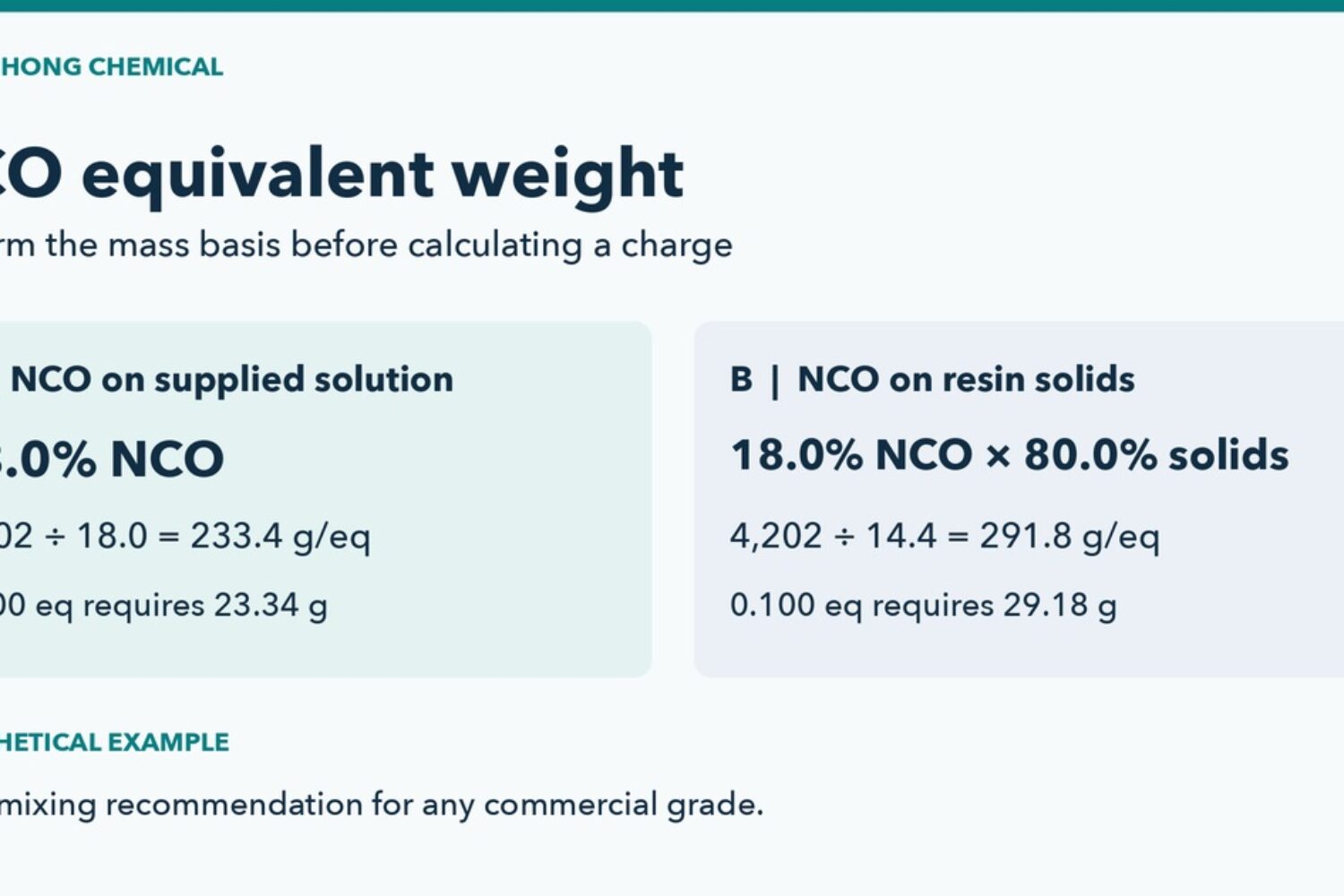
The following is a hypothetical comparison, not a formulation for any Changhong grade. Both documents show “NCO: 18.0%” and “solids: 80.0%.” In case A, NCO is explicitly on the supplied solution. In case B, NCO is explicitly on resin solids, and the supplier confirms that the 80.0% solids fraction is applicable.
| Calculation | Case A: NCO on solution | Case B: NCO on solids |
|---|---|---|
| NCO wt% in supplied solution | 18.0 | 18.0 × 0.80 = 14.4 |
| Supplied-product equivalent weight | 4,202 ÷ 18.0 ≈ 233.4 g/eq | 4,202 ÷ 14.4 ≈ 291.8 g/eq |
| Mass supplying 0.100 NCO equivalent | 23.34 g | 29.18 g |
Case B requires 25% more supplied solution for the same NCO equivalents. This difference follows from the assumed reporting bases; it does not demonstrate a difference in coating quality. Without the basis labels, neither charging quantity can be selected confidently.
Apply the check to a hardener inquiry
The published specifications for CH-HD4010 curing agent list solids of 90 ± 2% and NCO content of 20 ± 1%. For CH-HD4011 curing agent, the corresponding entries are 75 ± 2% and 17 ± 1%. These are two product specifications, not the hypothetical cases above.
The available specification tables do not explicitly identify the NCO reporting basis. Before calculating a charging weight for either grade, request a current TDS or batch document that resolves that field. Do not assume that the higher-solids grade is neat material, or that the two grades share an interchangeable mixing ratio.
- Identify the exact hardener grade, batch and document revision.
- Ask whether NCO wt% refers to the supplied material or resin solids.
- Request the NCO test method and distinguish a specification range from the batch result.
- Confirm the intended resin partner and the basis used for its reactive-group value.
Equivalent weight is one input to a mixing ratio
A hardener equivalent weight alone does not specify how much to add. The formulation also needs the reactive equivalents of the partner and the selected stoichiometric target. For a hydroxyl-functional resin, first establish the hydroxyl value and solids basis so that both sides of the calculation describe the material actually weighed.
Keep the arithmetic and the application decision in the same trial record: verified inputs, calculated mass, identified resin–hardener pair and trial conditions. A corrected equivalent weight fixes a quantity calculation; it does not, by itself, establish compatibility or an acceptable cured film.