

Before you compare a Karl Fischer water content result with a monomer purchase limit, check the lot number, the reporting basis and the test method. If the order gives a percentage and the certificate shows milligrams per kilogram, put both numbers on the same mass basis.
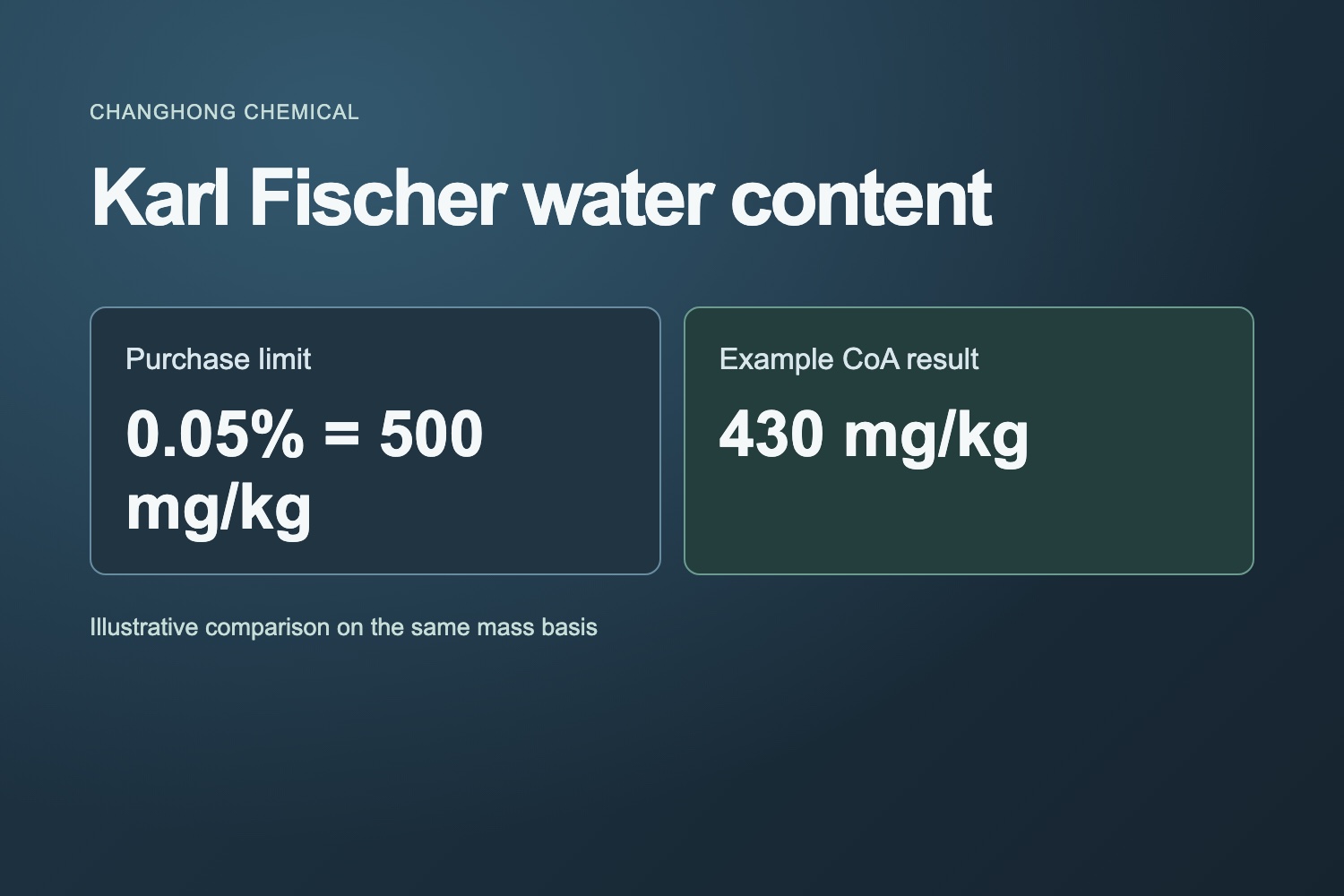
Compare the water reading with the purchase limit
De CHMA cyclohexyl methacrylate specification lists a water limit of 0.05%. Ask the supplier to state the basis and method in the order and on the certificate of analysis (CoA). The specification gives you the limit. The certificate should identify what the supplier found for the lot you received.
Suppose the order specifies a maximum of 0.05% by mass in the monomer as supplied. The limit is 500 mg/kg because 0.05 divided by 100 and multiplied by 1,000,000 equals 500. An example lot result of 430 mg/kg by the agreed method is 70 mg/kg below that limit. If the certificate says only “passes” and your order calls for a measured value, request the reading and keep the result field open.
Check which Karl Fischer method the lab used
In volumetric Karl Fischer titration, the instrument adds an iodine-containing solution from a burette. In coulometric titration, it generates iodine inside the cell and calculates the amount of water from the electrical charge. Coulometry is often used for small amounts of water. Both methods can be suitable when the lab validates them for the sample and range. ASTM E203 describes a volumetric procedure. If your certificate lists only “KF,” ask which procedure and revision the lab used.
A line marked “moisture” may come from a loss-on-drying test. That test measures the mass lost during drying and can include volatile material besides water. If the order calls for a Karl Fischer result, ask the supplier for that measurement before using the value to release the lot.
What to check when two labs disagree
Start with the lot and drum IDs. Find out when each lab’s sample was drawn and how it was sealed. Confirm that both labs report water on the same basis and used the agreed procedure. Ask whether the lab saw an unusual background reading, known as drift, or had difficulty releasing water from the sample. Keep both original results and follow the hold or retest procedure in the purchase agreement.
Keep water, assay, inhibitor and color in separate fields on the lot record. For a Pt-Co color limit, use the APHA color CoA guide to check how the supplier measured that property.