
Compare epoxy resin viscosity only after both suppliers describe the same kind of sample at the same temperature using a comparable test method. A value for resin before mixing cannot tell you how the resin and hardener will flow through your equipment. For incoming inspection, compare the measured lot with the agreed resin specification. For an application trial, request viscosity data for the actual mixture.
Identify what the lab measured
Start by marking each row on your comparison sheet as resin as supplied, hardener as supplied, or mixed system. A supplied resin may already contain a diluent or other components. Confirm which grade and supply form the number describes. For a mix, record the component grades, mix ratio, whether that ratio is by weight or volume, and how long after mixing the reading was taken.
Convert units before comparing the numbers. One centipoise (cP) equals one millipascal-second (mPa·s), so a value of 3,200 cP can be written as 3,200 mPa·s. A value in centistokes is kinematic viscosity and requires density at the measurement temperature to convert. If the sheet gives a flow-cup time in seconds, ask which cup and method it used before interpreting it.
Match the temperature and measurement setup
Use the sample temperature on the test record. Room temperature alone may leave enough uncertainty to change a grade comparison. For a rotational test, ask for the method, instrument or torque range, spindle or geometry, speed, and reading time. Confirm sample preparation and container geometry if your lab needs to reproduce the result. For a resin that changes apparent viscosity with shear, the same revolutions per minute on different geometries may still give different readings.
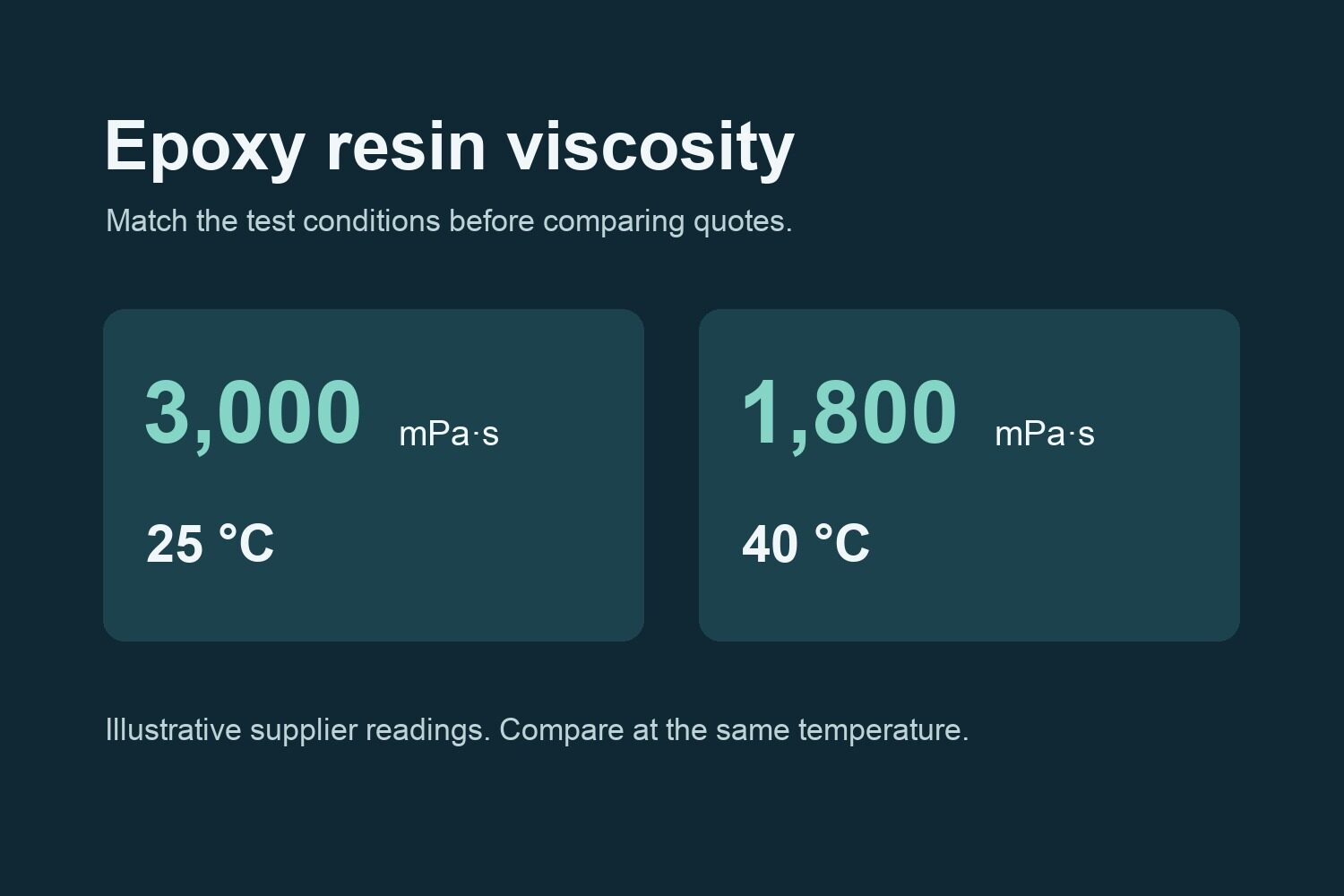
Suppose Quote A lists 3,000 mPa·s at 25 °C and Quote B lists 1,800 mPa·s at 40 °C. The figures alone cannot rank the resins at your 25 °C receiving condition. If a matched test later puts B at 3,400 mPa·s while A measures 3,000, A is the lower-viscosity sample under that test. Those figures are hypothetical. When your line runs at a different temperature, ask for another measurement there or a documented curve for the exact grade.
Separate incoming inspection from the process trial
For a CHLUMICRYL 241 epoxy resin inquiry, the product page lists 2,500–4,000 cP at 25 °C. Ask for the test method and a lot certificate if you plan to use that range for incoming inspection. The listed range applies to the resin. Request a separate result if you need to judge flow after adding hardener or filler.
For a trial, give the supplier your application temperature, the mix you intend to use, and the longest interval the material will sit before application. Ask for a starting reading and a reading at that interval under comparable conditions. Use the epoxy pot life guide to agree on the endpoint for usable working time. Then run the trial on your own equipment and judge the application result alongside the viscosity reading.