
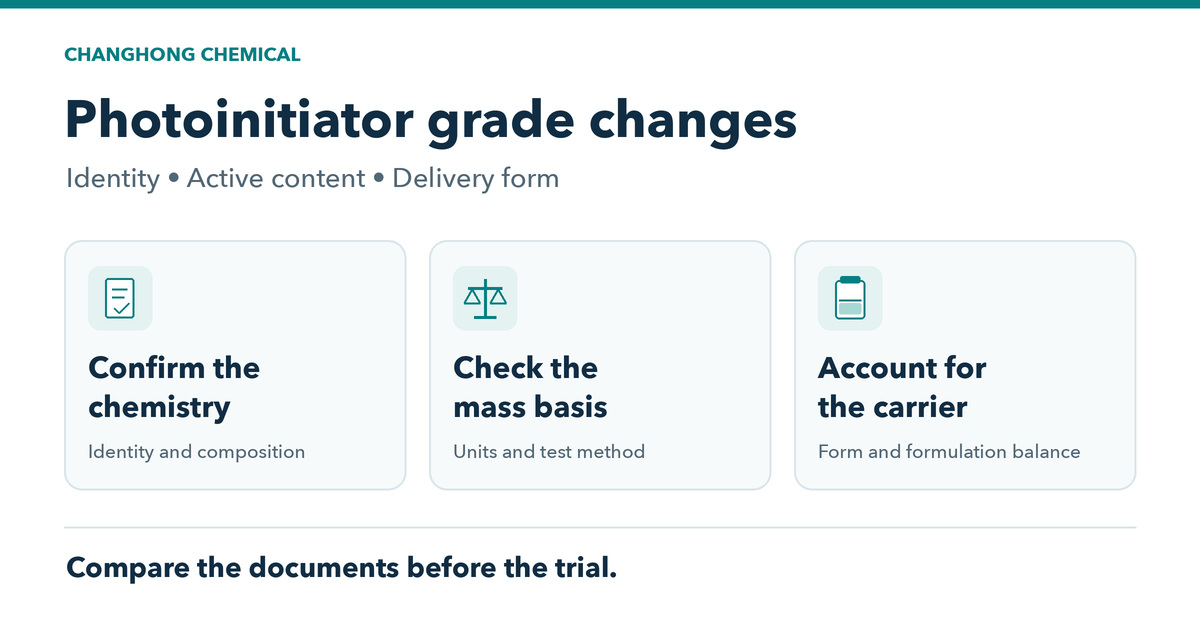
TPO-L is a different chemical from TPO, not simply TPO dissolved in a liquid carrier. When comparing TPO vs TPO-L for an industrial UV formulation, verify identity first, then the supplied grade, analytical specification and cure response. Neither a shared application nor a similar product name establishes a weight-for-weight replacement.
TPO vs TPO-L: the identity difference
| 확인 | TPO | TPO-L |
|---|---|---|
| 화학 물질 이름 | 디페닐(2,4,6-트리메틸벤조일)포스핀 산화물 | Ethyl (2,4,6-trimethylbenzoyl)phenylphosphinate |
| CAS 번호 | 75980-60-8 | 84434-11-7 |
| 분자 공식 | C22H21O2P | C18H21O3P |
| Form on Changhong’s product page | Crystalline solid | 밝은 노란색 액체 |
| Published assay entry | At least 99.0%; method not stated on the page | At least 98.0% by HPLC |
For the current published grade details, review Changhong TPO, CAS 75980-60-8 및 TPO-L liquid photoinitiator, CAS 84434-11-7. Confirm the quotation against the current TDS, SDS and lot COA. The assay entries above should not be used as mass fractions until the supplier confirms their reporting basis.
What does the liquid form tell you?
A liquid appearance tells you how a sample is delivered, not whether it contains a solvent. A photoinitiator product can be a neat liquid, a solution in a carrier, a dispersion, or a mixture of active components. Ask which description applies to the exact grade offered.
Keep a second distinction clear: a 50:50 mixture of two photoinitiators is not the same as a product containing 50% of one photoinitiator and 50% carrier. In the mixture, both components may contribute to the initiating system. A blend ratio alone cannot be used as a dilution factor.
Published experimental work on liquid photoinitiator delivery forms explicitly distinguishes the amount of supplied blend from its active content. Its results apply to the formulations and exposure conditions tested; they do not establish interchangeability between TPO and TPO-L.
Read the assay method before calculating a dose
An assay is a quantitative test. Chemical identity is a separate check. When a specification says “98%,” ask what was measured and whether the number means mass percentage, chromatographic area percentage, or another defined result.
GC and HPLC area percentages reflect detector responses under a particular method. Converting them into mass fractions requires appropriate calibration or response factors, with consideration of constituents the method does not measure. Water and solvents may need separate tests. The IUPAC technical report on organic purity measurement explains these analytical limits.
Request the concentration of each named active in the supplied product separately from non-volatile content. A solids result is not automatically a measurement of photoinitiator concentration.
When an active-mass calculation is useful
A concentration correction is useful when two grades contain the same named active at confirmed mass fractions. It is not a validated conversion from TPO to TPO-L, because those are different compounds.
Named-active mass = product mass × confirmed active mass fraction
Replacement product mass = target named-active mass ÷ replacement active mass fraction
Consider a hypothetical 100.0 kg final formulation. A 2.00 kg addition of a 50.0 wt% solution supplies 1.00 kg of one named photoinitiator. A 25.0 wt% solution of that same compound requires 4.00 kg to supply 1.00 kg. That addition must fit within the 100.0 kg final total, leaving 96.00 kg for the other ingredients. It also introduces 2.00 kg more carrier, which the formulator must accommodate deliberately.
This example is arithmetic, not a recommended dose or a Changhong grade specification. Do not remove an essential ingredient simply to keep the total at 100 kg. Record whether the loading is based on the total wet formulation, binder solids or another denominator. For a multi-active blend, account for each component separately.
Qualify the change in your actual UV process
For a proposed TPO-to-TPO-L change, agree a trial plan rather than treating the calculation above as an equivalence rule. Keep the resin, pigment, substrate, film thickness and exposure conditions documented, and record the exact grade, lot and addition level for each trial.
- Incorporation: verify that the selected material dissolves or disperses as intended and remains compatible under the specified storage conditions.
- Light source: compare the grade’s UV–Vis curve with the lamp output. For a 395 nm line, use the separate guide to reading a photoinitiator absorption spectrum.
- Acceptance: apply the same surface-cure, adhesion, appearance and other agreed performance tests to the reference and candidate formulations.
- Purchasing record: retain the approved grade specification, TDS, SDS, COA and trial conditions together. Resolve undisclosed composition or reporting-basis questions before treating the sample as an approved replacement.
Use the photoinitiator selection guide for the broader formulation context. For a sample inquiry, specify which grade you currently use, your lamp wavelength, formulation type, film thickness and the performance limits the replacement must meet.