
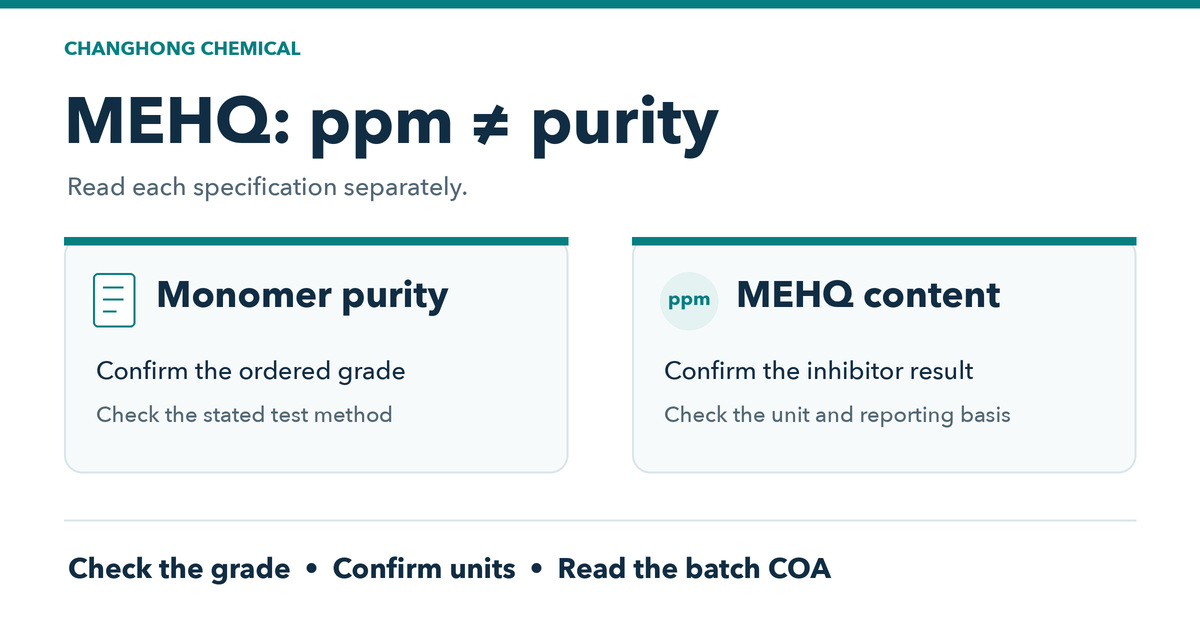
When comparing monomer quotations, put the MEHQ inhibitor requirement on its own line beside purity. A higher purity grade does not automatically have less inhibitor, and an acceptable purity result does not prove that the inhibitor result meets your order. Match both results to the selected grade before releasing a batch for use.
What does the MEHQ line tell you?
MEHQ is hydroquinone monomethyl ether, CAS 150-76-5. It is used as a polymerization inhibitor. The MPA/Cefic methacrylate esters manual, section 4.1, identifies this stabilizer in its discussion of methacrylate polymerization. Its handling guidance covers specified methacrylate esters; it is not a substitute for the documents supplied with your HEMA or HPMA grade.
For purchasing, the useful question is whether the quoted inhibitor identity, concentration and permitted range match your approved material specification. The word “stabilized” alone leaves those details unanswered.
Read purity and inhibitor concentration as separate specifications
Changhong’s published HEMA monomer specifications provide a clear example: four GC purity columns have the same MEHQ requirement. The HPMA monomer specifications show why you must also check the particular column being quoted.
| Monomer | Published purity (GC) minimum | MEHQ specification |
|---|---|---|
| HEMA, CAS 868-77-9 | 98%, 97%, 96% or 95% | 200 ± 40 ppm in all four columns |
| HPMA, CAS 27813-02-1 | 98%, 97% or 96% | 200 ± 50 ppm |
| HPMA, CAS 27813-02-1 | 95.5% | 200 ± 40 ppm |
These are published acceptance specifications, not measurements from a particular shipment. For HEMA, 200 ± 40 ppm gives a range of 160–240 ppm. The HPMA columns with 200 ± 50 ppm allow 150–250 ppm. Carry the correct range into the purchase specification rather than copying “200 ppm” as if it were the complete requirement.
Confirm the basis before converting ppm
A NIST guidance on fractions and concentration, sections 7.10.2–7.10.3, distinguishes mass, volume and amount-of-substance fractions. Ask which basis the supplier uses. The two product tables above label the inhibitor in ppm but do not state that basis or the inhibitor test method.
Conditional calculation: if a COA explicitly defines ppm by mass, 200 ppm means 200 mg of MEHQ per kg of material, equivalent to a mass fraction of 0.020%. That conversion explains a unit; it does not establish the basis of a COA that omits it.
Likewise, the label “Purity (GC)” does not, by itself, explain calibration or whether the reported percentage is a mass fraction. Do not subtract the inhibitor percentage from 100% to manufacture a monomer purity value. Request the reporting basis and method for each item.
A batch can meet one requirement and miss another
Consider a hypothetical HEMA order specifying GC purity of at least 98% and MEHQ of 200 ± 40 ppm. Assume the agreed methods and reporting bases match the COA. A reported purity of 98.2% meets the purity requirement; a reported MEHQ result of 260 ppm exceeds the 240 ppm upper limit. The purity result does not cancel that discrepancy.
Keep the batch pending technical review and ask the supplier to reconcile the inhibitor result with the order. This example is an acceptance calculation, not a Changhong batch result or a recommendation to alter inhibitor content.
What to request with the quotation and shipment
- At quotation: identify the monomer, CAS, selected purity column and full inhibitor range. Confirm any other required limits, such as water and color.
- Before shipment: request the batch COA with lot identity, actual purity and inhibitor results, units, reporting bases and test methods.
- Before a supplier change: have the formulation and quality teams review the agreed specifications and qualify the supplied grade in the intended process. Matching a CAS number alone does not complete that review.
When asking Changhong for HEMA or HPMA, state the purity grade and MEHQ range together. This gives the quotation and subsequent COA a shared reference and makes differences visible before the material reaches production.