
Description
Isobornyl methacrylate / IBOMA monomer CAS 7534-94-3
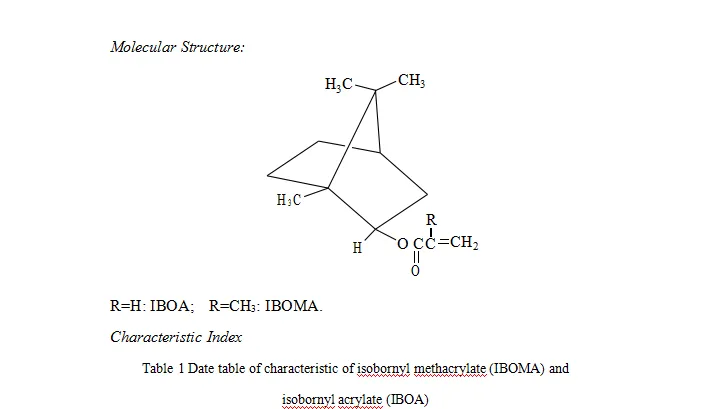
| Characteristic | IBOMA | IBOA |
| Appearance | Clear transparent | Clear transparent |
| Formula Weight | 222 | 208 |
| Density g/mL | 0.985 | 0.984 |
| Refractive Index (25℃) | 1.4750 | 1.5040 |
| Viscosity (25℃) mPa·s | 10~15 | 7.5 |
| Closed Flash Point ℃ | 119 | 93 |
| Glass Transition Temperature (Tg) ℃ | 110 | 90~100 |
| Surface Tension mN/m | 30 |
IBOMA Quality and Index:
Table 2 Date table of quality of isobornyl methacrylate (IBOMA) and isobornyl acrylate (IBOA)
| Index | IBOMA | IBOA |
| Appearance _ | Limpidity / clear,colorless | Limpidity / clear,colorless |
| Color(APHA) Pt-Co | ≤50 | ≤50 |
| Acid content % | ≤0.1 | ≤0.1 |
| Purity % | ≥98.5 | ≥98 |
| Moisture Content % | ≤0.1 | ≤0.1 |
| Polymer Test(methanol) _ | Pass or Fail | Pass or Fail |
| Inhibitor Content(MEHQ) ppm | 100-300 | 100-300 |
| PTZ ppm | ≤10 | ≤10 |
What is IBOMA monomer?
IBOMA monomer, molecular formula is C14H22O2, molecular weight is 222.32, CAS: 7534-94-3. According to different purity, isobornyl methacrylate can be divided into <85%, 85%-90%, 95%, ≥98%, etc. Isobornyl methacrylate has a unique bridge ring structure, and its physical and chemical properties are: low viscosity, high boiling point, low surface tension (low shrinkage), high glass transition temperature, low chroma, high refractive index, and good hydrophobicity. Good compatibility with various resins, solvents, pigments and fillers, low toxicity, non-flammable, etc.
Isobornyl methacrylate (IBOMA) monomer Usage
1. Isobornyl methacrylate (IBOMA) contains a huge rigid side group-isobornyl group, which has a strong inhibitory effect on the movement of the polymer segment, making the polymer heat resistance, abrasion resistance, water absorption resistance, shrinkage resistance and strong Resilience has been greatly improved.
2. Isobornyl methacrylate (IBOMA) is mainly used in the manufacture of various resins, coatings, powder coatings, cleaning coatings, high-solid and low-viscosity coatings, inks, adhesives, etc., and then used in coatings, automobiles, computers, mobile phones, home appliances, and instruments Instruments, CDs, optical fibers, furniture, flooring, engineering plastics, flexible plastic films, pressure-sensitive adhesives, sealants, heat-resistant organic plates, adhesives, screen printing ink carriers, modified powder coatings, clean coatings, high solids and low Viscosity coatings and other aspects.
3. Isobornyl methacrylate (IBOMA) can also be used as reactive diluent, resin toughness modifier monomer to improve the dispersion of resin to pigments.
4. In the acrylic resin formulation, adding methacrylic acid cyclic ester monomer (such as IBOMA) can effectively reduce the viscosity of the polymer solution while keeping the glass transition temperature, molecular weight, and amount of functional groups of the polymer unchanged. Among various cyclic monomers, the viscosity reduction effect of IBOMA is more obvious. Figure 1 is the curve of viscosity and IBOMA dosage %.
5. IBOMA is a monomer that unifies hardness and flexibility. Due to its molecular structure, its polymer has excellent high gloss, sharp image, scratch resistance, medium resistance and weather resistance. , and its hygroscopicity is significantly lower than that of MMA (methyl methacrylate). In addition, IBOMA-added acrylic resin has good compatibility with polyester, alkyd and many volatile paint film-forming substances.
6. When IBOMA is used in powder coatings, its copolymer can improve the agglomeration of powder, improve the stability of powder coatings and reduce the initial melt viscosity, thereby improving the leveling of the coating, improving the appearance and appearance of the coating film. luster.
7. IBOMA is suitable for the manufacture of high Tg thermoplastic acrylic resins. Its products have high hardness, high alcohol resistance and heat resistance, as well as good flexibility, adhesion, moisture resistance and weather resistance. It is a kind of special structure. A new type of acrylate polymerization monomer, suitable for the manufacture of soft plastic film coatings such as PET, PE, PP, and decorative protective coatings for engineering plastics such as PE, PP, and PC.
Isobornyl methacrylate (IBOMA) Package
Packing: 25kg/drum or 200kg/drum
Capability: 300-500Mt per month
Isobornyl methacrylate (IBOMA) Storage
Store in a cool, dry, well – ventilated warehouse. Stay away from fire and heat. Prevent direct sunlight. Packing seal.
Contact Us Now!
If you need Price and Sample Testing, please fill in your contact information in the form below, we will usually contact you within 24 hours. You could also email me info@changhongchemical.com during working hours ( 8:30 am to 6:00 pm UTC+8 Mon.~Sat. ) or use the website live chat to get prompt reply.
| CHLUMICRYL® AAEM Monomer | CAS 21282-97-3 | Acetylacetoxyethyl methacrylate |
| CHLUMICRYL® ADAMA Monomer | CAS 16887-36-8 | 1-Adamantyl Methacrylate |
| CHLUMICRYL® AMA Monomer | CAS 96-05-9 | Allyl methacrylate |
| CHLUMICRYL® BDDMA | CAS 2082-81-7 | 1,4-Butanedioldimethacrylate |
| CHLUMICRYL® BDDMP Monomer | CAS 92140-97-1 | 1,4-Butanediol Di(3-mercaptopropionate) |
| CHLUMICRYL® Bis-GMA Monomer | CAS 1565-94-2 | Bisphenol A Glycidyl Methacrylate |
| CHLUMICRYL® BZA Monomer | CAS 2495-35-4 | benzyl prop-2-enoate |
| CHLUMICRYL® BZMA Monomer | CAS 2495-37-6 | Benzyl methacrylate |
| CHLUMICRYL® CHA Monomer | CAS 3066-71-5 | cyclohexyl prop-2-enoate |
| CHLUMICRYL® CHMA | CAS 101-43-9 | Cyclohexyl methacrylate |
| CHLUMICRYL® DCPA Monomer | CAS 12542-30-2 | Dihydrodicyclopentadienyl Acrylate |
| CHLUMICRYL® DCPEMA Monomer | CAS 68586-19-6 | Dicyclopentenyloxyethyl Methacrylate |
| CHLUMICRYL® DCPMA Monomer | CAS 30798-39-1 | Dihydrodicyclopentadienyl methacrylate |
| CHLUMICRYL® DEAEA Monomer | CAS 2426-54-2 | 2-(diethylamino)ethyl prop-2-enoate |
| CHLUMICRYL® DEAM Monomer | CAS 105-16-8 | Diethylaminoethyl methacrylate |
| CHLUMICRYL® DMAEA Monomer | CAS 2439-35-2 | Dimethylaminoethyl acrylate |
| CHLUMICRYL® DMAEMA | CAS 2867-47-2 | N,M-Dimethylaminoethyl methacrylate |
| CHLUMICRYL® DMES | CAS 3570-55-6 | 2,2′-Thiodiethanethiol/Bis(2-mercaptoethyl) sulfide/Dimercapto diethyl sulfide/THIOCURE DMDS/Polythiol DMDS/Mercaptan DMDS |
| CHLUMICRYL® DMPT | CAS 131538-00-6 | THIOCURE DMPT |
| CHLUMICRYL® ECPMA Monomer | CAS 266308-58-1 | 1-Ethylcyclopentyl Methacrylate |
| CHLUMICRYL® EEMA | CAS 2370-63-0 | 2-ethoxyethyl 2-methylprop-2-enoate |
| CHLUMICRYL® EGDMA Monomer | CAS 97-90-5 | Ethylene glycol dimethacrylate |
| CHLUMICRYL® EGDMP Monomer | CAS 22504-50-3 | Ethylene glycol Bis(3-mercaptopropionate) |
| CHLUMICRYL® EHMA | CAS 688-84-6 | 2-Ethylhexyl methacrylate |
| CHLUMICRYL® EMA Monomer | CAS 97-63-2 | Ethyl methacrylate |
| CHLUMICRYL® EO10-BPADA Monomer | CAS 64401-02-1 | ethoxylated bisphenol A diacrylate |
| CHLUMICRYL® EO4-BPADA Monomer | CAS 64401-02-1 | ethoxylated bisphenol A diacrylate |
| CHLUMICRYL® HDCPA Monomer | CAS 79637-74-4 | Dicyclopentenyl acrylate (hydrogenation) |
| CHLUMICRYL® IBA Monomer | CAS 106-63-8 | Isobutyl acrylate |
| CHLUMICRYL® i-BMA | CAS 97-86-9 | Isobutyl methacrylate |
| CHLUMICRYL® MCPMA Monomer | CAS 178889-45-7 | 1-Methylcyclopentyl Methacrylate |
| CHLUMICRYL® MEMA | CAS 6976-93-8 | 2-Methoxyethyl Methacrylate |
| CHLUMICRYL® MPEG Monomer | CAS 26915-72-0 | MPEG Monomer |
| CHLUMICRYL® Muscomer Tricyclodecanedimethanol | CAS 26896-48-0 | Muscomer Tricyclodecanedimethanol |
| CHLUMICRYL® N,N-Dimethyl Acrylamide | CAS 2680-03-7 | N,N-Dimethyl Acrylamide |
| CHLUMICRYL® n-BMA | CAS 97-88-1 | n-Butyl methacrylate |
| CHLUMICRYL® PETMP Monomer | CAS 7575-23-7 | PETMP Monomer |
| CHLUMICRYL® Polythiol PM839 | CAS 72244-98-5 | Polythiol PM839 |
| CHLUMICRYL® TBAEMA | CAS 3775-90-4 | 2-(Tert-butylamino)ethyl methacrylate |
| CHLUMICRYL® THFMA Monomer | CAS 2455-24-5 | Tetrahydrofurfuryl methacrylate |
| CHLUMICRYL® ACMO Monomer | CAS 5117-12-4 | 4-acryloylmorpholine |
| CHLUMICRYL® DCPEOA Monomer | CAS 65983-31-5 | Dicyclopentenyloxyethyl Acrylate |
| CHLUMICRYL® DI-TMPTA Monomer | CAS 94108-97-1 | DI(TRIMETHYLOLPROPANE) TETRAACRYLATE |
| CHLUMICRYL® DPGDA Monomer | CAS 57472-68-1 | Dipropylene Glycol Dienoate |
| CHLUMICRYL® DPHA Monomer | CAS 29570-58-9 | Dipentaerythritol hexaacrylate |
| CHLUMICRYL® EO3-TMPTA Monomer | CAS 28961-43-5 | Ethoxylated trimethylolpropane triacrylate |
| CHLUMICRYL® EOEOEA Monomer | CAS 7328-17-8 | 2-(2-Ethoxyethoxy)ethyl acrylate |
| CHLUMICRYL® GPTA ( G3POTA ) Monomer | CAS 52408-84-1 | GLYCERYL PROPOXY TRIACRYLATE |
| CHLUMICRYL® HDDA Monomer | CAS 13048-33-4 | Hexamethylene Diacrylate |
| CHLUMICRYL® HEMA Monomer | CAS 868-77-9 | 2-hydroxyethyl methacrylate |
| CHLUMICRYL® HPMA Monomer | CAS 27813-02-1 | 2-Hydroxypropyl methacrylate |
| CHLUMICRYL® IBOA Monomer | CAS 5888-33-5 | Isobornyl acrylate |
| CHLUMICRYL® IBOMA | CAS 7534-94-3 | Isobornyl methacrylate |
| CHLUMICRYL® IDA Monomer | CAS 1330-61-6 | Isodecyl acrylate |
| CHLUMICRYL® IPAMA Monomer | CAS 297156-50-4 | 2-isopropyl-2-adamantyl methacrylate |
| CHLUMICRYL® LMA Monomer | CAS 142-90-5 | Lauryl methacrylate |
| CHLUMICRYL® NP-4EA Monomer | CAS 50974-47-5 | (4) ethoxylated nonylphenol |
| CHLUMICRYL® NPGDA Monomer | CAS 2223-82-7 | Neopentyl glycol diacrylate |
| CHLUMICRYL® PDDA | Phthalate diethylene glycol diacrylate | |
| CHLUMICRYL® PEGDA Monomer | CAS 26570-48-9 | Polyethylene Glycol Diacrylate |
| CHLUMICRYL® PEGDMA Monomer | CAS 25852-47-5 | Poly(ethylene glycol) dimethacrylate |
| CHLUMICRYL® PETA Monomer | CAS 3524-68-3 | PETA; 2-(Hydroxymethyl)-2-[[(1-oxoallyl)oxy]methyl]-1,3-propanediyl diacrylate; 3-(acryloyloxy)-2-[(acryloyloxy)methyl]-2-(hydroxymethyl)propyl acrylate |
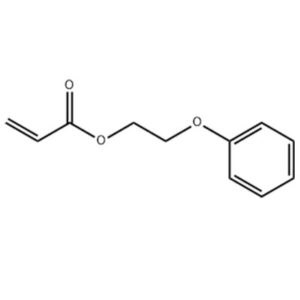
| CHLUMICRYL® PHEA Monomer | CAS 48145-04-6 | 2-PHENOXYETHYL ACRYLATE |
| CHLUMICRYL® PO2-NPGDA | CAS 84170-74-1 | |
| CHLUMICRYL® TEGDMA Monomer | CAS 109-16-0 | Triethylene glycol dimethacrylate |
| CHLUMICRYL® THFA Monomer | CAS 2399-48-6 | Tetrahydrofurfuryl acrylate |
| CHLUMICRYL® TMPTA Monomer | CAS 15625-89-5 | Trimethylolpropane triacrylate |
| CHLUMICRYL® TMPTMA Monomer | CAS 3290-92-4 | Trimethylolpropane trimethacrylate |
| CHLUMICRYL® TPGDA Monomer | CAS 42978-66-5 | Tripropylene glycol diacrylate |
| CHLUMICRYL® UV Functional Monomers | Acrylic Monomers |


Fanny Burke –
Perfect product and perfect company correspondence