
What does a photoinitiator do?
Hello everyone! I’m a star employee at CHROMÉCLAIR, a brand of hema free gel polish.Today, I’ll organize and explain the knowledge about photoinitiators, hoping it will be helpful to you.
Although the American company Inmot obtained the first patent for ultraviolet light curing as early as 1946,
Bayer of Germany industrialized UV light curing technology in 1967, introducing the concept of photoinitiators. Since then, photoinitiators have undergone continuous development. Today, the market offers a wide variety of photoinitiators. Today,
Keyou Company provides a detailed overview of photoinitiators, covering their mechanisms of action, performance requirements, common types,
characteristics, and usage principles.
 What is a photoinitiator?
 What is a photoinitiator?
Photoinitiators, also known as photosensitizers or photopolymerization agents, are compounds that absorb specific wavelengths of energy in the ultraviolet (250–420 nm) or visible (400–800 nm) spectrum. This absorption generates free radicals, cations, or other reactive species that initiate the polymerization and cross-linking of monomers.
In photopolymerization systems—including UV adhesives, UV coatings, and UV inks—these agents undergo chemical changes upon absorbing external energy, decomposing into radicals or cations that initiate polymerization reactions. Any substance capable of generating radicals and subsequently triggering polymerization upon light exposure is classified as a photoinitiator. Mechanism of Action for Photoinitiators.
Certain monomers, when exposed to light, absorb photons to form excited states: M* → M+ (hv – M*). These excited active molecules
undergo homolytic cleavage to generate radicals: M* → R* + R’. This subsequently initiates monomer polymerization, forming polymers. Radiation-curing
technology represents an energy-efficient and environmentally friendly innovation. Curing through radiation such as ultraviolet light, electron beams, infrared light, visible light, lasers, or chemiluminescence
fully aligns with the “5E” characteristics: high efficiency, practicality, economy, energy conservation, and environmental friendliness. Consequently, it is acclaimed as a “green technology.”
 Photoinitiators are one of the key components in light-curing adhesives, playing a decisive role in determining the curing rate.
When exposed to ultraviolet light, photoinitiators absorb the light energy and split into two active free radicals, initiating chain polymerization between the light-curing resin and active diluents. This process cross-links and cures the adhesive, characterized by its rapid action, environmental friendliness, and energy efficiency.
Performance Requirements for Photoinitiators
1) High initiation efficiency.
2) Absorption spectrum range compatible with the irradiation light source.
3) Good thermal stability, no dark reaction, suitable for long-term storage.
4) Good compatibility with monomers and prepolymers.
5) No yellowing or discoloration during photopolymerization film formation.
6) Safe and economical.
7) Photoinitiators and their photolysis products should be non-toxic and odorless.
Types and Characteristics of Common Photoinitiators
TP0 Photoinitiator
Chemical Name: 2,4,6-(Trimethylbenzoyl)diphenylphosphine Oxide
Absorption Wavelength: 299, 366 nm
Product Application: TP0 is a highly efficient radical (I) type photoinitiator, particularly suitable for colored systems and
thick film curing applications, offering extremely fast curing speed. TPO, with its broad absorption range, is widely applicable across various coatings. Its excellent absorption properties make it particularly suitable for screen printing inks, lithographic printing, flexographic inks, wood coatings, and adhesive production when used in combination with 184. Recommended addition levels range from 0.5-4% w/w, based on actual experimental results.

TP0-L Photoinitiator
Chemical Name: Ethyl 2,4,6-trimethylbenzoylphosphonic acid
Absorption Wavelengths: 273, 370 nm
Product Application: TPO-L is a highly efficient radical (I)-type liquid photoinitiator primarily used for UV curing of corresponding
resins, such as unsaturated acrylates. It is particularly suitable for white systems and thick film layers, offering exceptionally fast curing speeds. Additionally, TPO-L is a liquid photoinitiator suitable for formulations requiring low yellowing and low odor. Due to its broad absorption range, TPO-L can also be used for curing
containing white coatings. To enhance surface curing efficiency, TPO-L is often used in combination with other photoinitiators such as 184
1173 and benzophenones. Recommended usage concentration: 0.3-5%.
907 Photoinitiator
Chemical Name: 2-Methyl-1-[4-methylthiophenyl]-2-malonyl-1-propanone
Absorption Wavelength: 231, 307 nm
Product Characteristics: Excellent performance when used with GK-ITX
Product Application: 907 is a highly efficient radical (I) type photoinitiator used in deep curing of colored systems
such as adhesives, composites, lithographic printing inks, flexographic inks, offset screen inks, and varnishes.
It is also applied in the electronics industry, including photoresists, solder mask inks, and printing plates. Recommended addition rate
is 2-6% w/w.
ITX Photoinitiator
Chemical Name: 2-Isopropylthioanthraquinone (2,4-isomer mixture)
Absorption Wavelength: 258, 382 nm
Product Characteristics: ITX is a highly effective radical (II) type photoinitiator that acts as a sensitizer when used with anionic photoinitiators.
Product Application: ITX is used for layer curing of corresponding resins together with tertiary amine co-initiators. It exhibits excellent synergistic effects when used with 907. Suitable for transparent or colored UV-curable screen printing inks, copy varnishes, and UV-curable offset printing inks.
Applications: ITX is used for layer curing of compatible resins with tertiary amine co-initiators, exhibiting excellent synergy with 907. Suitable for transparent or colored UV-curable screen inks, photocopy varnishes, offset inks, flexographic inks, electronics, surgical coatings, adhesives, and photoresists. Typically used with amine synergist EDB, recommended dosage is 0.2-2% w/w.
EDB Photoinitiator
Chemical Name: Ethyl 4-dimethylaminobenzoate
Absorption Wavelength: 228, 308 nm
Product Characteristics: EDB is a highly effective amine co-initiator. When used with radical (I1) type photoinitiators, it is suitable for UV polymerization of monofunctional or multifunctional monomers and oligomers.
Applications: EDB is a solid amine synergist used in offset printing inks, adhesives, screen printing inks, solder mask inks, and related products. Typically used with ITX or 907, the recommended addition rate is 2-5% w/w.
184 Photoinitiator
Chemical Name: 1-Hydroxycyclohexyl-diphenyl ketone
Absorption Wavelength: 244 nm; GK-184
Product Characteristics: Used in surface curing systems, it exhibits excellent performance when combined with TPO.
Product Applications: 184 is applied in photocopier varnishes, plastic coatings, wood coatings, adhesives, lithographic printing
inks, screen printing inks, flexographic inks, and electronic products. It is typically added alongside other photoinitiators and may
be used with UV absorbers as needed. The recommended dosage in formulations is 2-59% w/w.
1173 Photoinitiator
Chemical Name: 2-Hydroxy-2-methyl-1-phenyl-1-propanone
Absorption Wavelength: 244nm Product Characteristics: Liquid, highly compatible with blending
Product Application: 1173 is used in surface-curing systems, suitable for acrylic UV-curable varnish systems such as wood,
metal, paper, and plastic varnish systems. 1173 is particularly recommended for UV-curable coatings requiring long-term sunlight exposure and yellowing resistance. Recommended addition rate: 1-4% w/w.
BDK Photoinitiator
Chemical Name: Benzoin Dimethyl Ether, equivalent to 651 Absorption Wavelength: 205-253nm
Product Application: BDK is used in colored curing systems and is widely applied in various UV-curable systems, PCB inks, UV ink systems, and varnish systems where it exhibits strong absorption properties. Recommended addition rate: 2-5% w/w.

OMBB Photoinitiator
Chemical Name: Methyl 2-benzoylbenzoate
Absorption Wavelength: 253nm
Product Characteristics: Low-odor curing system
Product Applications: 0MBB is widely used in odorless, non-toxic packaging for paper and food products. When paired with TPO, it enhances curing efficiency.
Principles for Using Photoinitiators
(1) Photoinitiators should be used in combination with the amine accelerator EDAB.
(2) Low odor, non-toxic, and environmentally safe.
(3) Economical and readily available, with low production costs.
(4) Select photoinitiators with appropriate reactivity based on the type of prepolymer and monomer.
(5) Possess good solubility and reactivity, requiring minimal dosage while delivering high initiation efficiency.
(6) Possess adequate thermal stability, resisting decomposition below 85°C, and exhibit long-term storage stability.
(7) Preferably, use a blend of multiple photoinitiators to initiate curing across different wavelength ranges, achieving faster curing speeds than a single photoinitiator.
The above content provides an overview of photoinitiators, including their mechanism of action, performance requirements, common types, characteristics, and usage principles.
Photoinitiators are essential components in free-radical UV light-curing reaction systems. Their type and dosage significantly influence the system’s photopolymerization behavior and play a decisive role in determining the sensitivity of the light-curing system.
I hope this article helps you understand photoinitiators more easily!
CHROMÉCLAIR offers Base coats, Top coats, solid color gel polish without HEMA, and hema free cat eye gel polish.
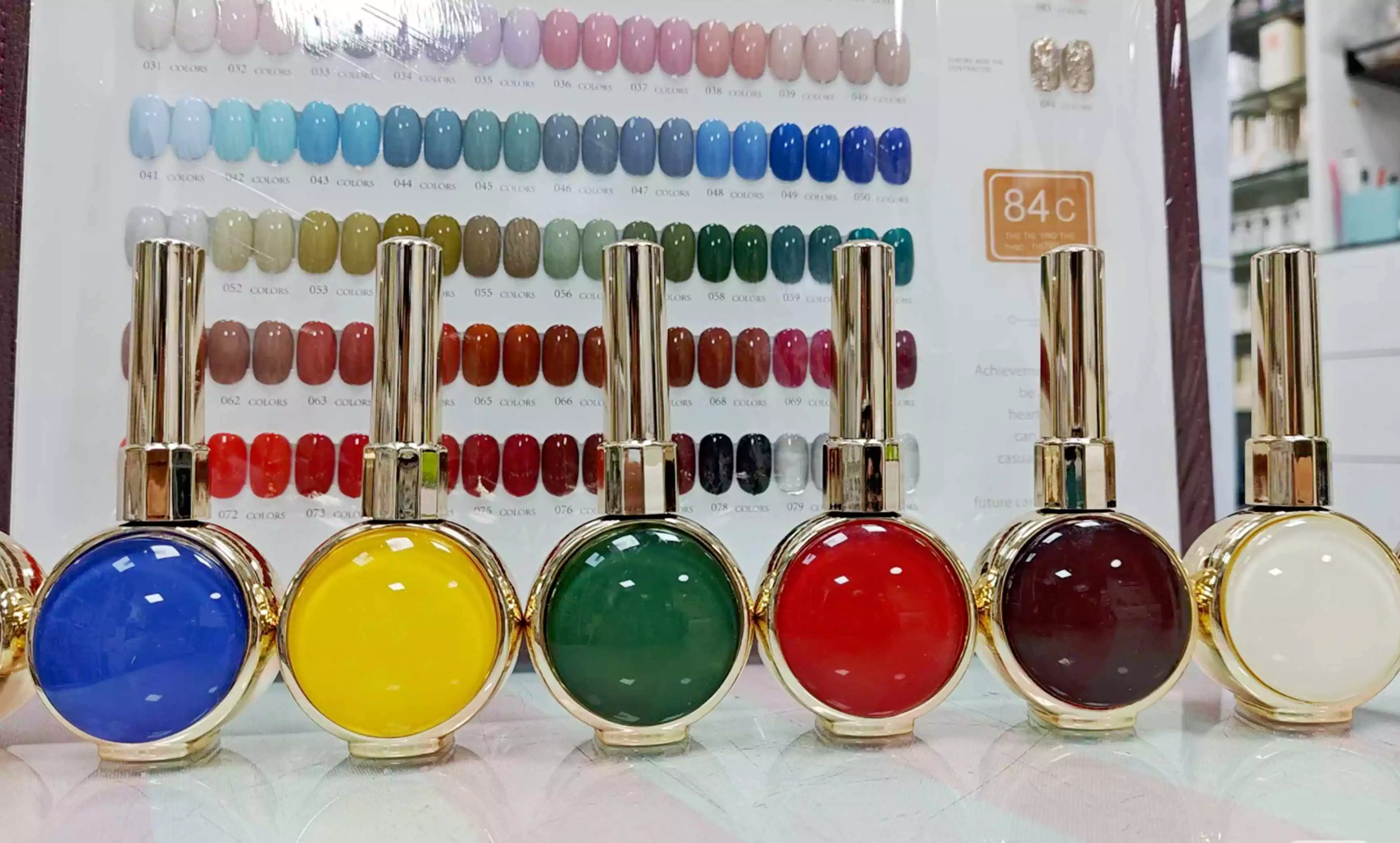 Their website also features nail art tutorials, such as: