
Quels sont les principaux composants chimiques des encres d'impression UV? ?
Comprendre les principaux éléments des encres d'impression UV permet de comprendre le fonctionnement du processus d'impression UV et de l'analyse des encres. Ces encres contiennent des monomères, des oligomères, des photo-initiateurs, des pigments et des additifs. Chaque partie a une fonction particulière dans l'impression. Le tableau ci-dessous montre comment ces éléments modifient le fonctionnement de l'encre et sa sécurité :
| Type de composant | Ce qu'il fait |
|---|---|
| Oligomères | Permet à l'encre de se plier facilement et de bien adhérer |
| Diluants réactifs | Modifier l'épaisseur de l'encre et l'aider à sécher rapidement |
| Photoinitiateurs | Commencer le processus de séchage lorsque la lumière UV brille sur eux. |
| Pigments/teintures | Donner de la couleur à l'encre et l'aider à rester forte |
| Additifs | Aide l'encre à s'étaler en douceur et à mieux adhérer, même en petites quantités |
Ces pièces permettent à l'encre de sécher rapidement, de durer plus longtemps et de réduire la pollution de l'air.
Principaux enseignements
- Les encres d'impression UV se composent de cinq éléments principaux : les monomères, les oligomères, les photo-initiateurs, les pigments et les additifs. Chaque partie est importante pour le fonctionnement de l'encre.
- Monomères et oligomères déterminent l'épaisseur et la souplesse de l'encre. Ils permettent à l'encre de sécher rapidement et de produire une impression solide.
- Les photo-initiateurs sont nécessaires pour lancer le processus de séchage. Ils réagissent à la lumière UV et font passer l'encre de l'état liquide à l'état solide très rapidement.
- Les pigments donnent aux encres UV des couleurs vives et les empêchent de se décolorer. De bons pigments permettent aux impressions de durer longtemps.
- Les additifs améliorent l'efficacité des encres UV. Ils permettent à l'encre de bien s'étaler, d'adhérer davantage et de ne pas s'estomper, de sorte que les impressions restent belles pendant longtemps.
Composition de l'encre UV
Vous pouvez en savoir plus sur la composition des encres UV en examinant les principaux groupes chimiques présents dans ces encres. Chaque groupe joue un rôle particulier dans le fonctionnement et le durcissement de l'encre sous la lumière UV. Les principaux groupes sont les monomères, les oligomères, les photo-initiateurs, les pigments et les additifs. Ces éléments travaillent ensemble pour aider l'encre à sécher rapidement, à paraître brillante et à produire des impressions solides.
Monomères et oligomères
Les monomères et les oligomères sont les principaux éléments constitutifs des encres UV. Les monomères agissent comme des diluants réactifs. Ils permettent de contrôler l'épaisseur ou la finesse de l'encre. Ils accélèrent également le processus de durcissement. Les oligomères forment le film principal lorsque l'encre sèche. Ils déterminent le degré de flexibilité, de résistance et d'adhérence de l'impression.
- Les monomères modifient l'épaisseur de l'encre et l'aident à durcir rapidement.
- Les oligomères constituent la structure principale de l'encre séchée. Ils confèrent à l'encre sa résistance et sa flexibilité.
Acrylates et monomères contenant de l'azote sont très importants dans la composition des encres UV. Ils permettent à l'encre de durcir rapidement et d'adhérer à de nombreuses surfaces. Le tableau ci-dessous présente quelques types courants que vous rencontrerez dans la formulation des encres à jet d'encre :
| Nom du monomère | Type |
|---|---|
| UrDMA | Diméthacrylate d'uréthane |
| UrA | Acrylate d'uréthane |
Vous verrez souvent ces monomères dans les monomères durcissant à la lumière UV. Ils permettent à l'encre de bien s'écouler et de créer des liens solides.
Photoinitiateurs
Les photo-initiateurs déclenchent le processus de durcissement. Lorsque la lumière UV brille sur l'encre, ces produits chimiques se décomposent. Ils créent des radicaux libres. Les radicaux libres permettent aux monomères et aux oligomères de s'assembler. L'encre liquide se transforme ainsi en un film solide.
Voici un tableau des photo-initiateurs les plus courants et des endroits où vous pouvez les trouver :
| Type | Nom du photo-initiateur | Applications typiques | Plage d'absorption de la lumière (nm) |
|---|---|---|---|
| Type I (clivage) | 1-Hydroxycyclohexyl phénylcétone | Revêtements, encres, adhésifs | ~245-330 |
| 2-Hydroxy-2-méthylpropiophénone | Revêtements transparents, résines d'impression 3D | ~240-320 | |
| Ether de benjoin | Encres et vernis UV | ~250-340 | |
| Oxyde d'acylphosphine | Systèmes pigmentés, revêtements blancs | ~350-420 | |
| Oxyde de bis(2,4,6-triméthylbenzoyl)-phénylphosphine | Films épais, composites dentaires | ~350-430 | |
| Type II (H-Abstraction) | Benzophénone | Encres, plastiques, vernis de surimpression | ~250-365 |
| Dérivés de la thioxanthone | Encres sérigraphiques, encres flexo UV | ~350-420 | |
| Camphorquinone | Résines et composites dentaires | ~400-500 |
Il faut savoir que tous les photo-initiateurs ne sont pas sûrs pour tous les usages. Si l'encre ne durcit pas complètement, certains photo-initiateurs peuvent passer dans les aliments ou d'autres produits. Il s'agit d'un problème majeur pour les emballages alimentaires. Par exemple, en 2005, il y a eu un grand rappel. Un photo-initiateur appelé isopropyl thioxanthone (ITX) est passé de l'encre au lait pour bébé. C'est pourquoi des pays comme la Suisse ont adopté des règles pour contrôler les photo-initiateurs pouvant être utilisés dans les encres pour emballages alimentaires.
Pigments et additifs
Les pigments et les additifs donnent aux encres UV leur couleur et leurs caractéristiques particulières. Les pigments sont de minuscules éléments solides qui restent dans l'encre. Ils rendent les couleurs fortes, brillantes et durables. Les additifs permettent à l'encre de s'écouler facilement, de mieux adhérer et de durer plus longtemps.
| Aspect | Influence sur les encres d'impression UV |
|---|---|
| Force de la couleur | Les pigments de haute qualité assurent une forte intensité des couleurs, ce qui permet d'obtenir des couleurs éclatantes en utilisant moins d'encre. |
| Opacité | Les pigments à fort pouvoir couvrant assurent une bonne couverture sur différents substrats, améliorant ainsi la clarté du design. |
| Taille des particules | Des pigments fins et bien dispersés permettent un écoulement plus fluide de l'encre et des bords d'image plus nets. |
| Solidité à la lumière | Les pigments de qualité résistent à la décoloration sous l'effet de la lumière, ce qui garantit une stabilité durable des couleurs. |
Les pigments sont différents des colorants. Les pigments restent solides et ne s'effacent donc pas aussi rapidement que les colorants. Cela signifie que vos impressions resteront claires et lumineuses pendant longtemps. Le type et la qualité du pigment influent également sur la résistance de l'encre à la décoloration. Les pigments inorganiques tels que le blanc de titane et le jaune de chrome résistent très bien aux UV.
Les additifs ne représentent qu'une petite partie de la composition chimique, mais ils sont importants. Ils peuvent aider l'encre à sécher plus rapidement, empêcher les bourrages dans l'imprimante et empêcher les couleurs de s'estomper.
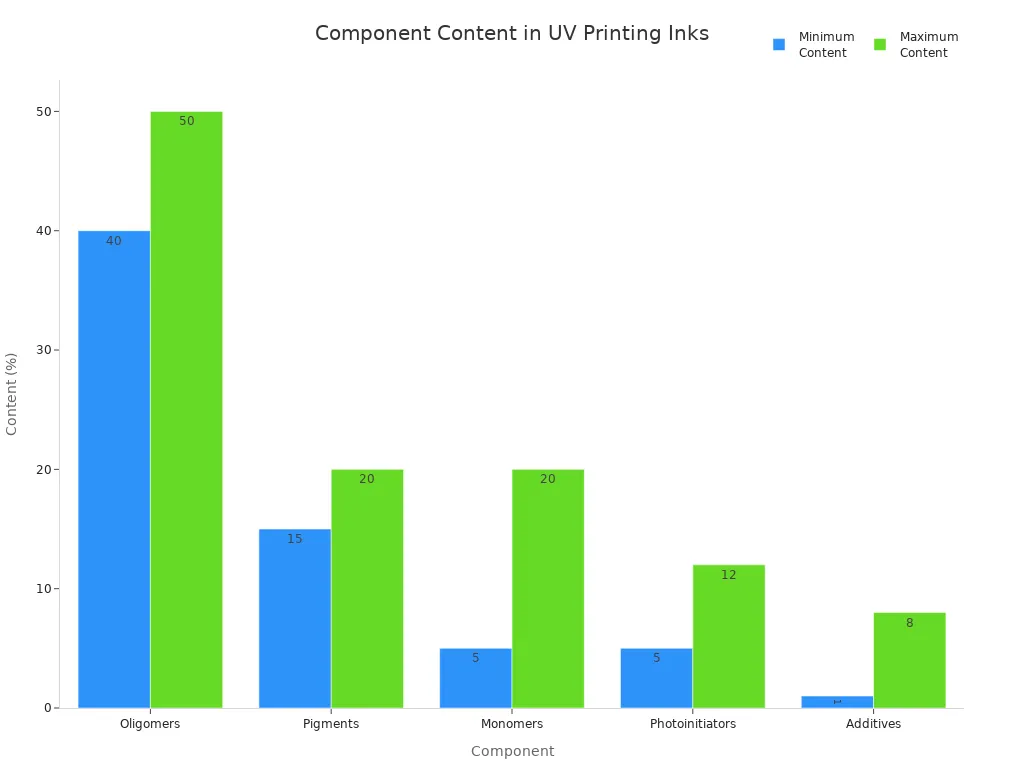
Le tableau ci-dessous indique la quantité de chaque élément dans la composition d'une encre UV typique :
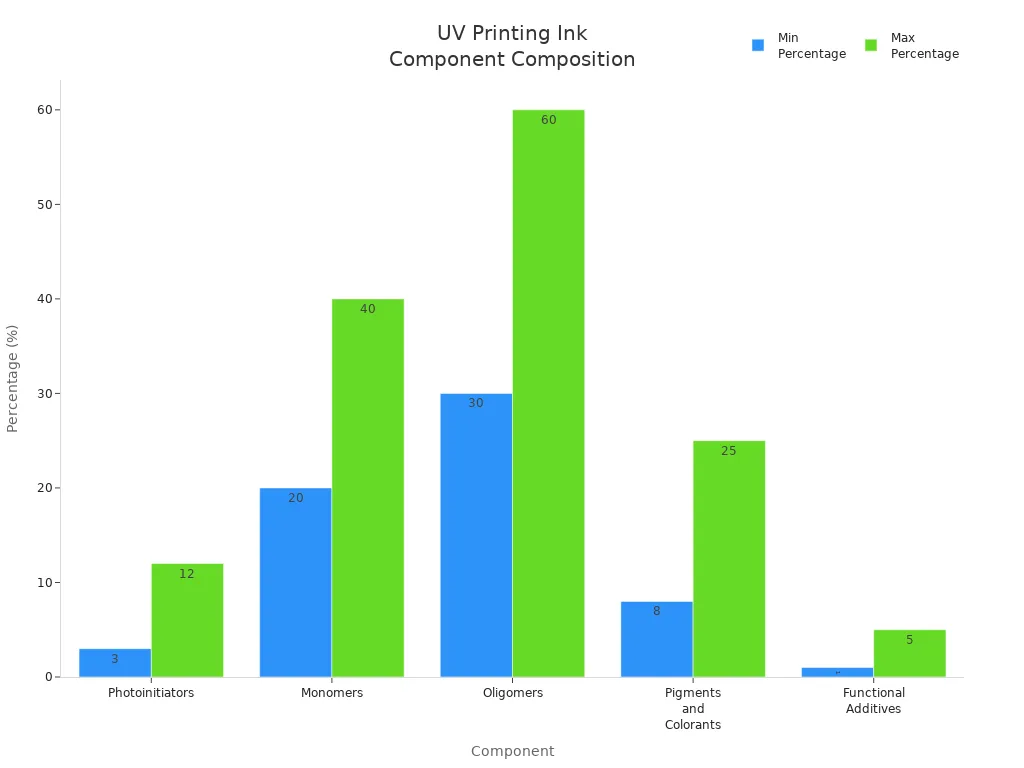
Lorsque l'on examine la composition d'une encre UV, on s'aperçoit que chaque partie a un rôle précis à jouer. Les monomères et les oligomères construisent la structure. Les photo-initiateurs amorcent le durcissement. Les pigments et les additifs donnent la couleur et améliorent le fonctionnement de l'encre. La connaissance de ces éléments vous aide à choisir l'encre la mieux adaptée à vos besoins.
Encres à séchage UV : Principaux groupes chimiques
Prépolymères et monomères
Les prépolymères et les monomères sont les principaux composants de l'encre à séchage UV. Les prépolymères sont des résines spéciales à double liaison. Ces liaisons permettent à l'encre de réagir rapidement sous l'effet de la lumière UV. La plupart des prépolymères contenus dans les encres à séchage UV sont des résines acryliques. Elles permettent à l'encre de durcir rapidement et lui donnent de la résistance. Les monomères sont également appelés diluants réactifs.. Ils modifient l'épaisseur ou la finesse de l'encre. Les monomères contribuent également à déterminer le toucher et le fonctionnement du film durci.
- Les prépolymères constituent la structure principale de l'encre polymérisée.
- Les monomères rendent l'encre facile à imprimer et durcissent rapidement.
- Le choix de différents prépolymères et monomères modifie la résistance et la souplesse de l'encre.
Vous pouvez voir dans ce tableau comment les différentes résines modifient l'encre à séchage UV :
| Type de résine | Caractéristiques principales |
|---|---|
| Résine époxy-acrylique | Facile à fabriquer, peu coûteux, il durcit rapidement, est dur, brillant et résiste aux produits chimiques et à la chaleur. |
| Acrylique polyuréthane | Très solide, flexible et résistant, il adhère bien à de nombreuses surfaces. |
| Polyester Acrylique | Peu odorant, doux, se plie bien et se mélange aux pigments. |
Si vous utilisez le prépolymère UDMA dans des films de polyuréthane, vos impressions deviennent plus résistantes. La réticulation dans le réseau de polyuréthane rend l'encre plus résistante à l'eau et moins susceptible de se casser.
L'encre utilise la réaction de clic thiol-ène. Les groupes thiols réagissent avec les doubles liaisons vinyliques sous l'effet de la lumière UV. Le photo-initiateur DMPA produit des radicaux libres. Ces radicaux libres commencent à se réticuler. Cela permet de créer un réseau solide qui confère au matériau imprimé sa solidité.
Fonction photo-initiatrice
Les photo-initiateurs sont très importants dans les encres à séchage UV. Lorsque la lumière UV éclaire l'encre, les photo-initiateurs absorbent l'énergie. Ils se désagrègent et produisent des radicaux libres. Ces radicaux libres déclenchent une réaction en chaîne. Cette réaction lie les monomères et les prépolymères entre eux. L'encre liquide se transforme en un film solide. Le type de photo-initiateur que vous choisissez détermine la rapidité et la qualité du séchage de l'encre.
Le durcissement par UV utilise une lumière forte, généralement entre 240 et 420 nm. Les photo-initiateurs absorbent cette lumière et déclenchent le processus de polymérisation. Certains photo-initiateurs, comme le 1173, fonctionnent très bien. Ils permettent à l'encre de durcir rapidement et de conserver des couleurs vives. Si vous voulez éviter le jaunissement et obtenir des résultats rapides, choisissez ces photo-initiateurs à haute efficacité.
Additifs dans les encres à séchage UV
Les additifs permettent à l'encre à séchage UV de mieux fonctionner pour différents travaux. Vous pouvez ajouter des produits chimiques spéciaux pour améliorer l'écoulement, la flexibilité et la stabilité. Certains additifs aident l'encre à résister à l'eau et aux produits chimiques. D'autres aident l'encre à adhérer à de nombreuses surfaces.
- Le M-313 permet à l'encre de durer plus longtemps et d'être plus résistante.
- M-5700 rend l'encre plus souple et lui permet de durcir rapidement.
- Le M-930 fluidifie l'encre et l'aide à lutter contre les produits chimiques.
- Les agents de nivellement permettent d'obtenir une finition lisse.
- Les antimousses empêchent la formation de bulles.
- Les promoteurs d'adhésion permettent à l'encre d'adhérer à de nombreux éléments.
Vous trouverez également des tensioactifs et des stabilisateurs dans certaines recettes pour jet d'encre. Ces additifs permettent à l'encre à séchage UV de rester stable et de bien imprimer. Lorsque vous choisissez les bons additifs, vos impressions durent plus longtemps et sont plus belles. Les additifs aident également les encres UV à résister à la lumière du soleil, à l'eau et aux manipulations. Les encres à séchage UV constituent donc un choix judicieux pour de nombreux besoins d'impression. Chaque partie de la formule travaille ensemble pour vous donner un durcissement rapide et des impressions solides.
Processus d'impression UV et analyse des encres
Réactions chimiques au cours de la polymérisation
Lorsque vous utilisez une encre durcissable aux UV, une réaction spéciale se produit. L'encre a monomèresL'encre est composée d'un grand nombre de substances, d'oligomères et de photo-initiateurs. La lumière UV éclaire l'encre. Les photo-initiateurs absorbent l'énergie et produisent des radicaux libres. Ces radicaux libres aident les monomères et les oligomères à se lier entre eux. Il en résulte un réseau solide et réticulé. L'encre sèche immédiatement et adhère bien aux objets. Il n'est pas nécessaire d'utiliser de la chaleur ou des solvants, le durcissement se fait donc à basse température. L'encre durcissable aux UV est donc adaptée à l'impression sur de nombreuses surfaces.
- Les monomères et les oligomères déterminent si l'impression est souple ou résistante.
- Les photo-initiateurs permettent à l'encre de durcir rapidement et uniformément.
- Les pigments ajoutent de la couleur, mais ils peuvent bloquer la lumière UV, de sorte qu'il faut un bon mélange pour obtenir de bonnes impressions.
Impact sur les performances et la sécurité
Le processus d'impression UV et l'analyse de l'encre montrent comment les produits chimiques de l'encre influencent son fonctionnement. Les monomères et oligomères appropriés permettent d'obtenir des impressions solides qui adhèrent bien. Les photo-initiateurs doivent être adaptés à la lampe UV pour durcir l'encre jusqu'au bout. Les additifs aident l'encre à s'écouler et à mieux adhérer. Vous pouvez voir les résultats dans le tableau ci-dessous :
| Paramètres | Valeur |
|---|---|
| Adhésion | 98% |
| Brillant | 50 GU |
| Temps de durcissement minimum | 0.7 s |
| Durabilité | Haut |
| Performance | Bon |
La sécurité est importante lorsque vous utilisez de l'encre à séchage UV. La lumière UV peut endommager votre peau et vos yeux si vous ne faites pas attention. L'inhalation du brouillard d'encre ou de l'ozone produit par les lampes UV peut entraîner des problèmes de santé. Certains produits chimiques contenus dans l'encre, comme les acrylates, peuvent provoquer des allergies. Vous devez porter des gants et vous assurer qu'il y a une bonne circulation d'air pour rester en sécurité.
Considérations environnementales
Le processus d'impression UV et l'analyse de l'encre montrent également l'impact de l'encre sur l'environnement. L'encre à séchage UV dégage très peu de COV, beaucoup moins que les anciennes encres. Cela signifie moins de pollution atmosphérique et un lieu de travail plus sûr. Le processus de durcissement ne fait pas appel à l'évaporation, de sorte que la quasi-totalité de l'encre reste sur l'impression. Certains produits chimiques, comme les photo-initiateurs, peuvent nuire aux poissons et autres organismes aquatiques s'ils ne sont pas manipulés correctement. L'encre durcie dure longtemps, mais elle est difficile à recycler. Des groupes comme l'EPA et la FDA établissent des règles pour que l'encre durcissable aux UV soit sans danger pour l'homme et la nature. Vous devez respecter ces règles lorsque vous imprimez sur différents supports.
Conseil : portez des gants anti-éclaboussures et couvrez les lampes UV pour éviter les fuites. Vérifiez toujours que votre encre est sans danger pour les emballages alimentaires et qu'elle respecte les règles environnementales.
Méthodes analytiques
Vous pouvez étudier le processus d'impression UV et l'analyse de l'encre à l'aide de nombreux outils. Il s'agit notamment de l'IRTF, de la spectroscopie Raman et de la chromatographie. Ces outils vous aident à vérifier ce que contient l'encre et à améliorer son fonctionnement. Lorsque vous testez l'encre, vous pouvez l'aider à durer plus longtemps et à bien imprimer.
Vous savez maintenant que les encres d'impression UV sont composées de cinq éléments principaux. Chacune d'entre elles contribue à la qualité de l'impression et à la sécurité d'utilisation.
| Composant | Fonction principale |
|---|---|
| Monomères | Contrôle de la flexibilité et de l'adhérence |
| Oligomères | Renforcer la force et la résistance |
| Photoinitiateurs | Commencer le processus de durcissement sous lumière UV |
| Pigments | Ajouter de la couleur et prévenir la décoloration |
| Additifs | Amélioration de la fluidité, de l'adhérence et de l'homogénéité de l'impression |
Si vous vous familiarisez avec la chimie des encres UV, vous pourrez choisir des encres qui fonctionnent bien. Cela contribue à votre sécurité et à celle de la planète. Savoir ce que contient votre encre vous permet de faire de meilleurs choix lorsque vous imprimez.
FAQ
Qu'est-ce qui différencie les encres d'impression UV des encres ordinaires ?
Vous utilisez des encres d'impression UV parce qu'elles sèchent rapidement sous la lumière UV. Les encres ordinaires ont besoin de chaleur ou d'air pour sécher. Les encres UV rendent également les impressions plus résistantes et plus colorées.
Les encres d'impression UV sont-elles sûres ?
Vous serez en sécurité si vous portez des gants et si vous travaillez dans un endroit bien ventilé. Certains produits chimiques peuvent provoquer une irritation de la peau. Respectez toujours les consignes de sécurité figurant sur l'étiquette de l'encre.
Conseil : Vérifiez que votre encre est compatible avec les denrées alimentaires avant d'imprimer sur un emballage.
Peut-on recycler les impressions réalisées avec des encres UV ?
Il se peut que vous ayez du mal à recycler les impressions avec des encres UV. L'encre durcie forme une couche résistante qui ne se décompose pas facilement. Vérifiez toujours les règles locales de recyclage.
Pourquoi les encres UV utilisent-elles des photo-initiateurs ?
Les photo-initiateurs facilitent le séchage de l'encre instantanément lorsque vous l'éclairez d'une lumière UV. Ils déclenchent une réaction chimique qui transforme l'encre liquide en un film solide.