
Benzophénone : Plus qu'une simple "polarité
Hi, I’m Starry, and I’ve been working in the chemical industry for almost fifteen years, dealing with various solvents, monomers, and additives every day. If you’re a newly-minted cosmetics formulator, a UV curing engineer, or simply curious about the chemical secrets behind sunscreen, you might be confused by the textbook concept of “molecular polarity.” Don’t worry, this article is here to help. I’ll not only explain why benzophenone is polar, but also share how this seemingly dry concept of polarity can be both a blessing and a curse in actual production and application, and how we can utilize it to solve practical problems.
I. Where Does Polarity Come From? An Intramolecular “Power Play”
Textbooks state that the polarity of benzophenone originates from the carbonyl group (C=O), which is correct. However, in my view, it’s more like a “mixed family”: two “laid-back” nonpolar benzene rings flanking a “dominant” polar carbonyl group.
The Carbonyl Group: An Unignorable “Center of Power”
- Electronegativity difference is the essence:
The electronegativity difference between oxygen (3.44) and carbon (2.55) is as high as 0.89, meaning that the shared electron pair is strongly biased towards the oxygen atom.
The result is that the carbonyl carbon end carries a partial positive charge (δ+), and the oxygen end carries a partial negative charge (δ-), like a tiny magnet.
- My personal observation:
I remember once in a client’s laboratory, they were measuring benzophenone using Fourier transform infrared spectroscopy (FTIR). The C=O stretching vibration peak was strong and sharp, around 1680 cm⁻¹. The engineer pointed to the screen and said, “Look, this is its ‘identity card’ of polarity. The stronger the polarity of the environment, the more this peak position might shift.” At that moment, the abstract concept became a tangible peak on the screen.
Overall Polarity: The Carbonyl Group Calls the Shots
Although the two benzene rings try to “neutralize” this polarity, the carbonyl group’s polarity is too strong, and ultimately the overall charge distribution of the molecule remains uneven. Simply put, one end of the molecule is slightly positive, and the other end is slightly negative, with a dipole moment greater than zero. This determines its fundamental character in the world (solvents) – a “two-faced” molecule with both hydrophilic (carbonyl) and lipophilic (benzene rings) tendencies. This characteristic is the cornerstone of all its applications.
II. How Does Polarity Influence Its Fate? A Practical Interpretation of Solubility and Reactivity
Knowing that it has polarity is only the first step; the key is to understand how polarity affects its behavior. This directly relates to how we choose solvents and design processes when using it.
Solubility: The Golden Rule for Predicting Miscibility
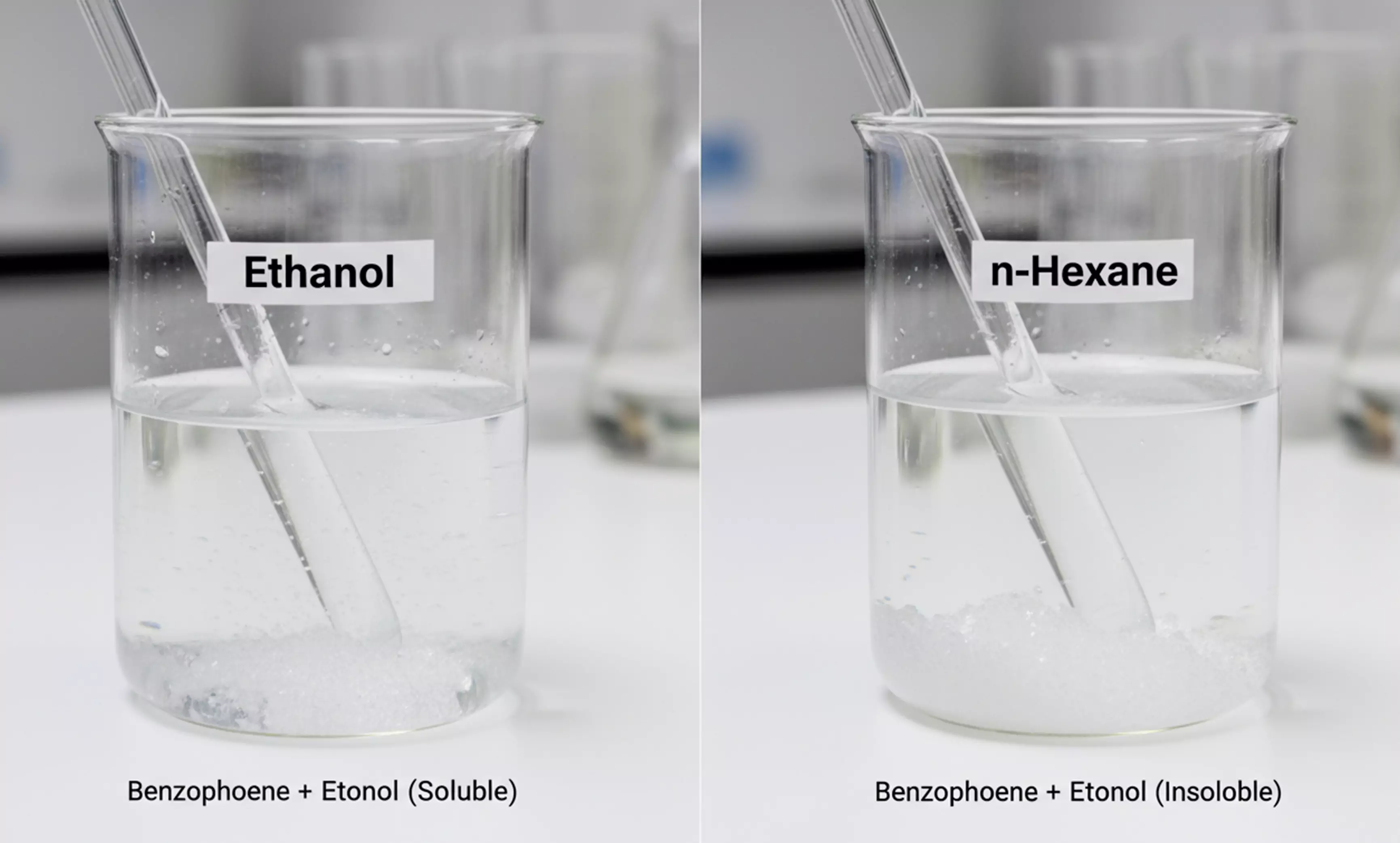
One of the most frequent questions my clients ask me is, “Starry, will this benzophenone dissolve in my system?” My answer is always based on an empirical rule: like dissolves like.
Its preferred friends (solvents):
- Polar solvents:
Such as ethanol, acetone, and ethyl acetate. Its carbonyl group can form dipole-dipole interactions with the polar parts of these solvents, and even hydrogen bonds (if the solvent is an alcohol), so the solubility is usually very good.
- Moderately polar to non-polar aromatic solvents:
Such as toluene and xylene. Although the solvent itself is non-polar, there are π-π conjugation interactions between the benzene rings, which allows them to “get along well” with the benzene rings of benzophenone, so the solubility is also good.
- A word of caution:
If you are using a completely non-polar, long-chain alkane as your base oil phase (such as mineral oil), the dissolution of benzophenone may be slower and require heating or vigorous stirring. I often advise clients to conduct a simple solubility pre-test to avoid problems during large-scale production.
Photochemical Reactions: The Solvent is the “Director”
This is the most fascinating aspect of benzophenone, and the reason it shines in the UV curing field. Its photochemical reaction pathway is highly dependent on the polarity of the solvent (medium).
- In non-polar solvents (such as toluene):
Like in a “quiet” environment, after being excited by light, it mainly follows the hydrogen abstraction pathway, generating a reactive species called a “ketyl radical.” This radical is the “pioneer” that initiates the polymerization of acrylate monomers.
- In polar solvents (such as acetonitrile):
The environment becomes “active,” and the excited benzophenone may undergo single-electron transfer or even ionic dissociation processes. Here, I propose a bold hypothesis: with the future popularization of water-based UV systems, can we consciously utilize this ionization pathway in a polar aqueous environment to design more efficient and environmentally friendly new photoinitiator mechanisms? This might be the next research hotspot.
- A practical case study:
We once had a client who manufactured UV inks, but the curing speed was always unsatisfactory. After reviewing their process, I found that they were using a very low-polarity reactive diluent. I suggested that they incorporate some higher-polarity monomers (such as hydroxyethyl acrylate), which not only improved the solubility and uniformity of the benzophenone photoinitiator but also subtly altered the polarity of the reaction microenvironment, thereby optimizing the radical generation efficiency. Ultimately, the curing speed increased by approximately 15%.
III. How to Harness Polarity? Application Strategies from Sunscreens to Curing Agents
Having understood the principles, let’s look at how to effectively utilize the “two-faced” characteristics.
As a sunscreen agent (e.g., BP3): Balancing Polarity and Stability
Benzophenone derivatives (such as BP3 and BP2) are classic broad-spectrum ultraviolet absorbers. Their polarity plays a crucial role here:
- Providing Compatibility:
Moderate polarity allows them to disperse to some extent in the oil phase of skincare products, and also to lightly bind to the stratum corneum of the skin through hydrogen bonds and other interactions, reducing loss due to sweat or friction and providing longer-lasting protection.
- Achieving Intramolecular “Stabilization”:
For example, 2-hydroxybenzophenone (BP2), its hydroxyl group at the 2-position can form an intramolecular hydrogen bond with the adjacent carbonyl group, forming a six-membered ring.
This structure not only enhances molecular polarity but also greatly improves its photostability and UV absorption efficiency, preventing it from being rapidly photodegraded. This is the ingenuity of chemical structure.
As a photoinitiator: The Trade-off between Solubility and Efficiency
- In UV adhesives and inks, benzophenone is a common photoinitiator partner (often used in conjunction with amine co-initiators).
- The core challenge:It must be ensured that it is completely and uniformly dissolved in the resin system of prepolymers and monomers. Any precipitation will lead to uneven curing and performance defects.
My list of suggestions:
- Pre-dissolve first:
It is recommended to pre-dissolve benzophenone with a small amount of a highly polar monomer (such as hydroxyethyl acrylate mentioned above) before adding it to the main resin. This can prevent localized crystallization.
- Consider compatibility:
If the overall polarity of the system is very low, using benzophenone alone may not be effective. Consider using a combination with other more lipophilic initiators (such as TPO), or, as mentioned earlier, adjust the monomer ratio.
- Control temperature:
In winter, the low temperature reduces the solubility of benzophenone in some systems. Before production, the raw materials or the system can be appropriately warmed to ensure uniform mixing.
Finally, here’s a question for you:
In the product or process problems you’ve encountered, could the “polarity” of a certain component be secretly causing the trouble? Thinking about its solubility and interactions from a different perspective might open up new possibilities.