Description
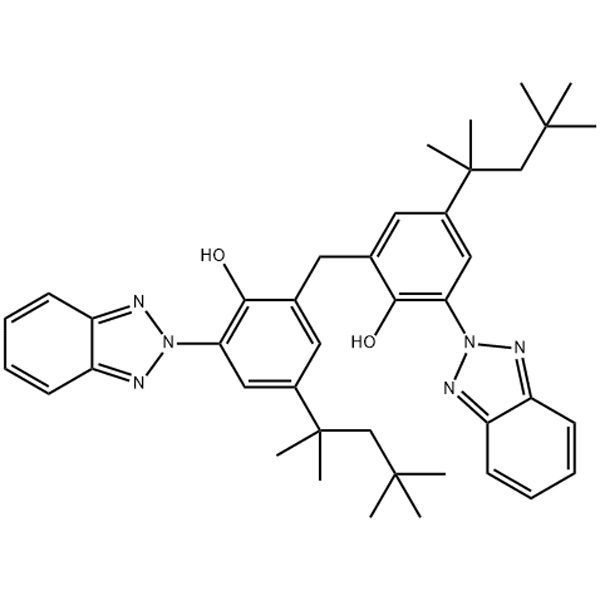
360 CAS 103597-45-1
| Appearance | Light yellow powder |
| Molecular weight | 658.9 |
| Content | ≥99.0% |
| Melting point | 195-198°C |
| Flash point | 420.5°C |
| Density@20°C | 1.16g/cm3 |
| Ash | ≤0.1% |
| Volatiles | ≤0.3% |
| Light transmission | 460nm≥97% |
| 500nm≥98% |
360 Usage
1. This product also has a very low volatility, can be used with other light stabilizers or antioxidants, especially suitable for processing, aging within the high temperature environment, it can be molded as a powder, solution or melt extrusion, can prevent crystalline seepage and sublimation, it is suitable for casting, thin layer construction of fibers, paper and wallpaper, etc.; This product is suitable for acrylate, polyester, polycarbonate, polyformaldehyde, polyamide, polyolefin, Styrene polymers, elastomers, adhesives, etc.
2. UV-360 is a benzotriazole-type UV absorber, capable of absorbing 300-400nm UV light, with a peak absorption of 353nm. It has high temperature resistance, extraction resistance, low volatility, low migration, good thermal stability, high absorption efficiency and anti-oxidation properties, etc. It is suitable for acrylic resin, polycarbonate, polystyrene, polyphenylene sulfide, polyphenylene ether, polyamide, polyformaldehyde, styrene copolymer. It is particularly suitable for high temperature processing conditions where high additive levels, high compatibility, high UV loading, low volatility and low migration are required to achieve high UV loading performance while reducing sublimation at the exit point and preventing deposition on mouldings and cooling rollers. Particularly suitable for bilayers, adhesive layers, laminating or co-extruding layers, direct bilayer extrusion of flakes without the use of a third layer, avoiding high temperature bleeding and surface crystallisation, preventing sublimation and high UV load deposition. Typical dosage is 0.1-0.5%.
3. Suitable for: processing where high UV loading, low volatility and good compatibility conditions are required. The aim is to achieve excellent UV shielding, reduce sublimation during venting and at the same time avoid deposits on moulds, cooling rollers and calibrators. It is able to avoid bleeding or crystallisation on the outside of the part during processing or high service temperatures. These features are particularly suitable for use on laminated film parts, fibres, flakes, double flakes, adhesive layers and laminated or co-extruded semi-finished parts.
Contact Us Now!
If you need COA, MSDS or TDS of UV Absorber, please fill in your contact information in the form below, we will usually contact you within 24 hours. You could also email me info@changhongchemical.com during working hours ( 8:30 am to 6:00 pm UTC+8 Mon.~Sat. ) or use the website live chat to get prompt reply.